Maple on Hawthorne
A quiet street learns to make itself a threat as a fast, hungry outbreak turns neighbors into something that remembers you just enough to hurt.
A quiet street learns to make itself a threat as a fast, hungry outbreak turns neighbors into something that remembers you just enough to hurt. A child's coat was nailed to the maple across from my porch. It turned slowly in the wind like a tongue, and the zipper kept catching on nothing. I live on Hawthorne. Houses close enough to hear one another breathe. We knew the rhythms of the street. On most evenings you could set your watch by the old man across the way lighting his pipe. You could tell by the newspaper stack who had stayed awake late and who had gone to bed in clean clothes. When the alert came through my phone I thought
Audio plays in the player below. Scroll to read the full transcript while you listen.
Rate this story
Hover a star to rate this story
About this story
A quiet street learns to make itself a threat as a fast, hungry outbreak turns neighbors into something that remembers you just enough to hurt.
A quiet street learns to make itself a threat as a fast, hungry outbreak turns neighbors into something that remembers you just enough to hurt. A child's coat was nailed to the maple across from my porch. It turned slowly in the wind like a tongue, and the zipper kept catching on nothing. I live on Hawthorne. Houses close enough to hear one another breathe. We knew the rhythms of the street. On most evenings you could set your watch by the old man across the way lighting his pipe. You could tell by the newspaper stack who had stayed awake late and who had gone to bed in clean clothes. When the alert came through my phone I thought
Transcript
Full text of the narration. Selecting text does not affect playback.
A child's coat was nailed to the maple across from my porch. It turned slowly in the wind like a tongue, and the zipper kept catching on nothing.
I live on Hawthorne. Houses close enough to hear one another breathe. We knew the rhythms of the street. On most evenings you could set your watch by the old man across the way lighting his pipe. You could tell by the newspaper stack who had stayed awake late and who had gone to bed in clean clothes.
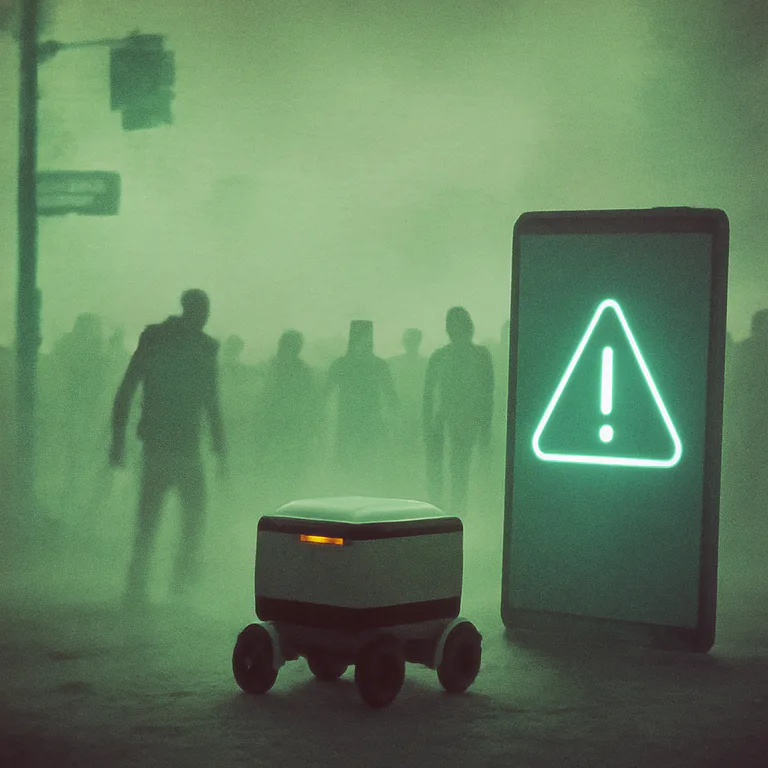
When the alert came through my phone I thought it was a mistake. It was a short notification with a blunt ribbon of red. the quarantine alert came before the hospitals reported anything. I read it twice because it felt like trying to make a map appear where there was only static.
They told us to lock our doors. They told us to stay inside. They recommended windows darkened and lights off. They did not say what was coming. They did not say when it would want us.
Outside, evening fell like a curtain. The maple's coat sounded like a whisper against the glass. My neighbour was fine yesterday and running today. I said it out loud because saying it made me prove I had seen him. He had run past my porch at dusk without looking, his jacket flapping. He ran like someone late for nothing, arms and legs at odd angles, head forward as if chasing a light no one else could see.
At first I thought he had started a new routine. Maybe a late jog. Maybe panic. Then I watched him round the corner and a woman down the street called his name through a screen door. The voice cracked. The man did not stop. He ran on, eyes fixed, and when a small dog yapped and lunged at him he did not hear. He ran straight past the dog as if it were part of the pavement.
An hour later he was at the corner with a group of others. They moved together slowly. They were barefoot and clasping one another like bookmarks in a book we had not yet read. They hummed. It was not a song. It was a low organizing sound that pooled in the gutters.
That was the first wrongness. The street had been ordinary, then ordinary with a tremor under it. You could still see the lamplight on the mailboxes. You could still hear the clink of a bottle against a recycling bin. But then you heard the humming and everything felt like it had been smudged by a hand.
We put furniture against the doors. We taped windows we thought might be weak. We learned how thin our trust had been. I watched the neighbor's porch light blink once and go out. No one else turned their porch lights back on.
People started to talk like it kept time. Someone would check the news and read aloud. They said the city was sealing off blocks. They said checkpoints had popped up at the ring roads. They said there were reports of aggression and of people collapsing in the streets. They said keep your doors locked.
Then there was a sound that did not belong to the city. It was a wet, soft tapping like hands on skin. It came from down the alley and moved along the backs of houses. It traveled like a rumor.
A woman across the street, half-shuttered to her windows, screamed once and then stopped. I watched as a shape pressed to her glass from the outside. At first I thought it was fogged breath. Then a palm flattened. A finger traced a letter on the condensation. The woman opened her window and said something soft in a language I did not know. The palm moved faster, urgent as a key. The glass did not break. The woman closed her window and did not breathe for a long time.
That was the second wrongness. The infected did not just attack. They learned the soft places. They found the loose boards. They remembered where to cry out to get us to unbolt a latch.
I slept in the dining room with the back door bolted and my phone between my knees. News feeds bled together into one slow wheel of panic. Reporters used words like outbreak and contagion and emergency. They spoke in flat voices designed to be heard late at night. All the while, our street hummed like a hive under glass.
The highway was gridlocked in both directions before dawn. People tried to leave. We learned how brave some are when they think escape is possible. Cars filled the on-ramps. Engines coughed and expired. People abandoned vehicles with keys in the ignition and luggage in the trunk. Then they walked off like they had been released from a rehearsal and forgot the lines.
On the third evening we ran out of battery on the radio. For hours the house felt like a crusted wound with nothing moving except for our own breaths. The moon laid out a cold coin of light on the kitchen tile. I thought of the maple outside and the coat with its broken zipper.
You can only be polite for so long when the world keeps bending. People came to my door, eyes rimmed in red, hands asking for aspirin or batteries or absolution. One man tugged at his wife's sleeve and said she had been quiet since midday. She was humming then, muttering about going home. He told me not to let anyone in, and then in the same sentence he leaned into my living room and asked if I had seen his son. His voice inverted like a key turning in something brittle.
More wrongness gathered on the sidewalk like fog. A family tried to leave with seven small plastic tubs full of toys balanced on a shopping cart. They left them in the street. Later I watched as a dispersed line of people passed the toys along, each one carrying them with the care of ceremonial objects. They did not speak. They did not glance at the faces of those holding the toys. They put them down in a neat row at the base of the maple where the child's coat hung.
That night there were no sirens. The city had turned its attention to other corners of itself. Out here we learned to listen to animal noises because they were the only honest things left. A fox moved through a neighbor's yard and froze, then trotted away with its head low. A crow landed on a television antenna and raggedly plucked at a loop of cable as if it were a nest.
On the fifth day the infected started to do the remembering we had been relying on to survive. They began to call names. From the sidewalk a woman called, in the voice of my childhood neighbor, pleading for help. People in the street who had only been watching their houses cracked and opened doors. They wanted to believe it was someone they knew. They wanted to bring the voice inside.
It is astonishing how quickly a single false hope can undo a lock. The first house that opened let a man in with a towel around his neck and a smear of something dark at the corner of his mouth. He smelled of copper and rain. He stood by the couch as if he had simply been delayed. He said his name like an apology. The household let him sit. They fed him warm broth. He ate with such gentle, stupid hunger that the people watching him relaxed and went to bed.
In the morning they all woke to the sound of the man weeping. He was in the backyard. He had removed his clothes and hung them over the fence as if to air sin. He returned when he heard someone moving at the back gate. He opened the gate and there, drawn like a compass needle, were three others. They came in small, easy movements. They were not violent in the way we expected. They were precise and deliberate. They took what they wanted. There were no screams that morning. There were only the slow sliding sounds of items being removed from drawers.
That was a new wrongness. The outbreak had taught itself manners. It had learned what would make humans open the door. It had learned how to be patient.
People began to leave signs. Names on index cards taped to the glass. Photos in the window. Toys tied to rails like talismans. They made patterns on their lawns so that anyone who turned up might see the family in order and decide to keep walking. It helped for a while.
Then some of us noticed the hands. The infected fingers were wrong. They were long and browned at the knuckles. They left smears like leaves on everything they touched. Their nails collected dust and secrets. Once you saw those hands you could not forget how human they almost were. You could not forget the ring a grandmother had worn or the bracelet with a child's name written on it. You could not forget the way the hand reached up to trace a face at a window.
One evening a small group banged on my neighbor's door below and yelled a name. The voice was my neighbor's voice. People behind me listened and counted beats. The neighbor's wife unlocked the door because the voice was familiar and demanded help. They opened it to a man who leaned in and smiled. He smelled like pipes and the city. He kissed their hands and said he had been just down the road. He wanted to come in for a blanket.
They let him in.
That night we heard nothing for hours. It was a mute, terrible absence. At three in the morning I woke to a sound at the window. The maple's coat had stopped moving and hung still like a noose. There was a smear on the glass that was not mouth fog. It was the shape of a hand reading my name from the inside out.
I unbolted the deadbolt and went to the door because I thought it might be the neighbor asking to help. The street outside was a dark basin. Figures moved in its low places. When I stepped onto the stoop I saw the neighbor across the way - he had returned to his porch and sat very still, head in his hands. He looked like a man composing himself after tragedy.
He saw me and lifted his face. His eyes were wrong. They were white down the center and bordered with a red like dried lace. He smiled in a way that was almost apology and not apology at all. A child might have pulled the coat from the maple and wrapped it around him like a cape.
He said, "I had to run. Something called me." He said the words without emphasis, as if ticked boxes of newsprint. "I ran and I found them and they said come, and I could not stop."
I asked him why he had come back. He looked at me the way you look at a photograph you have to explain. He tapped the porch rail with a finger. The nail left a line of gray dust. He said, "I remembered you. I wanted to tell you."
That is what killed me softly in the night. It is one thing to be hunted. It is another thing to be forgiven in the voice of the person who will take you. The neighbor's hands moved and left a print on the swing seat. He hummed a tune my sister used to whistle when she fell asleep. I could not move.
He reached up and touched the corner of my eye like a man checking a seam. The contact was warm and sticky.
Audio
Maple on Hawthorne
ReflectStart here