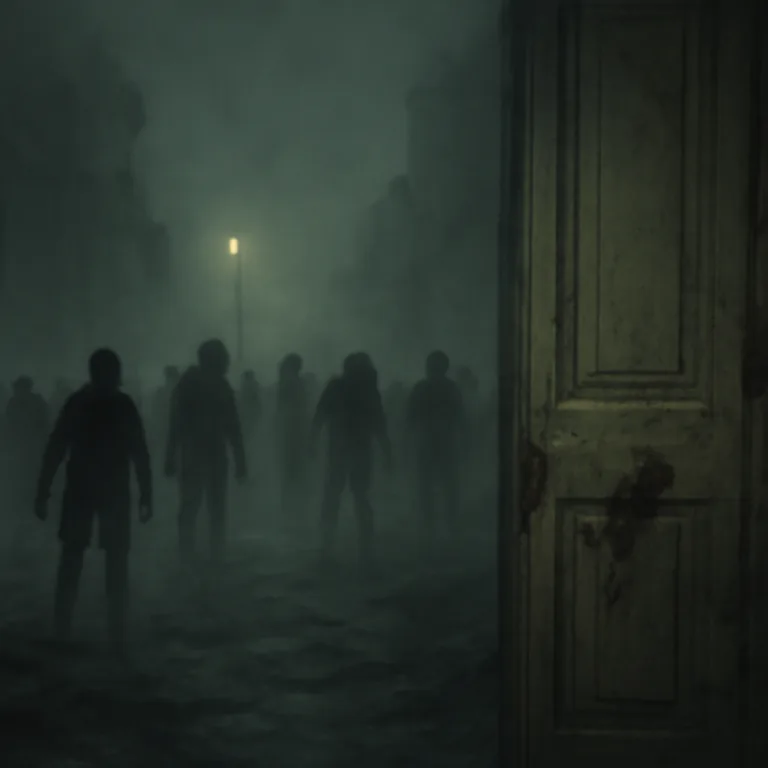
Bite Mark on the Door
In the dim hours of a seaside town, an ordinary evening spirals into creeping horror as memory and hunger drag the living and the dead closer to one small apartment.
In the dim hours of a seaside town, an ordinary evening spirals into creeping horror as memory and hunger drag the living and the dead closer to one small apartment. Evening pressed against the walls of my little apartment like a damp woolen shawl. The wind from the bay carried salt and something else I could not name, a hint of rot folded into the air. The town was quiet in a way that felt deliberate, as if the quiet had decided to settle in and stay forever. I kept the blinds half closed and watched the streetlights blot out the darker corners of the world beyond them. The kettle hissed, then quieted, and I listened for the sound it
Audio plays in the player below. Scroll to read the full transcript while you listen.
Rate this story
Hover a star to rate this story
About this story
In the dim hours of a seaside town, an ordinary evening spirals into creeping horror as memory and hunger drag the living and the dead closer to one small apartment.
In the dim hours of a seaside town, an ordinary evening spirals into creeping horror as memory and hunger drag the living and the dead closer to one small apartment. Evening pressed against the walls of my little apartment like a damp woolen shawl. The wind from the bay carried salt and something else I could not name, a hint of rot folded into the air. The town was quiet in a way that felt deliberate, as if the quiet had decided to settle in and stay forever. I kept the blinds half closed and watched the streetlights blot out the darker corners of the world beyond them. The kettle hissed, then quieted, and I listened for the sound it
Transcript
Full text of the narration. Selecting text does not affect playback.
Evening pressed against the walls of my little apartment like a damp woolen shawl. The wind from the bay carried salt and something else I could not name, a hint of rot folded into the air. The town was quiet in a way that felt deliberate, as if the quiet had decided to settle in and stay forever. I kept the blinds half closed and watched the streetlights blot out the darker corners of the world beyond them. The kettle hissed, then quieted, and I listened for the sound it would make if someone stood behind me, waiting to be invited to speak. There was no voice but mine, and the night, which spoke in a tongue made of rusted hinges and distant breakers.
I am a caretaker, or perhaps a sentinel, of a building that forgot how to sleep. The place is old enough to remember when storms came with more than broken gutters and a chorus of gulls. The corridors breathe differently at dusk, and the stairs sigh with every footstep, as though the building themselves were alive and unsettled by what wakes after nine o clock. I have a routine kept with the stubborn patience of a man who has learned that the world does not care for plans. I unlock, I check, I lock again. The rent is meager, the tenants thinner, and the city itself seems to be thinning out, as if a flood of something was draining through town with the grace of a slow exhale.
The first signs appeared in quiet rooms, where the lights would blink and then stand firm as if nothing had happened. When the lights blinked, I counted the seconds that followed and measured the flicker against the memory of storms that hit the coast with more certainty than most people. Tonight the lamp by the kitchen sink trembled in its glass and threw little gold motes across the chipped linoleum. The air did not smell like rain. It smelled like old copper and something sweet that slipped away when you tried to catch it with your hands.
At first I believed fear to be a habit, a tired companion who found new reasons to perch on the shoulder just when you thought it had finally loosened its grip. But fear has a way of growing quiet, almost polite, until you forget it is there and then it sits beside you in the lamplight and speaks through your own mouth. The hallway outside my door remained stubbornly dark, a black stripe that could swallow a man in one breath if he turned and stepped too close. The building wore its age like a stubborn badge. Wood warped at the edges, plaster peeled, and a long crack crawled along the ceiling like a pale, slow insect exploring the length of the room above me.
From the stair came shuffled footsteps, a rhythm that sounded almost human but not quite. It was not the careful tread of a resident coming home late, nor the soft padding of a cat creeping through the hall to its food dish. It was something else, a kind of languid advance that did not care for noise nor for witnesses. I told myself it was nothing more than the building settling, the way an old ship groans when the tide shifts. And then I told myself to ignore it, because fear loves to feed on attention, and attention would keep me awake all night with the sense that the air is thinning, like the skin of a fruit left too long in the sun.
I had not slept well in weeks, which is not to say I have not slept at all. Sleep came in patches, a handful of minutes here and there, where the world went soft and the edges blurred. Dreams visited rarely, and when they did, they were patient, almost ceremonial, as if the dream were invited to tea and I were only now learning the rules. Tonight the dream would not be invited. Tonight the waking world refused to lie down. The clock on the kitchen wall showed the hour as a stubborn little tick, and outside the window the sea breathed and then exhaled in a way that felt almost personal, as if it were listening to my private thoughts and judging them for their smallness.
The moment of fear came not with a scream but with a sound that might have belonged to the city and to the house and to a creature that knew how to be quiet even when it moved. It began with a single change in the ordinary. In the hallway, the air shifted, and the door to the stairwell breathed a sigh of old paint and rust. Then came the sound I cannot forget, no matter how long I live with its memory: the sound of something moving where there should be silence, something that was not quite human and not entirely machine. The sound grew, slow and deliberate, a kind of measurement of distance and intention, until it reached my door and stopped.
The door itself seemed to tremble, or perhaps it was only my nerves doing the trembling for it. I pressed my ear to the cheap wood and listened to the faint friction of something on its other side, as if a hand pressed hard against the other world and refused to let go. The building answered with a creak as if it were sighing under the weight of a world that did not belong to it anymore. And then the house dropped its voice, as if it decided to speak to me in whispers rather than in warnings, in a tone that sounded like a parent telling a child to listen, but with a memory of fear behind every syllable.
From the corner of my eye, I glimpsed movement in the hall - a shadow that did not belong to any lamp, a shape that hung between the light and the dark and chose to stand still for a breath, then another. The pattern of the shadow did not speak of human posture; rather it spoke of something else, something that can wear a body like a coat if it has to. I stood very still and waited, and the waiting felt longer than the night itself. The sound of water in the pipes grew louder, the pipes ticked and clacked as if they were listening too, listening for a sign that this particular evening would end without the building drawing everything into its own private fog.
That was the moment I noticed a detail I had overlooked in the dim. A mark, small and irregular, bore a curved bite in the wood near the frame where the door meets the hinge. A bite mark on the door, pale and fresh as first frost on a windowpane, with a smear of something dark around its edge. It looked like a mark a hungry animal might leave, but the line of it was too abrupt, too exact, as if a mouth had pressed there with careful intention rather than a moment of hunger. It was so odd that it could have been decorative, but the more I studied it, the more it turned from decoration into threat. I reached out and brushed the edge with a fingertip, and the surface gave under my skin, a little too soft, a little too warm in a way that suggested something was living just behind the door, waiting for a chance to step through. There could be nothing beyond that bite mark but the ordinary fear of what happens when a house finally decides to keep secrets from you.
I turned away from the door, telling myself that there was nothing there I could not deal with in the daytime, and that the night always loves to trick us into treating shadows as threats we must conquer. And yet the quiet kept growing. The air in the hall carried a scent of iron and something sweeter, a memory of fruit that had gone overripe in a basket and now poured itself out, muting the senses. My lamp threw a small, stubborn halo against the floor, and the apartment kept its breath, waiting for a moment to exhale.
At times like this I remind myself that there is a difference between fear and caution. Fear is the wild thing that makes you run. Caution is the thing that makes you stay and listen long enough to learn what you truly fear. Tonight I chose to listen. The stairwell remained quiet for a while, but the quiet was not empty. It was full of small noises, the kind of sounds you do not notice when your life is moving along in ordinary circles: a distant door closing with an almost ceremonial latch, the soft clink of a loose window latch, the shallow breathing of a building that has become the home to many people who do not sleep or do not wish to be seen while they sleep. The sounds did not form a chorus, but they formed a choir that sang in a language I could not quite translate.
I did not open the window to look outward at the town, at the harbor where the lights of boats bled into the water like spilled ink. To do so would have felt like inviting a witness to something I did not yet know I was witnessing. Instead I turned a page in the small notebook I keep beside my bed, a notebook where I write the weather and the thoughts that travel in from the street like stray dogs. In that notebook I wrote the word sleep as if it were a small ritual, a way of telling fear that it was not the final word. When the page lay still beneath my pen, the figure in the hall moved again, lighter this time, and I heard a whisper of fabric on carpet, and then a heartbeat that did not belong to any human chest I had ever seen.
The heart belonged to something else, something that could mimic a heartbeat if it needed to lure a person into its circle. And then the whisper again, a voice not loud but somehow intimate, as if leaning its cheek against the door in a private confessional and speaking directly to me. It did not say my name, not at first, but it seemed to know exactly what my name was. It whispered in a language that was not mine, a syntax of hunger and longing and memory that felt ancestral and intimate and dangerous all at once. The whisper paused and then settled into a sentence that rang with a familiar ache, a conversation I had never had but could recall all the same. It was then I realized the house was not trying to scare me into leaving. It was trying to remind me that my life is made of choices I have not yet learned to voice aloud. And then I heard a word that I did not recognize as a spoken word, but as a memory tried to become real: they remembered my name.
A chill gripped me and I stood, frozen, not with fear but with a kind of careful curiosity. If memory could walk, if memory could stand at the door and knock, would it be a friend or a ghost? The question sounded childish when I spoke it aloud, but the room did not laugh at me. It listened with a patient, almost affectionate regard, as if an older self were sitting across from me and nodding, approving of my hesitation because hesitation had kept me alive this long. The corridor, which had been a mere corridor a few hours ago, widened inside my head into a corridor of possibilities.
Audio
Bite Mark on the Door
ReflectStart here