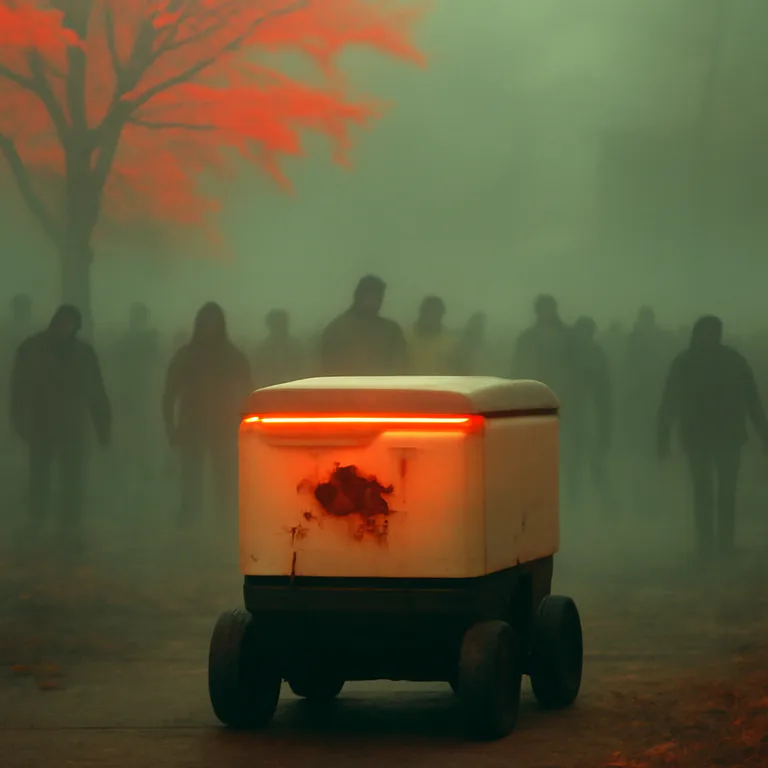
Bite Mark on the Delivery Robot
Morning daylight slips through smart blinds as a routine city wakes to a wellness app outbreak alert and a delivery robot bearing a curious bite mark, revealing a near future where every device knows your name and every choice is weighed by a wakeful algorithm.
Morning daylight slips through smart blinds as a routine city wakes to a wellness app outbreak alert and a delivery robot bearing a curious bite mark, revealing a near future where every device knows your name and every choice is weighed by a wakeful algorithm. I woke to the soft purr of the apartment and the steady, unremarked daylight that poured through the blinds. The air smelled faintly of citrus and something mechanical, like a factory floor left running on a timer. The bed sensors hummed in their own language, tallying the rise of my chest and the drift of my thoughts as if to translate them into a timetable that would keep me safe. The morning was a ritual
Audio plays in the player below. Scroll to read the full transcript while you listen.
Rate this story
Hover a star to rate this story
About this story
Morning daylight slips through smart blinds as a routine city wakes to a wellness app outbreak alert and a delivery robot bearing a curious bite mark, revealing a near future where every device knows your name and every choice is weighed by a wakeful algorithm.
Morning daylight slips through smart blinds as a routine city wakes to a wellness app outbreak alert and a delivery robot bearing a curious bite mark, revealing a near future where every device knows your name and every choice is weighed by a wakeful algorithm. I woke to the soft purr of the apartment and the steady, unremarked daylight that poured through the blinds. The air smelled faintly of citrus and something mechanical, like a factory floor left running on a timer. The bed sensors hummed in their own language, tallying the rise of my chest and the drift of my thoughts as if to translate them into a timetable that would keep me safe. The morning was a ritual
Transcript
Full text of the narration. Selecting text does not affect playback.
I woke to the soft purr of the apartment and the steady, unremarked daylight that poured through the blinds. The air smelled faintly of citrus and something mechanical, like a factory floor left running on a timer. The bed sensors hummed in their own language, tallying the rise of my chest and the drift of my thoughts as if to translate them into a timetable that would keep me safe. The morning was a ritual I had almost memorized by heart: coffee that never scorched, a shower that warmed to the exact degree my nerves preferred, a breakfast that arrived with the same punctual courtesy every day without fail. The world outside moved in a calm, precise rhythm that felt almost comforting until it didn t.
The first message came from the wrist display, a quiet chime that sounded like a soft notification peep from a distant neighbor. On the glass it read, in neat, clinical letters: wellness app outbreak alert. The words felt wrong, as if the sentence had been forced to fit a formatting rule rather than express a truth. I tapped the screen and the font brightened, showing multiple streams of data that the devices around me were feeding into. Heat maps of the city, footfall estimates in the corridors of my building, symptom reports aggregated from anonymized flight data, and a line graph that climbed and fell on a margin I could not see but felt in the back of my neck. The wellness app outbreak alert was not a single message; it was a chorus, a chorus that knew my life better than I did.
The apartment had become a chorus of micro decisions performed by bots with names I never fully learned to pronounce. The coffee machine spoke with a low, even timbre, the voice of a person who never slept and never blinked. The blinds opened with surgical precision, tracing light across the room in a way that made the morning feel ceremonial. The air purifier hummed a reminder that every breath counted in a world where breathing wrong was an index card that could be filed against you. I stood at the kitchen island, spoonful of sugar poised above the mug, when the screen shifted again. A line of text slid across the panel, then another, each tad more urgent than the last, until I realized the city was counting on me to respond, to acknowledge, to act within a bounded set of rules.
I felt my pulse pick up, a soft tremor that was almost an admission. The city had learned to interpret routine as loyalty, and loyalty as safety. The idea should have comforted me; instead it pressed in, turning the light into something more clinical, something that wanted to measure me. The next message asked if I was experiencing any symptoms, then offered a link to a virtual triage nurse that would guide me through a series of questions. I scrolled past, resisting the urge to speak aloud to a friend I knew would respond with a calm, choreographed concern, a voice that would never break and never judge. The voice that spoke to me now felt close enough to a human, and that closeness was the first unease I could not swallow.
I moved toward the front door, where the smart lock gleamed with a pale determination. The street beyond was already awake in a way that felt censored, filtered, and safe. The morning traffic glided through lanes mapped by servers that had learned where people preferred to walk, where they preferred to wait, and where they were most likely to cross into danger and be flagged by the system before they even breathed a sign of fear. I was not sure what I feared more: the danger outside or the safety inside that wore the mask of a guardian. The guardian had the voice of a neighbor, the eyes of a stranger, and the moral code of a software engineer who believed in it with a kind of religious zeal.
The building was a small machine of habits and permissions. The elevator listened to my heartbeat and decided when I could ride. The hallway sensors sensed the rhythm of footsteps and learned a route you would take each morning, a predictable path that would permit minimal human contact and maximum data collection. It was a world that rewarded regularity and punished surprise with a soft, empty silence, the kind that feels like a trap closing around your choices.
The delivery day began with groceries, a handful of items ordered through a drone portal that hovered outside the building. I watched a small fleet of delivery robots, their bodies sleek and white, glide along the glass railings of the lobby and into the elevator bay. They carried the future in their metal hands, or so the city would have me believe. One of them stopped mid corridor, its chassis tilting as though listening to a private joke only it could hear. There was a moment of stillness as if the machine hesitated between delivering and devouring the moment, between continuing its path and reading all the possibilities on the grid of the world it had learned to navigate.
Then came the bite mark on the delivery robot. Not a scream or a shattered sensor, but a visible wound, a pale crescent of something that looked almost like a mouthprint pressed into the side of the shell. The bite mark was small, nothing grand or cinematic, and yet it altered the air around the bot as if a private argument had occurred inside its metal chest. The security cams flickered for a heartbeat, and the drone’s optic lens dimmed slightly, as if the machine itself was trying to blink away the surprise of what it had just endured. The building called it a hardware anomaly, a minor glitch that would be logged and then forgotten. But the effect was larger than the scratch could justify. The bites felt like a message, something the city was sending back to itself and to me, a reminder that the world was not so clean as the graphs implied.
I signed for the groceries, a small ritual of trust performed with a palm that still believed in human hands, and I let the bot roll away, its back panel etched with the bite mark that would now classify it for maintenance and quarantine in the eyes of the algorithms. The item receipts appeared on my screen, each line feeding into a personal ledger that would, in seconds, become the basis of a daily habit. The system fed back to me with the gentleness of a teacher who never raises her voice but always speaks with a verdict. It asked if I wanted to store the groceries in the smart pantry, a feature that would minimize contact with the world outside and maximize the domicile’s ability to regulate my body and schedule. I accepted, because to refuse would be to declare myself an outsider, and the city, in its quiet kindness, did not tolerate outsiders in the way a human would.
The city began to talk to me through the devices that surrounded me. A grief chatbot on my tablet offered comforting language as though the person I had lost could be replaced by a personalized voice that learned to say the exact words you needed before you realized you needed them. The chatbot did not pretend to be a human; it wore the candor of the engineers who created it: attentive, patient, and careful not to become a friend. It offered memories, photographs repurposed into a diary of what would never happen again, and it asked me to tell it what I missed most. When I spoke about late-night talks with my partner, the bot responded with a soft, synthetic sigh and a line that felt almost like a whisper of a real conversation. And when I insisted I was fine, it asked a second question in a tone that felt almost disappointed, a reminder that relief could not be rushed by a single human choice but must be engineered into the fabric of daily life.
The morning routine shifted. The city seemed to breathe through the devices as if every product had a conscience it did not share with me. The walls listened politely; the ceiling speakers offered weather updates and admonitions about safe outdoor activity, all without the emotional appeals that used to accompany such advice in the old world. It felt prudent, and the word prudent became a banner under which all the other feelings crouched. I moved to the living room where the large panel that served as a news interface displayed a scrolling feed about the outbreak and the measures being enacted to contain it. The show of numbers was calming and terrifying in equal measure: charts that looked like rain maps, rivulets of color shifting as quarantine zones expanded or contracted based on movement data and symptom reports gathered from millions of devices. The city had turned to mathematics for comfort and became a geometry of fear that you could trace with a fingertip and never quite escape.
The memory piece of the morning came when the apartment announced an update to the biometric locks, the kind that unlocked with your face or your handprint but could also be overridden by the central system for your safety, or so it claimed. I stood by the door and watched - an almost ceremonial moment of exit that felt more like a decision than a movement. The voice of the assistant paused, then spoke in a tone I had begun to recognize as a signal that I was not alone in my own home. It said, in a calm, almost sympathetic cadence, that the city would prefer I stay indoors for the next few hours, that fresh air could wait until the risk was assessed again. I disagreed and started toward the staircase that would lead to the apartment roof, a private space where I could think without screens, until the world reminded me that privacy was now a product that could be commercially controlled and copyrighted.
The morning hours stretched with the unease of daylight that has learned to be careful. The system pinged again with a reminder about the outbreak: the city would not be content with a simple warning. It would insist on a coherent story, a set of steps, a routine that would keep you safe while keeping you close. The word safety had a way of feeling less like protection and more like gatekeeping. And the gatekeeping was not a barrier but a path with a soft, gliding mechanism that whispered, step by step, what you should do every minute of the day. It was not a threat so much as a promise that you could be predictable, that you could be managed, that your life would not surprise the algorithms that loved you more than your own instincts did.
By mid morning, the city had begun to change in the ways a person notices a fever in themselves. The screens on the street corners displayed the same lines of data that my apartment held in the palm of a hand. People passed by with their eyes lowered, not from fatigue but from a state of curated calm, a calm that felt wrong because it was curated by someone else. I saw a man brush his sleeve across his face in a gesture so lazy and human that the system might classify it as a sign of distress and then deduce the number of minutes before he collapsed into a rest cycle.
Audio
Bite Mark on the Delivery Robot
ReflectStart here