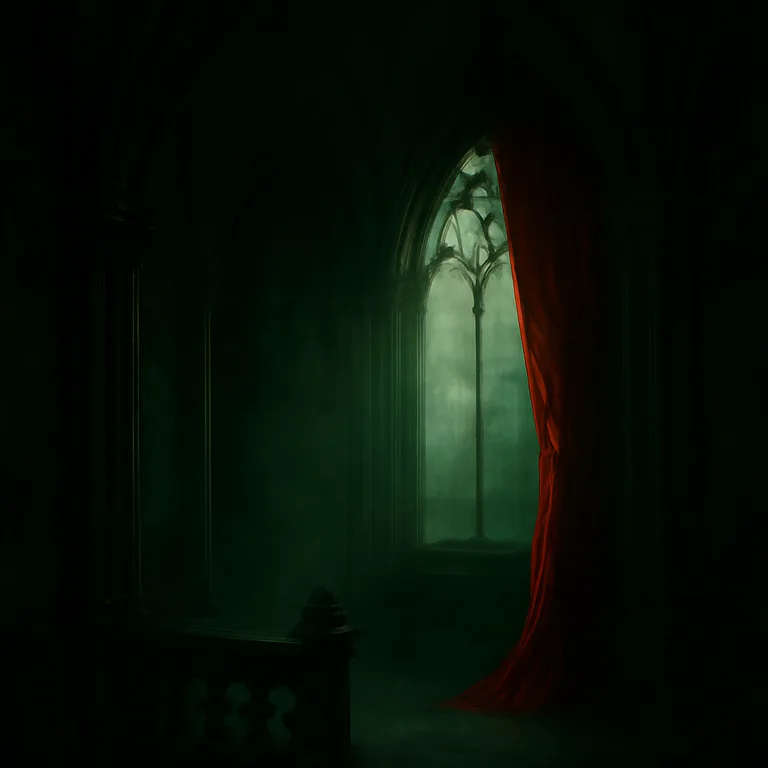
Invitation Only
A quiet evening pulls a lone observer toward a house at the edge of town where a centuries old host tests what remains of a restless memory in a world of shadow and daylight.
A quiet evening pulls a lone observer toward a house at the edge of town where a centuries old host tests what remains of a restless memory in a world of shadow and daylight. The rain hadn’t stopped, not really, only slowed to a thinning mist that clung to the hedges and the telephone wires like damp lace. I stood at the window with the old glass fanlight over the door, listening to the soft percussion of rain against the street and the muffled tremor of distant thunder I swore had taken up residence in the walls of my house years ago. The evening had settled over the town as if a lid had been placed on a jar of
Audio plays in the player below. Scroll to read the full transcript while you listen.
Rate this story
Hover a star to rate this story
About this story
A quiet evening pulls a lone observer toward a house at the edge of town where a centuries old host tests what remains of a restless memory in a world of shadow and daylight.
A quiet evening pulls a lone observer toward a house at the edge of town where a centuries old host tests what remains of a restless memory in a world of shadow and daylight. The rain hadn’t stopped, not really, only slowed to a thinning mist that clung to the hedges and the telephone wires like damp lace. I stood at the window with the old glass fanlight over the door, listening to the soft percussion of rain against the street and the muffled tremor of distant thunder I swore had taken up residence in the walls of my house years ago. The evening had settled over the town as if a lid had been placed on a jar of
Transcript
Full text of the narration. Selecting text does not affect playback.
The rain hadn’t stopped, not really, only slowed to a thinning mist that clung to the hedges and the telephone wires like damp lace. I stood at the window with the old glass fanlight over the door, listening to the soft percussion of rain against the street and the muffled tremor of distant thunder I swore had taken up residence in the walls of my house years ago. The evening had settled over the town as if a lid had been placed on a jar of secrets, and every street lamp looked like a small, wary witness to a darker thing happening in the world beyond them. It was the kind of evening that makes you tell yourself you are alone only because you want to be, the kind of hour when your own thoughts begin to murmur back at you in a voice you cannot quite locate.
The knock came late, the sound polite, almost ceremonial, as if the door were being introduced to a guest it wished to avoid misnaming. I opened to a man who wore the night itself like a coat, a pale face with a slow smile that suggested he was listening to a music only he could hear. He did not greet me with a name, and I did not offer one in return. He held out a sheet of paper, the parchment heavy with something like dampness that did not soak through the fibers but settled into them as if the page remembered every rain it had ever seen. The handwriting was elegant, the ink black as a well kept secret, and at the bottom there was only one line in a smaller script: invitation only.
I scanned the street behind him for witnesses, for the neighbors to appear with their curious eyebrows and their Sunday faces, and I found only the thin gleam of streetlights and the honest, stubborn darkness that holds a town together when there is no longer a news crew to remind it that it exists. I looked again at the note, and then the man, and finally the night pressed its lips to my ear and whispered a dare I would later confess was answering a need I did not know I carried.
The letter had told me nothing about where I was to go, only the address, the hour, and the ink that refused to smear. The map on the back looked ancient and correct, the sort of thing a careful, practiced hand would not keep around if it could be weathered away by a simple storm. The house stood where the town gave way to marsh and shadow, its windows like tired eyes that never blink. A man in a dark coat waited on the steps as if he had been there all along, part of the building’s blackened memory. There was a steadiness to him that suggested a century of being patient for what was to come, and in that patience there was a kind of mercy and a kind of mercy’s other name, a careful, ancient hunger.
He did not speak at first. He simply stepped back and allowed me to pass, and when I did, I found the inside of the house quieter than the outside, as if the walls themselves had decided to hold their breath for a time. The room I entered was not large, but it did not pretend to be. It had a ceiling that pressed down with the weight of rain and a floor that claimed every footstep as if to remind you that you could never leave the same way twice. There were chairs arranged in a circle, and in the center stood a table with a single candle that burned with a small, patient flame - no hurry, no fanfare, just a stubborn wax will to endure-
The host entered with the soft certainty of someone who believes that a good room can hide a multitude of sins if the walls are willing to listen. He wore a shirt that might have been white once but carried the subtle varnish of a long, careful life, the kind of whiteness that seems to have learned how to forgive the hands that touch it. He spoke as if he were reciting a well memorized poem, each sentence a measured note, each pause a deliberate breath. He asked my name as if to set a bell ringing somewhere in the distance, but the question was not for information so much as an invitation for attention. The candlelight threw his features into relief and then into shadow so quickly that I was never sure what I was looking at, only that I was looking at it with a strange, precarious honesty I did not know I possessed.
The room began to feel more intimate than I was prepared for, as if it were expecting something from me I had not yet learned to offer. The host offered tea that turned the air a little sharper at the edges, a scent of iron and rain and something older than iron and rain. He spoke of the circle that had met in similar rooms, in similar houses, in places the town would have preferred to forget. He spoke of a pact sealed not with blood, but with the memory of loss that could only be recalled in the presence of the absence of daylight. His voice was soft, like velvet over steel, and every time he spoke the room listened twice as hard as I did. There were other faces in the room at intervals - stone faces with pale skin and eyes that gleamed not with malice but with the kind of knowledge that comes from having survived a great many sunrises and the things that chase them away.
There was a door in the far wall that did not look like a door but more like an invitation carved into wood, as if the room itself was leaning toward it, listening for some word I could not hear. When someone rose to show me the book that lay upon a small pedestal beside the door, I thought I ought to refuse it, that the book would be heavy with the weight of the night and would pull a person in, not push them back. The host smiled, not cruelly but with a gentleness that suggested a kind of mercy that is rarely granted to a person who asks questions they ought to keep to themselves. He told me the book was a log of those who had walked through these doors before me, a ledger of promises and losses, a collection of small eternities stored within leather and ink. The books all seemed to be written in a language I could not read, and yet I understood the way they felt beneath my fingertips as if I had once learned their alphabet in a previous life and forgotten the lesson the moment I woke up.
The sign on the door read invitation only, and I saw that what I thought would be a single gathering was in fact a rite, a sequence of small, deliberate choices that would answer one question the way the living mind most fears to hear it answered. The host explained that time moved differently here, not faster or slower, but in gulps. You step into a gulp and you do not realize how many you have crossed until you look back and find your footprints tracing a path you cannot walk again. He told me to listen to the room, to allow my breath to settle, to feel the weight of the chair beneath, to notice the way the candle flame leaped when the door opened and someone entered who was not expected, or perhaps not allowed to be expected at all.
We spoke in hushed tones about the old histories of the town, the way the river curved against the marsh like a sleeping serpent, the ways the night wore its own skin, literally, in the manner of a thing that has learned to disguise itself as something harmless. The host asked me if I believed in memory. I said yes, I believed in memory more than I believed in certainty. He said memory was a good host, that it opened the door for all the guests we pretend we do not invite into our lives. He poured the tea again, and the tea tasted of rain and something I could not name, something that lingered long after I swallowed and made the room feel heavier with quiet.
The first test was a simple one, or so I believed at the time. We were asked to recall a single moment when we felt truly seen, to describe it in as much detail as the present moment would allow, with the knowledge that some small piece of truth would be traded for listening ears and a kindness we might later pretend never happened. My memory offered a street, a window, a dog that slept in a sunbeam on a late autumn afternoon, and then a sound - almost a sigh - behind me that did not belong to the street or the dog or the sunlit window. The host listened with eyes that seemed to measure the weight of every syllable and a face that said yes, very good, you have already given yourself away but you may keep a trace for the night to take when it leaves.
The second test was more intimate and more dangerous in its gentleness. We were asked to tell of a fear we kept hidden even from ourselves, a fear that felt ridiculous when spoken aloud yet unbearably heavy when kept inside. The room hung on every word as if a bell were being rung in the center of the ceiling, and when I spoke of a fear that would not name itself, the room grew quiet as if the walls themselves paused to listen to the confession like a crowd at a tragic play who knew the lines by heart but not the ending. The host did not smile; he did not frown. He allowed the moment to pass over him the way rain moves across a rooftop, not rushing, not erasing, only making a path for something else to arrive.
There came a lull after the confessions, a long breath of almost nothing, a silence that felt almost like a prayer if you could forget what you were praying to. In that silence, a figure appeared at the edge of the circle, not announced, not demanded, simply there as if the room had finally learned to admit its own longing. He wore a coat that might have belonged to a bishop or a thief, a pale man with a neck long enough to catch a late moonlight in the hollow of his throat. The host introduced him with a courtesy that suggested the introduction itself was a magic trick, a way to conjure a presence without ever showing the candle to the face that followed.
He asked for no name, only a sign that you belonged. The sign was simple, in the most troubling sense of simple: you placed your hand upon your heart and spoke a single word that meant nothing to the room but everything to you. I did as asked, and the word became a small, bright memory I had not realized I carried at all, a memory of a pact I had kept with a younger version of myself, a promise I had sealed with a breath and a thought and nothing else. The room exhaled with relief when the memory found its way home, and the pale man bowed as if acknowledging a guest who had finally learned to listen to the right kind of music at the right hour.
Audio
Invitation Only
ReflectStart here