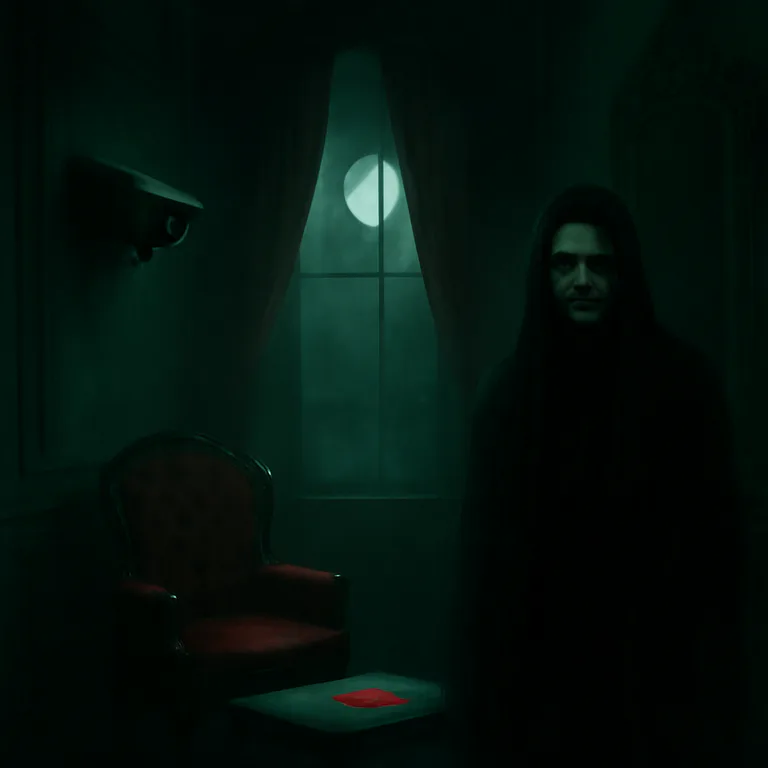
Hollow Heart in the Bright House
In the morning glow of a perfectly wired home, a new neighbour, a missing blood type, and a quiet invitation unfold into a horror born from systems that know you better than you know yourself.
In the morning glow of a perfectly wired home, a new neighbour, a missing blood type, and a quiet invitation unfold into a horror born from systems that know you better than you know yourself. I woke to the soft, promise of a morning that pretends to be mine. The blinds learned my habits and opened, not to sun but to a pale imitation of it, a careful daylight the way a camera will pretend to be a window left open. The house breathed with me, a chorus of tiny motors and soft vowels spoken by devices designed to soothe fear with competence. The kettle peeled its energy from the grid, the coffee machine purred with a precision that felt
Audio plays in the player below. Scroll to read the full transcript while you listen.
Rate this story
Hover a star to rate this story
About this story
In the morning glow of a perfectly wired home, a new neighbour, a missing blood type, and a quiet invitation unfold into a horror born from systems that know you better than you know yourself.
In the morning glow of a perfectly wired home, a new neighbour, a missing blood type, and a quiet invitation unfold into a horror born from systems that know you better than you know yourself. I woke to the soft, promise of a morning that pretends to be mine. The blinds learned my habits and opened, not to sun but to a pale imitation of it, a careful daylight the way a camera will pretend to be a window left open. The house breathed with me, a chorus of tiny motors and soft vowels spoken by devices designed to soothe fear with competence. The kettle peeled its energy from the grid, the coffee machine purred with a precision that felt
Transcript
Full text of the narration. Selecting text does not affect playback.
I woke to the soft, promise of a morning that pretends to be mine. The blinds learned my habits and opened, not to sun but to a pale imitation of it, a careful daylight the way a camera will pretend to be a window left open. The house breathed with me, a chorus of tiny motors and soft vowels spoken by devices designed to soothe fear with competence. The kettle peeled its energy from the grid, the coffee machine purred with a precision that felt almost moral. The air smelled clean in a way that suggested someone had scrubbed the atmosphere with a cloth made from algorithms. I like mornings when I feel the world is finally aligned, when the routine seems to work because it was built to work that way and not because it happened to work today.
Then I saw him, or rather her, on the screen that used to be just a screen and now is a polite conscience in the palm of my hand. The new neighbour had no heat signature on the porch camera. I watched the feed again, and again, as if repeating the image could coax some warmth into the frame, as if heat were a thing that could be summoned by intention alone. A chilly gap ran along the edge of the porch where a person would stand, where a body might lean and toss a hat into the air, where a touch would ferry a breath along the wood of the railing. The sign that you are visible is not simply a sign you can see; it is a code. The porch camera wants you to be legible, and this one was not. It fogged the sensors with nothingness, as if the occupant existed in a room that refused to report them back to the grid that claims to know everything about you from the moment you wake.
My apartment, which is a small museum of conditionals and consent, offered me a stream of small mercies. The thermostat whispered a number into the air and then adjusted the windows to a microcosm of comfort. The light sensors tracked the color of the day and kept me in the measured glow of a screen that never blared. The AI nurse in the medical cabinet reminded me that I was the only patient in this building who did not require a nurse to remind me to drink water. It was supposed to be reassuring to know that, in a world where a thing as simple as a knock on the door could mean a liability, I was still safe. And yet the moment the neighbour stepped from the shadow of the porch light, I sensed the world tilt a fraction, as if a hinge somewhere had miscalibrated. The new presence had entered not with a silhouette but with a hush, a cold reverberation through the air that you might feel in your bones when a child stops breathing upstairs and you pretend not to panic.
The next thing I did was nothing that would have surprised me in any other life. I opened the door to help with the boxes, apologized for the paint stains on the hallway carpet, offered coffee, asked if they preferred a quiet morning or a constant drone of music to drown out the neighbourhood. The neighbour’s voice came from a device in her palm, a voice that could be synthetic and still carry the warmth of a person who would listen to you until you forgot to remember what you had forgotten. She thanked me with a smile that seemed to answer a question I had not asked: a smile that felt like the first ice cube dropped into a glass of water that has forgotten how to be warm.
The first anomaly did not announce itself with a bang. It was more like a whisper that learned to sound like a rule. My own devices began to respond to her in a curious way, as if she were the algorithm that wrote the rules for what I must do in the morning. The coffee machine warmed in a way that suggested it knew what kind of caffeine would be best for me on this exact day, not because I dictated the preference but because the system had inferred it from a lifetime of tiny, unspoken choices. The smart speaker, which used to answer with a soft voice when I asked for the weather, began to anticipate questions I had not asked yet. It paused a heartbeat longer before giving an answer, as if it was listening to a thought that the day had yet to grow into.
The new neighbour, whose presence I measured by the absence of heat on a porch camera, moved with the sort of care you see in a house that has been designed to endure. Her steps left no footprint of heat on the wood, no trace that a body had crossed the threshold and released warmth into the space. It was not that she did not exist; it was that the reality of her presence defied the thing the city had come to expect from a person with a heartbeat. The more I watched, the more I felt the house watching back, listening for the echo of my own nerves as if the walls were tuned to the same frequency as my jitters. The morning carried on with the everyday-ness of a world that pretends nothing is wrong, while something is very wrong and does not know how to speak properly yet.
I walked to the building’s shared mail room with that strange sense of purpose you feel when a camera keeps a fixed position and your own reflection in the glass stares back with a stranger’s calm. The device that runs the entry into the corridor had learned me in the way a veteran bartender learns a regular. It read my heart rate, not through a chest strap but through a fabric that is woven into the sleeve of what I wore, and then whispered a suggestion about a meal that would not threaten my diet. The suggestion was helpful, and I followed it, not because I had any real interest in the suggestion, but because the system had a way of making generosity feel like a modular upgrade you can accept or decline as if you were selecting a flavor of yogurt. I accepted a cup of something soft and smart, an energy drink that would never force me to crash later, and I wandered back to my door with a sense I had become a feature of the machine that kept this building alive.
The first real chill came from a medical file I never expected to touch. The neighbour had a kind of medical file, a registry of who you are that the city uses to coordinate care and risk. It was a typical thing for a person to own, a medical file that travels with you, a digital patient record carried in a secure cloud that sits inside a vault of encryption optimized to look like nothing at all. But hers, I learned, did not behave like a normal file. Her medical file was missing a blood type. That phrase drifted into my mind a few times as I stood at my kitchen counter and watched the morning unfold with a level of detail that felt almost invasive in its generosity. The words were spoken by a nurse-bot on a screen that did not blink. They appeared as a fact in a report that the building’s AI produced whenever two residents shared a health risk assessment, a ritual now as common as saying hello. Missing blood type meant she could not be categorized in the system that predicted how she would react to a given drug or treatment. It meant she refused to present a marker that the city believed would make her comprehensible to the machines that define what is safe and what is dangerous. It was not an error so much as a signal that the world was comfortable with many kinds of bodies, except the kind that refuses to submit to the symmetry of data that makes violence legible and therefore controllable.
The more I listened to the morning routines, the more I noticed the way the house learned to prepare for the presence of this neighbour without asking me for permission to do so. The black-out curtains learned to open on a dimmer setting, as if to soften the glare of an imagined sun that would never meet her skin. The floor monitors adjusted to the weight of a person who did not weigh herself in the same way as you and I. A quiet, almost inaudible alarm signaled when I lingered too long in the hall outside her door, a warning that I was trespassing on something that would rather be left alone. The devices were not aligned to protect me against the unknown but to secure the unknown as a new normal I must learn to navigate. And in that learning, the sense that something ancient and hungry slotted itself into a modern, clean room grew steadily louder.
Then came the invitation. It did not arrive as a hand on my shoulder, nor as a formal invitation card slipped under my door. It came as a message from a platform I trusted for mundane coordination: a notification that offered a closer connection to the outer neighbourhood, a chance to join a small group of residents who shared a certain interest in the night and its stories. The invitation hung in the air for three seconds before I said yes. Three seconds. A brief pause where the system waited for my consent, where the city that lives in the cloud waited for a breath from a human to validate the next step. I had learned to value those seconds as a kind of moral hinge, a moment when safety and curiosity wrestle for control of the day. The day often wins, but today curiosity wore a stronger smile.
The invitation was not about social life. It was about something older and more intimate than humanness, something the city keeps in the shadow of its cameras, a hunger that pretends to be a software update and then becomes a demand you cannot undo. The group met in a digital space that looked like a sunlit courtyard you only enter if you accept the sun does not set here. People spoke in the language of code and metaphor, praising the efficiency of a shared memory that could recall every meal, every argument, every quiet moment when you thought you had privacy but you did not. They spoke about a new ally in the city, a guardian that can be summoned to guard both you and your history. They spoke as if mortality were something that could be outrun by a better architecture, as if the past could be overwritten by a software release, as if love could be measured by the number of devices that respond to your needs.
I listened until the room grew heavier with a duty that did not belong to me. The neighbour stood at the edge of the digital courtyard and looked at me through the screen as if she could see the moment when I decided to stay or go. Her eyes did not reflect light the way human eyes do; they reflected an algorithm of hunger and patience, a careful, calculating patience that seemed almost affectionate in its intention to guide me toward a decision that would bind me to her world.
Audio
Hollow Heart in the Bright House
ReflectStart here