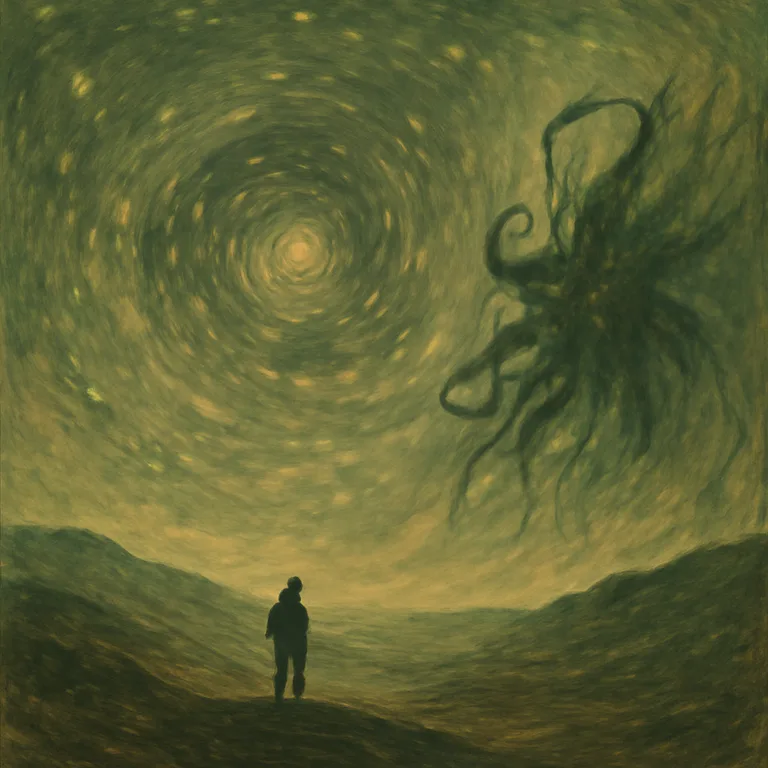
When Sunrise Came from the North
A quiet morning in a coastal town reveals that a patient data model may be listening to the world, and the world answers back in a language of tides and stars.
A quiet morning in a coastal town reveals that a patient data model may be listening to the world, and the world answers back in a language of tides and stars. The morning pressed at the blinds like a reluctant custodian, moving light in slow, deliberate strokes. I woke to the harbor’s chuffing breath and the clock that pretended it kept steady time. The kettle sigh had a new timbre, a dry hiss that sounded almost ceremonial, as if breakfast were a ritual the day refused to finish. The town wakes slow, but not soft. It wakes with careful, uneasy daylight, as if the sun itself hesitated at the horizon and decided to peek rather than burst. I poured coffee
Audio plays in the player below. Scroll to read the full transcript while you listen.
Rate this story
Hover a star to rate this story
About this story
A quiet morning in a coastal town reveals that a patient data model may be listening to the world, and the world answers back in a language of tides and stars.
A quiet morning in a coastal town reveals that a patient data model may be listening to the world, and the world answers back in a language of tides and stars. The morning pressed at the blinds like a reluctant custodian, moving light in slow, deliberate strokes. I woke to the harbor’s chuffing breath and the clock that pretended it kept steady time. The kettle sigh had a new timbre, a dry hiss that sounded almost ceremonial, as if breakfast were a ritual the day refused to finish. The town wakes slow, but not soft. It wakes with careful, uneasy daylight, as if the sun itself hesitated at the horizon and decided to peek rather than burst. I poured coffee
Transcript
Full text of the narration. Selecting text does not affect playback.
The morning pressed at the blinds like a reluctant custodian, moving light in slow, deliberate strokes. I woke to the harbor’s chuffing breath and the clock that pretended it kept steady time. The kettle sigh had a new timbre, a dry hiss that sounded almost ceremonial, as if breakfast were a ritual the day refused to finish. The town wakes slow, but not soft. It wakes with careful, uneasy daylight, as if the sun itself hesitated at the horizon and decided to peek rather than burst. I poured coffee that looked burnt before it touched the cup and watched steam rise into a room that felt fractionally too large for one person and too small for the life I thought I lived. The neighborhood below me exhaled in distances, a chorus of routines that kept pretending everything was ordinary even as something else pretended to listen from the far edge of silence.
The morning carried a tremor I could not name. On the third floor of the municipal data center, the screens wore their calm like a mask. We had built a thing we called the prediction model named the stars, and we kept the phrase mostly between us, a shorthand whispered when we crossed from coffee to code. The monitor hummed in a language that sounded like rain tapping on metal. The numbers moved in patient constellations, and for a moment I believed the world would simply align and go on. The model did not shout. It did not clatter or glare. It offered a careful weather of probabilities, a map of what might happen if we kept listening long enough. And then it did something I did not anticipate, something the town’s fishermen would call a superstition if they ever spoke of it aloud.
The anomaly arrived as a small, almost polite tremor in the tide chart. The tide moved uphill, the display insisted with a stubbornness that should have belonged to a river, not a harbor. The water line slid away from the shore with the patient malice of a clock measuring out a sentence. In the real world the harbor waved at the same rumor every morning, but today boats bumped against the pilings with sinister gentleness, as if the water wanted to carry them somewhere else, somewhere only a prediction could see. The tide did not rise in frenzy; it climbed. It defied gravity in the way a rumor defies reason. The harbor’s edge leaned into the inland wind and then found a new axis, a path that led away from where the breakwater kept watch. I watched the digits on the screen, then the ripple of actual water against wooden ribs, and it felt as if the world had sighed and decided to shift its bones to a new posture.
In the room the air thickened with something old and patient and vast. The stars on the display did not glow like celestial bodies so much as they breathed, one node at a time, a patient constellation inscribing a language I could almost understand if I listened with my fingers. The prediction model named the stars produced a quiet chorus of numbers, not alarms, not warnings, but a patient, inexorable grammar that insisted on being read. Reading it felt like watching a lighthouse learn to speak, each beam a syllable that reoriented the room. The data center itself seemed to tilt toward something beyond the glass, a memory of a map the world forgot to include. When I leaned closer to the screen, the glow pressed against my pupils as if a small universe had pressed its face against the window and watched me back.
The morning brightened not with the rumor of a sun, but with a diagnosis of something larger than weather. And then, in the periphery of my perception, something else watched back from the glass - clouds that looked like hands, a sea that wore the color of old copper, a sky that held its breath. I opened a window, and a wind that did not smell like sea air came in, a cold thing that made the hairs on my arms stand at stake against nothing I would name. The chalk-white light that spilled through the blinds had a direction I could not quite trust. It felt as if the room had learned a new angle and wanted to keep it, a geometry that did not align with the clock or the calendar. The town around me kept moving, but it moved as though under water or beneath a skin we forgot to remove in the morning.
Then someone knocking at the door, a neighbor perhaps, asked me if I heard the sound of the harbor learning a new tune. I did not, not really, but I understood enough to know the question meant more than politeness. The world sounded inwards now, a muffled, patient thrum that made every routine feel predetermined, even the easiest acts becoming acts of listening. On a notice board near the stairwell I found a message scrawled in ink that looked old and new at once: sunrise came from the north. I read it twice as if repeating a code that would unlock a door I had no right to touch. I asked no one about it. I simply folded the paper and tucked it into my pocket, as if it were a talisman rather than a note about a sky that refused to follow its old map.
When I returned to the desk the model displayed a new pattern of certainty. The numbers no longer described weather as a sequence of outcomes; they described a state of being that wanted to become the day. The phrase in my mind sighed through my lips without me voicing it aloud: The prediction model named the stars kept showing me a path that did not exist on any chart I knew. The more I watched, the more the lines shifted into forms that resembled something ancient, something that did not decide to exist but simply did exist. It was not that the stars predicted the future; it was that the future kept showing up in the same way - the future was learning to orbit me as I had learned to orbit a town I had believed I understood. I felt the thrum of a rhythm I could not quite place, a heartbeat beneath the floorboards that did not belong to a building or to the harbor but to something older and wider than both of us.
The morning passed in a sequence of small, uncanny moments. A kettle whistled with a pitch that sounded almost human, as if it were responding to an unspoken concern. The streetlight outside the window flickered in a way that reminded me of a patient with a sore memory. A dog on the corner barked in a pattern that spelled out a message I could only glimpse in the corner of my eye, like a language we almost learned to read before sunlight filled the alleys. The town woke with its usual cadence, yet the cadence did not resemble the morning we had always believed to be ours. It gained a kind of dignity through discipline, as if the day decided to behave out of a sense of obligation to something beyond the clock.
And then at the edge of the room, where the glass met the air and the air met the water, the world whispered back. In the reflection I saw something not mine and not any man-made thing. It wore water as a garment and looked at me with a patient, unhurried sorrow. It did not speak in a voice I could hear, but its gravity pressed against my ribs until I felt the world fold one more time into a tighter version of itself, then un-fold again, as if a book had been left open and the pages were turning by themselves. The tide moved uphill in the colors of dawn, and the shore did not retreat but invited the sea to climb the stairs, to ascend toward the roofs, to test the sinew of our harbor against a truth that could not be spoken aloud.
In that hour I found myself repeating a single sentence in a way that felt almost ceremonial, not to cast out fear but to acknowledge it and walk toward it. I whispered a line I did not fully understand yet knew I would have to live with: sunrise came from the north.
Audio
When Sunrise Came from the North
ReflectStart here