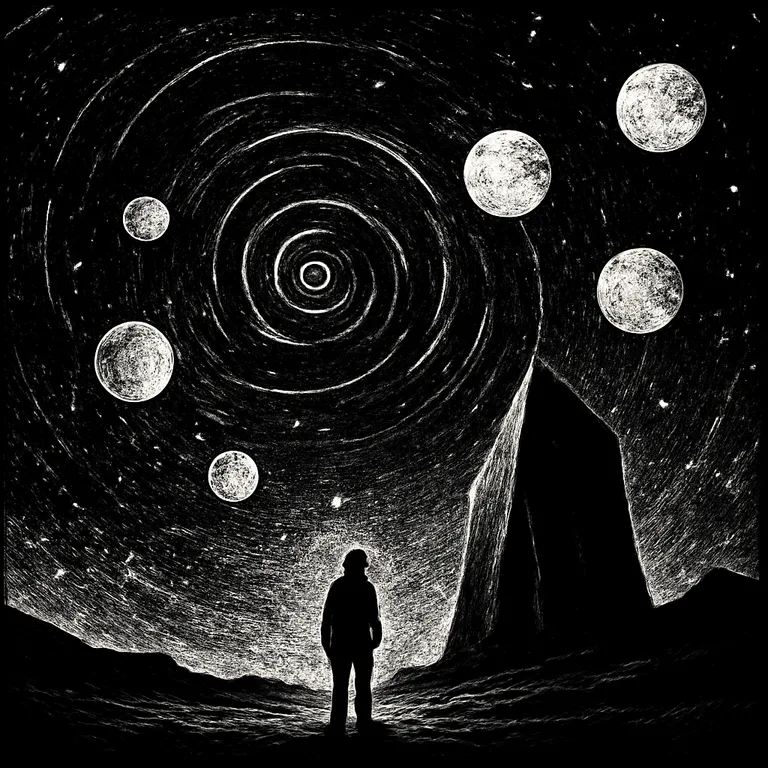
Seven Moons in the Quiet House
A routine morning unravels into a quiet invasion from a cosmos that prefers daylight, as one narrator watches a room turn stranger and the day refuse to wake as it should.
A routine morning unravels into a quiet invasion from a cosmos that prefers daylight, as one narrator watches a room turn stranger and the day refuse to wake as it should. I wake to the clock’s thin tick in a room that feels too large for the morning, as if the light itself has stretched the walls out a little and decided to stay. The kettle exhales steam the color of pale smoke, and the radio sighs with a static that sounds almost like breath. This is a morning episode in a town that pretends to be ordinary, the kind of place where the blinds never quite sit straight and the streets carry a rumor of rain you can almost
Audio plays in the player below. Scroll to read the full transcript while you listen.
Rate this story
Hover a star to rate this story
About this story
A routine morning unravels into a quiet invasion from a cosmos that prefers daylight, as one narrator watches a room turn stranger and the day refuse to wake as it should.
A routine morning unravels into a quiet invasion from a cosmos that prefers daylight, as one narrator watches a room turn stranger and the day refuse to wake as it should. I wake to the clock’s thin tick in a room that feels too large for the morning, as if the light itself has stretched the walls out a little and decided to stay. The kettle exhales steam the color of pale smoke, and the radio sighs with a static that sounds almost like breath. This is a morning episode in a town that pretends to be ordinary, the kind of place where the blinds never quite sit straight and the streets carry a rumor of rain you can almost
Transcript
Full text of the narration. Selecting text does not affect playback.
I wake to the clock’s thin tick in a room that feels too large for the morning, as if the light itself has stretched the walls out a little and decided to stay. The kettle exhales steam the color of pale smoke, and the radio sighs with a static that sounds almost like breath. This is a morning episode in a town that pretends to be ordinary, the kind of place where the blinds never quite sit straight and the streets carry a rumor of rain you can almost hear as it approaches. I rise, I brew coffee, and I tell myself the same things I tell myself every day: take your time, you are not late, the world will not shatter if you count to ten before you speak to anyone. But the day already has a tremor in it, a heartbeat that may or may not belong to the town or to some far and indifferent thing beyond the map of my memory.
The kitchen windows catch the pale morning light and throw it into a narrow strip along the counter. Everything looks normal enough - cup, spoon, the box of oats with its cheerful yellow lid - but the ordinary carries a thread that you can tug and pull and never quite find the end of. The cat pads in from the hall with that peculiar morning grace, as if it thinks the floorboards themselves are listening, and I am suddenly very aware of the geometry of the room. The geometry hurt to look at, not because of any obvious danger, but because it refuses to stay still the way a room is supposed to. The tiles in the kitchen floor tilt ever so slightly under the weight of a single passing moment. The edge of the counter should be a straight line, but it ripples with ripples that do not belong to water. The chair legs seem to lean inward, inviting a guest that I know cannot exist. It is not a frightening vision, exactly; it is more like a dream you wake from still feeling the dream’s pressure on your bones.
I tell myself I am being ridiculous and pour the coffee anyway. The smell is bold and warm and wrong in a way that feels almost affectionate. I take two sips, then set the mug down and listen to the house listen back. The radiator sighs with a longer note than usual, as if it has learned a new language overnight. The clock on the wall, a stubborn thing with a red second hand that never quite lands where I expect, seems to pause for a fraction of a breath before continuing. It is all small and human, and I want to pretend nothing cosmic is happening, because a cosmic event does not require a man to swallow his fear and continue standing in his kitchen, but the fear is here and it sits in the corners with the other forgotten objects - gloves without a mate, a spoon with a bend in its bowl, a photograph of people I do not recognize but feel as if I should.
The day begins to move, not with a run of events that demand attention, but with a slow, patient rearrangement. I pull the blinds up and the street outside looks different from the daylight I expect. The lane has the same houses, the same pale brick, the same little shop with a bell on the door, but the way it feels to look at them has shifted. A man in a coat I have seen at the bus stop but cannot name passes the window and nods at me as if we share a secret we are not allowed to reveal. When I blink, for a moment the entire world seems to elongate, then snap back to its usual length and gravity. I do not trust the reflex; I keep blinking anyway, counting the blinks like a boy counting coins, trying to find something that feels reliable. It does not exist.
The morning hums with its ordinary rituals, and I walk the same route I have walked since I was a child, except the town has learned to listen to me a little less and to respond to something else - something I cannot see, something that breathes through the overhead wires and remembers the shape of a coastline that does not belong to this map. The bakery on the corner smells like toast and rain at the same time, and the cashier greets me with a smile that wobbles, as if the smile is not the correct shape for a face at all. I buy a loaf, because even in a world that tilts and forgets, bread remains a stubborn truth. I carry it back to my small apartment and set it on the counter next to the coffee cup and the notebook where I scribble words I pretend will later make sense.
In the notebook, I write to anchor the morning, to remind myself of what is mine to remember and what is not. The handwriting is careful, the letters rounded and deliberate, the ink of a pen that knows how to hold its breath. And then a notion - one that feels like a whisper in the back of my skull - arrives without ceremony: that this day, this blue and gold, is not simply a day but a doorway. It opens toward something ancient and patient, something that looks through glass as if glass were a boundary and not a barrier. I do not tell anyone this. I do not tell myself a lie about it either. I simply write and listen and walk, as if listening and walking are acts of prayer to a god who forgot to leave a name.
The first sign comes from the floor again, a softer ripple this time, like the surface of a pond that trembles when a breeze refuses to be named. The hallway stretches a little longer than it did yesterday, and the line where the carpet meets the tiles forms an angle that seems to move when I am not watching. I pause and look at it, and the angle bends away from me as if the wall has decided to lean its back against the universe and watch me in return. This is not grotesque or cartoonish. It is patient, like something waiting to be remembered after centuries of pretending not to exist. The geometry hurt to look at, not because the geometry itself is hostile but because it asks questions I do not know how to answer. It invites me to step into a space where three dimensions feel like a disguise, where what is visible is only the faintest shadow of what lies beneath.
I retreat to the kitchen, to the mug of coffee that I keep refilling with a ritual precise as a bell rope. The radio crackles to life with a voice that is trying to sound cheerful about the morning, a voice that rituals itself into the air with a note of forced bright, as if someone had told it to jokes about the day. The host speaks of pollen and daylight and schedules and the weather, and I listen until the words become a small knot in my chest. The breakfast cereal, when I pour it, lands with a sound that is a hair too loud, as if the bowl has learned to become a drum and the room to become a stage. And then outside, the air moves in a way that feels almost like a sigh, the kind of sigh that wakes with you and follows you through the day, insisting that you know you are being watched even while you pretend not to notice.
By midmorning, the town has settled into its ordinary rhythm and the extraordinary thread begins to pull itself into view with the stubborn texture of memory remembered too late. A man in a pale suit with a tie the color of dry grass asks after a friend I am certain I never had and invites me to a place I cannot name. The invitation has the feel of a door one is meant to walk through even though it lies inside a wall you cannot see. I decline, and the man’s mouth trembles for a moment, as if the face he wears is not his own but a mask that has learned to imitate a body well enough to walk around in it for a few hours before forgetting how to speak and becoming instead a rumor in the street. I return to my apartment and the day continues to pull at the edges of itself, the way a sweater fogs at the cuffs when you rub your hands together to warm them.
The first real disruption arrives not as a bang or a crash but as a small, almost affectionate correction of the air. A breeze slides through the room, though the windows are closed and the door is shut as it always is. It does not chill me; it asks something of me. It moves in a way that is too deliberate to be a normal draft, as if an invisible hand has brushed a fingertip along the back of my neck to measure my posture and decide whether I am worth entering in the morning. I am. I am worth entering because I am here, and being here is already a kind of defiance against something older than memory. The breeze curls around the edge of the notebook page and flips it to a new line without the permission of the handwriting. I watch this with a certainty that should scare me and does not. The line reads as if a second voice has decided to learn to speak through me, but it speaks in a language that sounds like weather patterns and the taste of rain on a morning that should be dry.
Then the calls begin. Not voices, exactly, but a series of small knocks against the apartment door, one after another after another, in a pattern I almost recognize. It tells me the day is listening to me in a way I cannot control, that the day wants a response and will settle for nothing less than a reply. When I open the door, there is no one in the hallway, only the pale reflection of a man that does not quite exist in the glass of the apartment door. He smiles with a mouth that seems too wide, as if the room has learned to borrow someone else’s face to pass through. I tell him there is no appointment, and he says the appointment is with the universe itself, which is a sentence I do not understand but feel true in a way that makes my limbs go heavy with the certainty that I am not the one who will decide how this ends.
The day moves on with the quiet insistence of a tide coming to meet the shore. I measure my steps as carefully as I measure the coffee scoops and the bread slices. The town is unusually polite today, which is to say it has learned to say your name at precisely the right moment and then forget it so I must repeat it as if I am reading a poem aloud to a room that forgets the verses in which it appears. The bus lifts and tilts on its springs with a sound that is almost musical, the way a chain of bells might sound if the bells decided to exchange their voices with the rain.
Audio
Seven Moons in the Quiet House
ReflectStart here