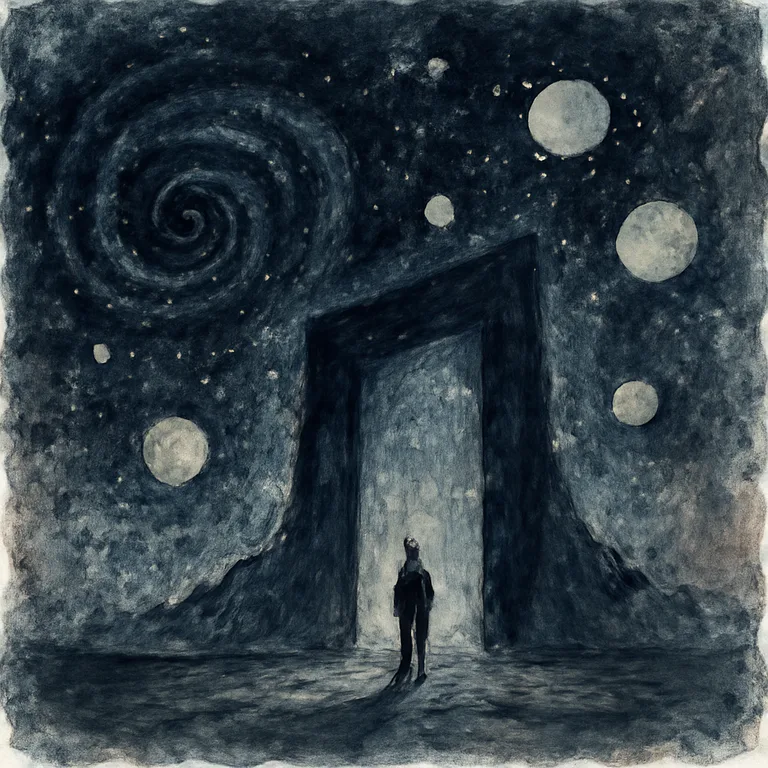
The Window That Watched Back
A quiet morning in a town that smells of rain and old batteries turns uncanny as the day unfolds with signs that reality is listening back to the one who wakes first.
A quiet morning in a town that smells of rain and old batteries turns uncanny as the day unfolds with signs that reality is listening back to the one who wakes first. I woke to the kettle sighing on the stove and a streetlight still burning through the curtains, pale as a tooth in a mouth that hadn’t smiled in days. The alarm clock blinked its stubborn red digits, and I let the sound of the morning return to me the way a shoreline remembers the sea after a storm. It was not a dramatic morning, not a thing with a thunderous warning. It was a morning that took its time unwrapping itself, as if the day wished to be
Audio plays in the player below. Scroll to read the full transcript while you listen.
Rate this story
Hover a star to rate this story
About this story
A quiet morning in a town that smells of rain and old batteries turns uncanny as the day unfolds with signs that reality is listening back to the one who wakes first.
A quiet morning in a town that smells of rain and old batteries turns uncanny as the day unfolds with signs that reality is listening back to the one who wakes first. I woke to the kettle sighing on the stove and a streetlight still burning through the curtains, pale as a tooth in a mouth that hadn’t smiled in days. The alarm clock blinked its stubborn red digits, and I let the sound of the morning return to me the way a shoreline remembers the sea after a storm. It was not a dramatic morning, not a thing with a thunderous warning. It was a morning that took its time unwrapping itself, as if the day wished to be
Transcript
Full text of the narration. Selecting text does not affect playback.
I woke to the kettle sighing on the stove and a streetlight still burning through the curtains, pale as a tooth in a mouth that hadn’t smiled in days. The alarm clock blinked its stubborn red digits, and I let the sound of the morning return to me the way a shoreline remembers the sea after a storm. It was not a dramatic morning, not a thing with a thunderous warning. It was a morning that took its time unwrapping itself, as if the day wished to be gentle and then forgot how. The world held itself in the pale glow of unreality, a color that wasn’t quite white and wasn’t quite gray, more like the space between thoughts when you wake and try to catch a dream you do not want to forget. I stood with the cup in my hand and watched the kitchen tile catch the light and hold it, as if it were listening to something just beyond the edge of sound.
The town woke with a routine that felt newly important, as if the simple acts of brushing teeth and pouring milk carried a deeper weight that had not existed before this morning. I measured coffee like a ceremonial act, poured it with careful attention, and then stood at the window to let the day cast its first test across the room. The street beyond the glass was quiet in a way that suggested it had decided to listen, not to speak. It is strange how noise can become a kind of weather, and how a weather that is only sound can press against the skin inside the house until it feels like a memory trying to push outward. I did not hurry. I did not rush. I moved just slowly enough to feel the rhythm of a life that was not mine alone to command.
The world outside wore a look of ordinary brightness that refused to rest fully in the ordinary. The trees on the block stood with their branches still, and the sun, when it reached them, did not pierce so much as it suggested a partial truth, as if the light was half convinced it should have shone elsewhere or for a longer hour. The clock in the hall kept time as if it were counting the grains of dust that had drifted down from a ceiling no longer certain of its own gravity. The morning coffee tasted sharp and clean, the way clean glass sounds when you tap it with a fingernail and hear a crack you swear you did not intend to hear. Routine offered its usual promises: you wake, you wash, you eat, you leave for a day that will be a ledger of ordinary hours. And yet the ledger did not lie so much as it rearranged the columns in a way that invited a quiet fear, a fear of what would be missing when the numbers settled again at the bottom.
When I stepped outside, the air felt almost transparent, as though morning itself had learned to breathe with a slow, careful exhale that carried small, almost unnoticeable tremors. The sidewalk tiles lined up in their neat, predictable fashion, but the more I walked, the more I felt I was walking through a memory that did not belong to me, a sequence of steps that had learned my weight and decided to imitate it with the most precise accuracy. I checked the mailbox, the usual ritual of finding bills and mail that would not be read for days, and I saw the ordinary confluence of names, the ordinary handwriting that could tell you where a person slept and what they feared, if you learned to listen to the empty lines between the ink dots. The town looked back at me with the sincerity of a painting that has learned to blink, and for a moment I wondered if this was the era of mornings that refused to arrive at their proper destination.
The bakery door chimed. The shop smelled of warm bread and the musk of something older, a scent that suggested bread was not only meant to fill the belly but also to remind you that time has a crust you can break. The baker’s hands moved with the same care of a ship’s captain tending to a vessel that would sail only through the old maps of memory. I asked for the usual, a croissant and a coffee, and the baker told me to take an extra because the day would need it. It was a small kindness, the kind that makes a person feel held by a whole city that pretends not to notice you unless you are necessary. I accepted with a nod that is half a smile and half a thought about leaving a tip that would feel like a debt I would never repay.
On the corner, a man folded his newspaper with a practiced arithmetic of sleep and habit. He wore a coat that did not quite fit the weather, a long, pale scarf that fluttered as if it existed between two moods. He looked at me as if trying to read the weather in my face the way a fisherman reads the sea from the color of the waves. He said nothing, but his eyes held me for a moment with a directness that felt almost indecent in its honesty. Then he turned away and walked with that careful cadence of a man who has learned the road by tracing it with his fingertip each morning until it leaves a map of nerves along his palm. The town continued to wake around us, and with each passing second the ordinary promises grew thinner, as if the day were adjusting itself to a new scale, a scale that could not quite hold the minutes in their true proportion.
The first sign of something wrong came without ceremony. It was not a scream or a crash. It was the way the geometry of the street began to bend its edges ever so slightly, not enough to draw your eye, but enough to make your steps feel as if they were stepping inside a painting that had learned to breathe. The houses stood in their neat rows, but their silhouettes refused to sit still; a window would tilt a fraction toward the street, a doorframe seemed to lean a touch as if listening for a particular word spoken somewhere far beyond the town. It was not fear at first; it was the sense that the world was practicing a new language, one you could understand by listening to the sound of things that should not be listening back.
At the corner store, I spoke to the cashier in the casual tone I reserve for the familiar. She wore a pair of small round glasses that perched on the edge of her nose as if they could slip off at any moment and reveal a face that was not hers, a face of the world that had learned to imitate human expression. She smiled, and I could see the effort that goes into every ordinary gesture when the day is learning to unfold itself in a language it did not bring with it. I asked how her morning was, and she said it was the same as yesterday, only different enough to notice, which is the kind of answer that keeps you polite and unsettled at once. The air carried a pale metallic note, like the taste of rain on a copper roof, and I thought that if you listened long enough you might hear the town rehearsing a lie to tell the day so it could go on pretending nothing had changed.
On the walk home I passed the library, where the doors stood open despite the morning chill, as if inviting the fresh air to review the shelves before letting them sleep again. The librarian waved with a thin, practiced hand, and in that gesture I felt the weight of the world’s quiet, a reminder that stories outnumber people and that some stories have learned to keep the daylight careful, to avoid shouting in the corners where the world hides its breath. The shelves held volumes with titles that looked like letters from a dead language, books about stars that do not exist in any map, as if the town had decided to borrow a few pages from elsewhere to confirm that it was indeed part of something larger than it could finally admit. I did not buy anything; I only stood and let the words wash over me as if the pages were small waves breaking against a shoreline I could not identify.
The geometry of everyday life began to feel like an instrument that did not know what music it should play. The sidewalks curved at the corners with a particular logic, a logic that suggested there was a hidden architect who preferred to work in the gaps between our steps. A streetlight flickered here, a mailbox leaned there, and for a moment I could swear the town had decided to test my focus, to see what I would notice when I was convinced that nothing anomalous would ever intrude upon this small, well-lit morning again. I kept a steady pace, as one does when one suspects a lie is walking beside you, and you want the comfort of the lie to keep from noticing the tremor in the air that suggests a form of listening that is not for human ears.
It was a small, almost laughable thing to begin noting, yet it nagged at me with the persistence of a stubborn detail: the sky itself seemed to have a memory. If you stood long enough and watched, the color behind the treetops shifted in a way that reminded me of water when someone runs a finger along its surface to see if it remembers the touch. Then, without any signal I could name, the sky blinked. One moment it held the pale day in its careful blue; the next, a silence pressed in and the light dimmed for a breath that felt too long to be merely a pause. I blinked in return, like a man who has learned to blink in a coded rhythm to hide the fear that a door you thought was closed is somehow open again, just at the edge of vision. The street exhaled in a way that was almost a sigh, and the air lost some of its earlier warmth as if a quiet thing had decided to cough into the morning to remind us that it was still there, still listening, still capable of changing the room with only its breath.
I walked on, the day becoming a rehearsal for something I could not yet name. A neighbor waved from a porch that looked smaller than the last time I had seen it, as if the house itself had scuttled back an inch to avoid becoming part of a larger plan. I returned the wave, and for a moment we both watched a small bird that at once appeared and seemed to vanish, a trick of light and wind and the kind of morning that makes a man feel as though his memory is being reassembled while he is not looking. The bird vanished in a way that suggested it had never existed at all, and I felt the peculiar, intimate fear of meeting something you did not know you had once known in a different life, a life that was not this morning but might have been. The word memory drifted through my mind and settled like a coin at the bottom of a well, and I knew that some part of me was already searching for the surface that would never be found again.
Audio
The Window That Watched Back
ReflectStart here