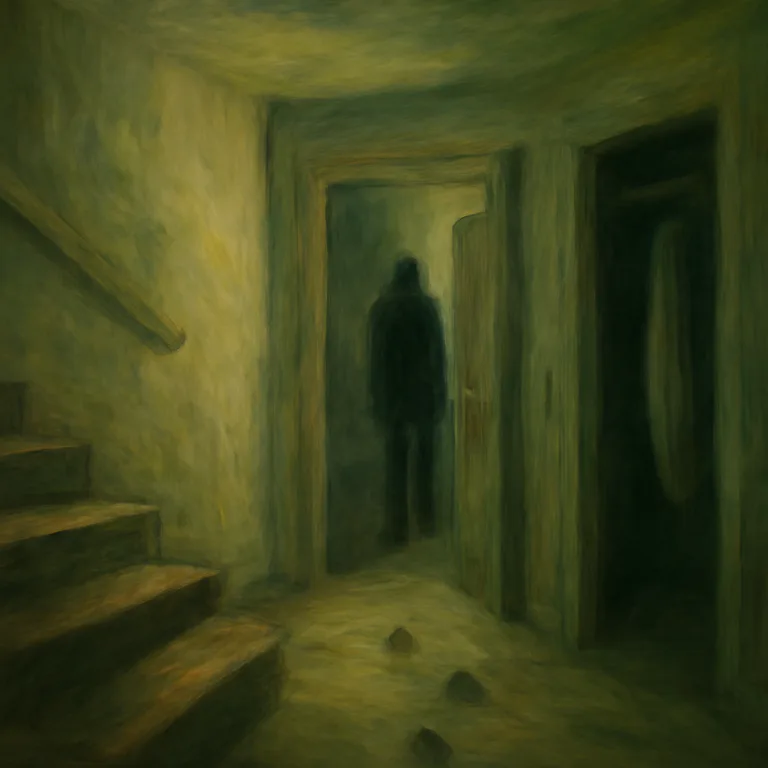
Watcher in the Spare Room
In a quiet evening, a lone resident senses a stalking presence inside an old house that seems to watch back and waits for sleep to forget what it cannot remember.
In a quiet evening, a lone resident senses a stalking presence inside an old house that seems to watch back and waits for sleep to forget what it cannot remember. The light through the kitchen window slides down the wall in a slow, deliberate way, as if the room itself is making a quiet apology for the day. I am alone with the clock and the kettle and the soft rasp of a radiator that sounds like a tired animal exhaling. The air is cool but not cold, the kind of cool that knows your secrets and does not pretend otherwise. Outside, the trees lean in and listen. Inside, a house that kept a family intact for generations now keeps
Audio plays in the player below. Scroll to read the full transcript while you listen.
Rate this story
Hover a star to rate this story
About this story
In a quiet evening, a lone resident senses a stalking presence inside an old house that seems to watch back and waits for sleep to forget what it cannot remember.
In a quiet evening, a lone resident senses a stalking presence inside an old house that seems to watch back and waits for sleep to forget what it cannot remember. The light through the kitchen window slides down the wall in a slow, deliberate way, as if the room itself is making a quiet apology for the day. I am alone with the clock and the kettle and the soft rasp of a radiator that sounds like a tired animal exhaling. The air is cool but not cold, the kind of cool that knows your secrets and does not pretend otherwise. Outside, the trees lean in and listen. Inside, a house that kept a family intact for generations now keeps
Transcript
Full text of the narration. Selecting text does not affect playback.
The light through the kitchen window slides down the wall in a slow, deliberate way, as if the room itself is making a quiet apology for the day. I am alone with the clock and the kettle and the soft rasp of a radiator that sounds like a tired animal exhaling. The air is cool but not cold, the kind of cool that knows your secrets and does not pretend otherwise. Outside, the trees lean in and listen. Inside, a house that kept a family intact for generations now keeps me company with a different promise: not protection, but witness. I am here to tell you what I learned when the evening became a patient thing, and the patient thing began to listen back.
The house wore its age like an old coat that slopes over the shoulders too heavily in the middle of a crowded night. The hallway bends where it should be straight, and the plaster on the walls breathes with a tiny sigh every time my lamp flickers. I moved in three days ago, after the last lease ended, after the last real estate agent vanished from the kitchen with nothing but a polite smile and a nervous cough. The owner said the house had seen a long life and remembered a long ache. I believed not in memory but in the statistics of pests and insulation. Yet by dusk, I realized I was landlord to a memory that would not stay quiet. The evening did not arrive so much as it leaned against the door and asked to be let in. I opened the door. The evening walked in with its shoes full of dust.
The first night I kept the door locked and the windows shut with the careful precision of a patient person counting pills. The place creaked in its own language, a tongue older than the furniture, older than the photo frame that hung crooked on the wall as if a hand had pressed it there in a hurry and never let go. I told myself I was tired, that the body knows fear when the body says, It is safe to rest now. Fear, I learned, does not care for safety. Fear cares for attention. It wants to be heard. That is how you survive a house that does not want you to sleep.
Evening comes with a particular slowness here. It is not a rush of colors or a sudden breath of wind. It is a patient, heavy thing that finally decides to sit in the chair across from you and watch you watch it. In the kitchen, I prepare a mug of tea, a ritual that might be the only way to remind myself that I am not only a consequence of this house but a person who can choose to be a quiet thing, too. The kettle shudders and sighs as if it has a nearby ghost, and for a moment I imagine the past tenant still here, deciding whether to go to bed or to listen to the night pour itself into the hallway like a black liquid. The clock ticks, but the tick does not sound like a promise. It sounds like something measured against a fear that has not yet learned to speak aloud.
I tell myself stories as I drink and listen to the silence. The stories are not the kind you tell to friends at a late café; they are the kind you tell to the walls, because the walls understand you in a way that people do not. The boards under the floor have a rhythm; they talk in a language of small trembles that you learn to understand only when you are too tired to pretend. In the living room, the cat - the house cat, a stray with eyes like burned coins - stares at me as if I am not a person but the last in a long line of visitors who forgot to sign the guestbook. The cat does not blink when the house goes still. It simply tilts its head to listen for something I cannot hear and does not tell me what it hears.
That is how fear grows in a place like this: not with one loud scream but with a dozen quiet ones that never quite reach your ears, because they learned to keep score in your bones. In the second night I notice something else, something that belongs not to fear but to patience, something that belongs to the house itself. The steps in the hall occur with a certain gravity, a weight that is not quite a sound and not quite a feeling. It is as if the floorboards themselves have learned to travel, to move a fraction of a breath to a different place and then to hold that breath again until I am gone from the room. I tell myself it is a draft, a draft of air that slips through a crack in the old window, a draft that moves the dust motes into small transitory galaxies above the coffee table. But dust does not whisper, and air does not tell you that you are late, or that you must hurry, or that you should not turn on the lamp because a hand might appear in the circle of light on the wall.
The third night, the house stops pretending. The house speaks in a language that is not language at all but a memory trying to become words. It begins with the whisper of a whisper, a sound you think originates from the old pipes but then you realize is deeper than metal, older than the house itself. The sound travels along the timber like a string pulled tight, something almost musical that knows how to carry the moment you decide to listen. I am not sure when I begin to listen differently, only that listening stops being a choice and becomes a need, a hunger for the ordinary turned into a ritual you hope to keep intact. I stand in the hall with a cup of tea that is now cooling in my hand, and I hear the stair creak in its own careful tempo, as if someone or something takes each step with a sense of purpose and then waits for me to notice. The note of it lands in my chest and sinks through, and I feel the room dim a little, not from the lack of light but from an absence of someone there who should have kept walking before I arrived home.
I tell myself to go back to the kitchen, to measure the hour by the sound of water heating, to measure the hour by the way the kettle begins and ends its small tremor. But I cannot move. The house itself holds me where I stand, a glassy, patient thing that has no need to rush anywhere. Then the whisper grows into a cadence, soft and intimate, and I realize the cadence comes from upstairs and from nowhere else at all. The house is trying to tell me I am not the first person to be kept here after dark. Not by a thief or a stalker, but by something else, something that does not require threat to assert its presence. It requires a story. And it wants me to tell it back.
The words come in a way that they never did when I was younger, when fear was a tourist with a bright map. Now fear is a quiet librarian who speaks in margins and footnotes. I walk toward the stair, one careful step after another, and the floorboards sigh as if the house just exhaled a breath it forgot to take earlier. The room at the top of the stairs is a room I have not used since I moved in: a spare bedroom with a window that looks out onto the slate roof of the neighbor’s garage, a window that used to be the source of a cool evening wind but now is an eye that never closes. On the door a small brass plate, the kind you expect to see on a closet but on this door there is no closet inside, only a room that has learned to listen in. The door is closed. The house is watching me decide what to do next.
In that moment I recall a phrase I once read in a book about old houses and old comforts: a house can grow quiet enough to hear the way a person breathes. I am not sure if the author meant the home will listen for movement, or if it will listen for the breath of a life that would rather forget the day it learned to fear. But I am sure that the room upstairs is no longer empty. The door is shut with a small, stubborn sound that makes the hair at the back of my neck stand on end. I place my palm against the wood and feel the pulse of the house, a soft resonance that seems almost human. The house is listening for a signal. I give it one, a breath that is mine and not mine, a careful exhale that pretends to be nothing at all.
When I finally gather the courage to turn the doorknob, I am met with a small, private air, the kind of air that carries a scent you forget you miss until you smell it again. It smells like old rain and old wood, a smell that belongs to a house that has stood in the same place for a hundred years and will stand in a hundred more if I fail to leave. The room beyond the door is not in the least what I expect. It is not a bedroom or a storage nook or a place to keep old paint cans. It is a small chamber, a space that seems to have gathered memories like dust. On a shelf I see objects that do not belong to me: a faded photograph of a woman with a smile that has never learned to fade, a tarnished ring with a tiny etched compass, a key that does not fit any lock I can see in this house.
The air grows dense as if the room has decided to press in from all sides, to lean close and tell me a single truth, the truth that information cannot carry. I tell myself it is just the draft again, a trick of motion that makes the objects in the room appear to rearrange themselves when I blink. But I blink and they remain in place, and the photograph on the shelf tilts its head to look at me as if it were the same woman who once wore that smile in the frame. The room goes quieter. It is not silent, but it is very nearly still. The hush feels almost like a warm hand over the mouth of a frightened child, a hush that says, Quiet now, you will hear the truth if you stay very still. In that moment I hear something else, a sound from the closet door that is not a sound at all but a presence, a slow exhale followed by a breath that trembles through the wood and settles into the room with a thoughtful sigh. I think of the phrase I have kept in the back of my mind for months, a phrase I learned while reading the police reports of a dozen places that never felt like home to anyone: every door locked. I step back from the closet and whisper the words in my own way, as if I am trying to seal them into the room so that nothing else can slip through.
The idea that there is a person in the house is not the most frightening part.
Audio
Watcher in the Spare Room
ReflectStart here