Hatch Knock at First Light
A morning on a drifting habitat exposes a routine that dilates into dread as daylight feels manufactured and the ship seems to listen.
A morning on a drifting habitat exposes a routine that dilates into dread as daylight feels manufactured and the ship seems to listen. Morning on the ring is supposed to be a quiet reassembly of the night shift habits. The air is cool, and the corridor hums with a patient, almost ceremonial rhythm. I am the last to wake, toggling the feed into the day with a coffee that tastes like copper and a promise I do not quite trust. The windows show a pale blue daylight that should comfort a person who trusts a daily routine. Instead it feels like something polished and false, a glassy lie poured into a cup and handed to you with a polite smile.
Audio plays in the player below. Scroll to read the full transcript while you listen.
Rate this story
Hover a star to rate this story
About this story
A morning on a drifting habitat exposes a routine that dilates into dread as daylight feels manufactured and the ship seems to listen.
A morning on a drifting habitat exposes a routine that dilates into dread as daylight feels manufactured and the ship seems to listen. Morning on the ring is supposed to be a quiet reassembly of the night shift habits. The air is cool, and the corridor hums with a patient, almost ceremonial rhythm. I am the last to wake, toggling the feed into the day with a coffee that tastes like copper and a promise I do not quite trust. The windows show a pale blue daylight that should comfort a person who trusts a daily routine. Instead it feels like something polished and false, a glassy lie poured into a cup and handed to you with a polite smile.
Transcript
Full text of the narration. Selecting text does not affect playback.
Morning on the ring is supposed to be a quiet reassembly of the night shift habits. The air is cool, and the corridor hums with a patient, almost ceremonial rhythm. I am the last to wake, toggling the feed into the day with a coffee that tastes like copper and a promise I do not quite trust. The windows show a pale blue daylight that should comfort a person who trusts a daily routine. Instead it feels like something polished and false, a glassy lie poured into a cup and handed to you with a polite smile.
I move through the arcs of the station the way you walk a familiar hallway and pretend you know where the floor meets the wall, the way you pretend your breath belongs to you and not to the machine that breathes with you. The morning checks are simple on paper: life support, water recovery, gravity and orientation, the cargo manifest, the logs from the last rotation. The problems that have teeth usually hide in the irrelevant, in the small noises that no one mentions aloud. Those are the clues you must learn to read if you want to stay ahead of what lives between tasks.
The first sign is not dramatic. It never is. It is the soft, almost polite hiccup of the corridor lights, a suggestion that the day is about to tilt without your consent. The gravity stabilizers pop into a smoother pattern, then stumble for a heartbeat and settle. gravity flickered, I note in the log, and the line stays there like a fingerprint that does not belong to me. The numbers flicker, the screens brighten for a fraction that feels like a blink I cannot claim ownership of, and then they settle back into their appointed tones as if nothing happened. It is the sort of thing you file under Routine Anomaly, the way a ship folds its hands and looks away when you ask about what frightened you last night.
I tell myself gravity is a force, a stubborn thing that refuses to care about your mood. The truth, though, is that I feel the old ache of fear when it happens. The corridor becomes a small chamber I must walk slowly through, as if the walls themselves have decided to listen to my footsteps. The day begins with that odd sense that I am being observed by someone who undresses the world with the same careful, implacable gaze I bring to my work. It is not a person in the conventional sense. It is a pattern of sound and shadow and the way a long corridor seems to bend just a fraction when you look away.
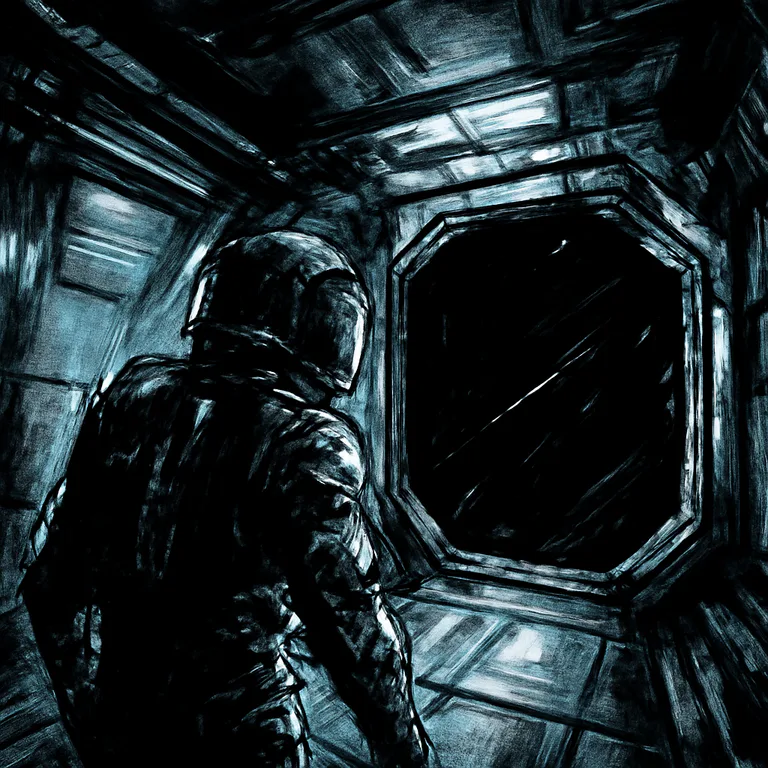
I reach the prep bay and suit up for the morning maintenance on the outer hull. The suit is heavy, but that weight is the kind you can measure in minutes and breath. I shoulder a tool belt, clamp and diagnostic tablet, and start the sequence that will take me outside for a quick sweep of the panels facing the planet. The helmet remains on the rack until I am halfway through the corridor because I want the morning to pretend it is only a routine, not a dare. I am careful not to rush. Rushing invites mistakes, and mistakes attract the kind of attention you do not want while you are standing on the lip of a hatch with the cold of space pressing in.
The moment the suit locks around me, the ship speaks differently. Not a voice with words, but a careful, deliberate breath that slides along the hull as if the hull itself is listening. The helmet cam hung at the corner of the visor, the way I always wear it for the outside work, is supposed to show me what I cannot see with my eyes in the dust and the light. The helmet cam delayed by six seconds sits there in the readout as a stubborn stubbornness that mocks the idea of seeing clearly. It is a small defect in a universal language of alarms and indicators, a minor thing that makes the outside world feel as if it is a performance with a curtain drawn halfway across the stage. The six seconds feel like a long pause before a confession I am not ready to hear, a moment when the world seems to pause and then decide to go on without you.
The hatch out to the maintenance spine opens with a sigh and a sigh like a ship exhaling. The air is cold enough to make your breath froth. The starfield does not look far away, though it is only a few meters beyond the metal and glass that keep us safe from the vacuum. The outside world is not the page of a travel brochure. It is a painting with edges that drift when you blink, a place where heat bleeds away and your skin remembers a cold it should not have to remember anymore. The panels glint with frost, the rivets like tiny eyelets in the fabric of the ship. It feels almost ceremonial to step out, to feel the world tilt again just by leaning your weight toward the seam that will not stay closed if you forget to hold it.
The routine becomes a ritual of small, precise checks. I scan the seam lines with a handheld emitter, listen for the metallic sigh of a loosened bolt, watch the way the solar panels reflect the pale daylight back at me, as if the sun itself is judging the work of the crew by the way the platform holds its position. The outside is quiet in a way that feels almost sacramental. It is not glory or fear, but a quiet, patient assent to the simple truth that something dangerous can be invisible in the daylight and obvious only when you look away for a breath too long.
Inside the hull again, the day moves toward a rhythm that resembles normalcy. The logs record nothing dramatic, nothing out of the ordinary, and yet a sense of a line drawn in the sand remains. The crew has been thinning, the corridors less crowded than they used to be, and the voices in the comms carry a different timbre, a certain dampness you notice only when you listen for it, the way a room can feel damp without a drop of water. I tell myself this is what happens when you live with a machine for too long, when you learn to count the minutes by the changing alarms rather than by the changing sun. The ship does not forget. It stores memory the way a coral reef stores color, and every day adds a shade you did not expect to see when you woke up.
At the turn of the corridor, I find the first sign that I am not alone in my morning of routines. A note, taped to the panel by a person I do not recall meeting, written in a careful hand, a hand that looks as though it learned to write by tracing the shapes of the hull plates. The note says only a single word in a language that belongs to the old days, the days of before the ring existed, the days when we believed we could own the universe with our tools. It is a word I cannot pronounce without thinking of the tremor of a door that trembles in a wind that should not exist. The message ends with a line of numbers that do not make sense, coordinates perhaps, or an unreadable key. It feels like a breadcrumb left by someone who vanished while trying to remember where they hid something important. I pocket the note, bow my head toward the handwriting as if to honor a stranger who left a map in a language the ship understands better than I do.
The sense of wrongness grows in small, insistent increments. The routine that should soothe me becomes something that tests me. The coffee cup I pour into from the filtered line looks duller than it should look. The aroma that should lift the morning from its limping pace does not rise; it stays flat, a thin sheet of warmth that refuses to crest into real comfort. I check the air mixer again, the water recycler, and the gravity panels. I find nothing wrong with the numbers, and yet the sensation persists that the ship is listening to me more closely than I thought possible. It is not a sentient thing with a will and a voice. It is a creature made of metal and memory, a thing that learned to be careful with my mistakes, a thing that will reproduce my mistakes if I do not learn to listen to it back.
I encounter a coworker in the corridor and the moment I see him, I cannot tell if he is the same person who woke up with me. He speaks in the same voice, tells me the same things I expect to hear, but there is a glaze in his eyes, a distance that makes a person feel as if they are looking at someone through glass, someone who is trying not to break the surface with their own reflection. We talk about the schedule, about a routine maintenance window that has to be kept, about the ship’s habit of waking and sighing at odd hours. He asks if I checked the hatch again, as if the hull has begun to remind us that it is there, that it may decide to remind us that it is alive in the morning, and not a mere barrier between us and whatever waits outside the pale daylight.
The third sign is the most direct. The hatch knocked from outside. It is the sound that will not go away, a rhythm of weight on a door that should be heavy enough to hold back anything that would dare to knock, and yet the knock comes with the certainty of a person who knows the ship better than the crew knows themselves. The sound does not come once. It repeats, slow and patient, a deliberate knock that seems to be trying to break through the wall and into the room with me. I stand at the hatch and press my ear to the metal, listening for any other sound beyond the sound of the ship breathing. There is nothing except the conclusion that something has learned the schedule, learned my steps, learned the exact rhythm of a door that is supposed to be quiet and obedient, and used it to prod me into a decision I do not want to make.
I do not open the hatch at once. It would be too easy to mistake the knock for a door that means to let in the ordinary and then fail to recognize the extraordinary when it arrives. The ship has taught me to wait, to count the internal seconds between a knock and a door and to measure the tremor that follows. The six seconds that the helmet cam delayed by six seconds returns to my mind with a stubborn force, as if the helmet itself has become a clock that insists on being right, even if the world refuses to be. It is not fear that drives me. It is a careful, almost ritual decision to withhold entry until the outside tells me what I ought to know, until the outside reveals a shape in the daylight that I could not discern through the glass or within the pipes or in the logbooks.
When I finally lift the hatch, there is nothing but the pale light of the corridor outside and the sense of a weight behind the door, a weight that has no mass but has a gravity of its own.
Audio
Hatch Knock at First Light
ReflectStart here