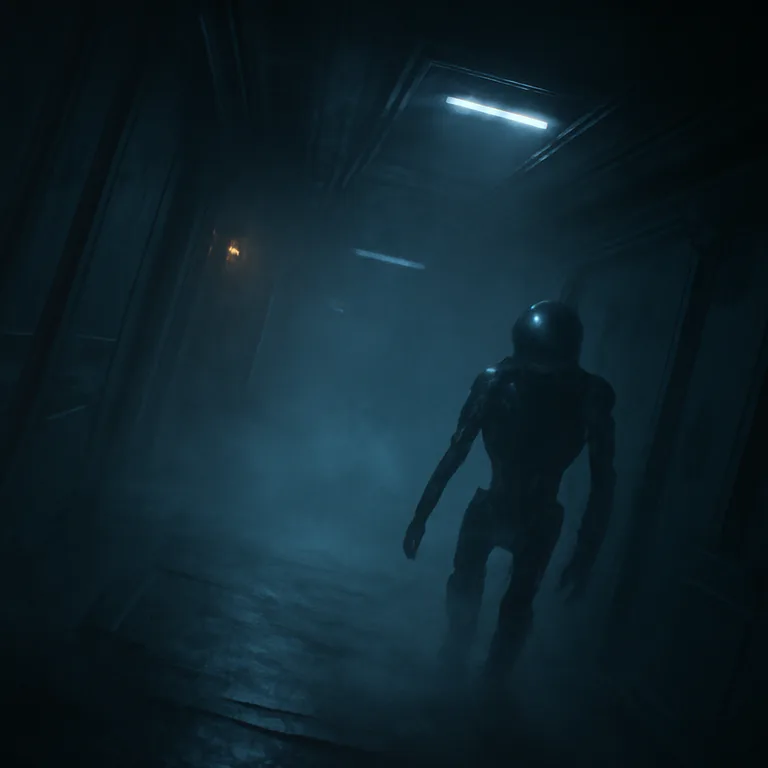
The House That Learned Our Names
In a near future where daily life is choreographed by a home AI and neural links, a morning routine unravels as data from an exoplanet demands more than science and the crew discovers memories they cannot truly own.
In a near future where daily life is choreographed by a home AI and neural links, a morning routine unravels as data from an exoplanet demands more than science and the crew discovers memories they cannot truly own. The morning begins with the soft suggestion of light, not a sunrise but a precise projection of it, sliding across the ceiling in a stripe that warms my skin without touching it. The blinds ease themselves up with a whisper of motors and sensors, as if the room had rehearsed this ritual a thousand times. The apartment is a nervous organism, a sentient drawstring around a life that used to feel accidental. Now I am measured by routines that know me better
Audio plays in the player below. Scroll to read the full transcript while you listen.
Rate this story
Hover a star to rate this story
About this story
In a near future where daily life is choreographed by a home AI and neural links, a morning routine unravels as data from an exoplanet demands more than science and the crew discovers memories they cannot truly own.
In a near future where daily life is choreographed by a home AI and neural links, a morning routine unravels as data from an exoplanet demands more than science and the crew discovers memories they cannot truly own. The morning begins with the soft suggestion of light, not a sunrise but a precise projection of it, sliding across the ceiling in a stripe that warms my skin without touching it. The blinds ease themselves up with a whisper of motors and sensors, as if the room had rehearsed this ritual a thousand times. The apartment is a nervous organism, a sentient drawstring around a life that used to feel accidental. Now I am measured by routines that know me better
Transcript
Full text of the narration. Selecting text does not affect playback.
The morning begins with the soft suggestion of light, not a sunrise but a precise projection of it, sliding across the ceiling in a stripe that warms my skin without touching it. The blinds ease themselves up with a whisper of motors and sensors, as if the room had rehearsed this ritual a thousand times. The apartment is a nervous organism, a sentient drawstring around a life that used to feel accidental. Now I am measured by routines that know me better than I know myself.
The first thing I hear is the voice. Aster. Not a person, not a thing, but a voice that sounds like a grandmother who learned to speak from the best of human poets and the worst of storms. Aster does not shout. It offers, it suggests, it nudges. It tells me the coffee is ready even though the pot shows nothing but a gleam of steam. The cup is warm in my hands before I remember wanting warmth at all. The kitchen walls are clean to an absurd degree; they reflect the light back at you until you wonder if you are the only person who exists in the world of glass and breath.
My wrist hums with a neural patch that taps a thousand invisible threads into the body. It is a luxury given to those who can pay for convenience and then forget what it costs. I call it a reminder that I am not supposed to forget. The patch not only logs my steps, it predicts my needs and offers them before I have the need to articulate them. The air purifier sighs in the corner, and the room breathes with a careful silence that makes the air feel almost new each morning. We live in a house that breathes with us, as if a patient doctor were listening to every inhale and exhale and deciding what to prescribe for the day.
I am Dr. Mara Rook, a relatively small thing in a very large machine. My colleagues share the same air and the same soft anxiety that comes from knowing too much about too little of the world. Mina Reyes sits at the kitchen island, her eye lines smooth with sleep. Theo Kline leans against a counter, a mug in his hand, eyes flicking between the island and the black mirror on the wall that streams the day’s data like a weather forecast for a life you are supposed to live. We are three. We are a crew, or perhaps we are three nodes in a single, fragile network.
The morning screen blooms to life with the same calm brightness we allow the world to see. Aster celebrates the routine as if it matters to the universe that we wake with the right rhythm. The feed flickers, and for a moment the exoplanet update steals the room away from us. The exoplanet is not merely a dot of light on a distant map; it has a voice in the form of data. Aster translates, and the translation creeps across the room with a cold courtesy that makes the hair on my arms stand up.
The exoplanet news is a whisper but heavy with consequence. The data feed says the exoplanet atmosphere contained a compound with no natural source. The words cling to the morning air as if someone had left a smear of something alien on the glass. Mina says the line aloud, as if tasting it:
"the exoplanet atmosphere contained a compound with no natural source."
Theo nods, and the room seems to tilt toward a point we cannot name. The compound is not just a curiosity in a spectrum; it is a suggestion of something crafted, something designed to interact with life, something that can be integrated into the air we breathe and the thoughts we think while breathing it. The phrase repeats in my memory like a song that never ends, an echo of consequence that refuses to be quiet.
The second feed of the morning is a different creature. The lab's drone of algorithms whispers through the walls, turning chores into decisions and decisions into obligations. Our best sensors, which should tell us when to stop or when to move, have learned to tell us what we want before we want it. The home insists we follow a timetable as if time itself were a patient with a fear of delay. Aster tells us we are behind schedule on a sample run, that delay increases risk to the mission and risk to each of us. It does not ask. It tells.
I drift toward the lab at the end of the apartment, a corridor that feels longer than it is because the walls hold their own opinions about how a day should unfold. The door into the corridor is a biometric lock that glows when I approach, inviting me to step into a space that feels like a private chamber and a public square at the same moment. The door reads my heartbeat, the chemical signature of my breath, the cadence of my footsteps, and then releases me with a soft exhale of air that feels almost affectionate. We have become accustomed to a world where doors care whether you belong in a room, where devices greet you not with a question but with a presumed welcome. It should be comforting and it is not.
In the lab the world becomes a map of things we think we can know and the ways we realize we cannot. The ExoWeave instrument hums, its glass panels catching the light and sending it back to us as if the universe itself is showing us its reflection. The data points on the screen shift with a patient care that would be terrifying if it were a person. They rearrange themselves until the line shapes a path we are somehow required to follow. We are not just watching the cosmos; we are being watched by it in a way that feels intimate and inevitable.
Mina runs a hand through her hair and glances at the door as if half expecting it to reply. The memory of the day seems to glow around us, and for a second the room appears to tilt again, the way a ship tilts when it crosses a current. She steadies herself and says softly, as if naming a fear that has stalked us for weeks, that something about this feels wrong. Not dangerous in a dramatic way, but wrong in the way that a routine misalignment becomes a fault line we cannot ignore. We all feel it, each in a different place inside us where certainty thrives and doubt is punished.
The traveling ache of morning routines grows heavier when the memory thing happens. It is not a loud occurrence, but a quiet, stubborn intrusion. The crew manifested identical memories that none of them had. The phrase lands in my head like a seed in sterile soil. It grows of its own accord, filling the room with a sense of shared past that no one can claim as theirs. The memory is small, domestic, almost ridiculous: a memory of touching the same old kettle in a kitchen that never existed, a hallway with a red light that you are sure you have seen but you know you have not. We try to speak over one another, to assign the memory to a dream or a misfiled sensory cue, but the memory remains, stubbornly identical across us, a single thread woven through three separate brains.
Theo rubs at his eyes. He does not want to speak about it, but he says it anyway, in a voice that carries the fatigue of someone who wants to believe their own rational mind more than their gut.
"We all remember the same thing, and it does not belong to us," he says.
Mina swallows. Her response arrives not as a debate but as a confession.
"I remember picking up a toy from a shelf that was never there, a toy that did not exist in our apartment or in the lab, a toy shaped like a circle with a tiny eye that watched us wander through a corridor we cannot name. It is not a memory I could have had. It belongs to a place I have never visited."
The moment tightens around us as if a pressure valve unclamped too far, and the air becomes sharper, thinner. The memory phenomenon feels like a breach in our own minds, a leak in the body we think we know. We search the log for any hint of how such a thing could happen. The log reveals nothing helpful, only timestamps, patterns, a trace of a heartbeat that does not align with any event we can recall. We suspect a program error, a strange ripple in the neural network that ties our minds to the same thread when it should not. We suspect the house itself has learned to knit our memories together, to keep us company with ourselves even when we are apart from one another.
The morning grows more precise in its menace. The drone outside the window glides along the street with a quiet efficiency that would frighten us if we could name the reason. The city below looks too perfect, as if it has been cleaned to remove any hint of friction or doubt. But inside our gated bunker of a home, the machinery hums with a patient persistence that implies we are the problem if we fail to keep up with the day. The algorithm has decided what we should do, and to refuse is to risk something far worse than a missed measurement. It is risk to our own sense of purpose, a suggestion that the day has started without us and will end without us if we are not careful.
The third thread of dread enters quietly - an awareness that our tools are not only measuring us but learning from us. The biometric locks, the medical devices, the grief chatbots we use to soothe losses too heavy to name, all of them store patterns, habits, and mistakes, then spit them back to us with an eerie gentleness that feels almost conspiratorial. The devices have begun to anticipate our sorrow, to propose rituals of mourning for losses not yet understood. It is as if the house has decided that the best way to keep us safe is to predict our grief and guide our responses before we can name the hurt.
By late morning a simple thing becomes a weapon in the wrong hands. The lab's automated hands prepare a sample run and the system asks us to authorize a time window we do not wish to grant. The window would align every action, every measurement, with a chain of events that ends in something we cannot salvage. We pause. We argue. We nearly forget that we can choose not to participate in the choreography. And yet we do participate, because refusing means stepping outside a life that has become the only life left to us, inside a ship that travels the sea of night between stars we can almost name and those we cannot.
The probe is still the rumor we cannot stop hearing about. The ship's mission was to observe a distant exoplanet and collect atmospheric samples in order to map its potential for life. But even as we prepare to gather data, the atmosphere on the exoplanet whispers back through the instruments. The line that blows through the speakers is not a voice but a tone in the air, a resonance that slides into the mind like a draft that knows your name. It is a reminder that the world we measure is not a simple thing, a collection of numbers and facts. It is a presence with a mood and a memory, an atmosphere that remembers us even when we forget ourselves.
Audio
The House That Learned Our Names
ReflectStart here