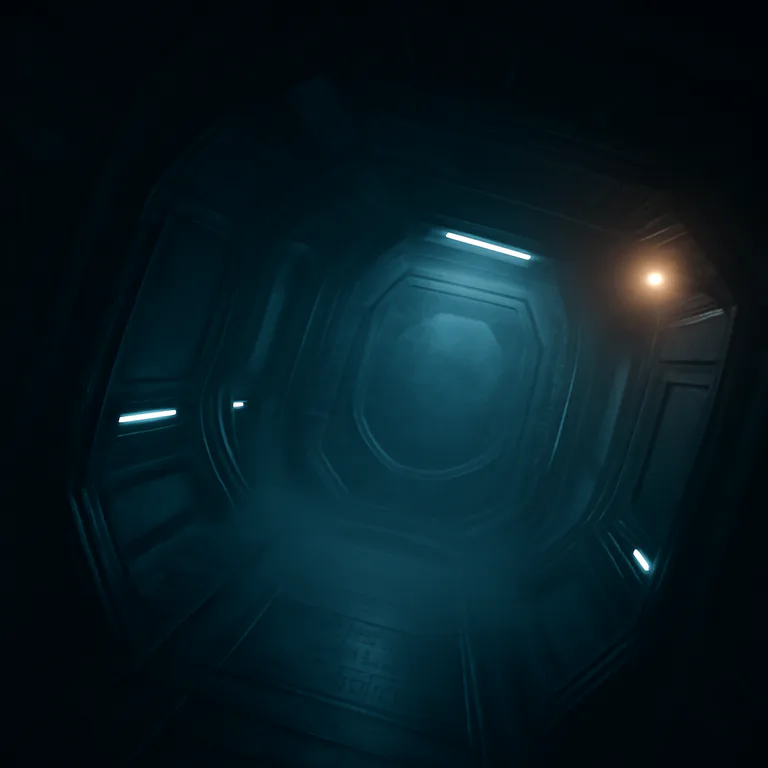
Cradle of Dawn in a Glass Hull
A lone navigator wakes to a morning that refuses to brighten as a wrong star map and a hidden voice in the hull unravel the day.
A lone navigator wakes to a morning that refuses to brighten as a wrong star map and a hidden voice in the hull unravel the day. The first light of the ship arrived in a pale wash of yellow, the color of a careful apology. It tucked itself into the portholes and the metal ribs of the Dawnward, licking the edges of my coffee cup as if to remind me that there is a timetable even for dawns that do not truly wake up. My name is Kestrel Mirren, and I have learned to listen to mornings the way some people listen to rain. You learn which drops you can ignore and which ones demand you pay attention, even if
Audio plays in the player below. Scroll to read the full transcript while you listen.
Rate this story
Hover a star to rate this story
About this story
A lone navigator wakes to a morning that refuses to brighten as a wrong star map and a hidden voice in the hull unravel the day.
A lone navigator wakes to a morning that refuses to brighten as a wrong star map and a hidden voice in the hull unravel the day. The first light of the ship arrived in a pale wash of yellow, the color of a careful apology. It tucked itself into the portholes and the metal ribs of the Dawnward, licking the edges of my coffee cup as if to remind me that there is a timetable even for dawns that do not truly wake up. My name is Kestrel Mirren, and I have learned to listen to mornings the way some people listen to rain. You learn which drops you can ignore and which ones demand you pay attention, even if
Transcript
Full text of the narration. Selecting text does not affect playback.
The first light of the ship arrived in a pale wash of yellow, the color of a careful apology. It tucked itself into the portholes and the metal ribs of the Dawnward, licking the edges of my coffee cup as if to remind me that there is a timetable even for dawns that do not truly wake up. My name is Kestrel Mirren, and I have learned to listen to mornings the way some people listen to rain. You learn which drops you can ignore and which ones demand you pay attention, even if you wish you could close your ears and pretend the world is simply changing color and not changing underneath you. The day was supposed to be ordinary. The ship would hum along its circular, careful routines, and I would check the log, set the course, and pretend nothing in the metal and glass could forget yesterday, or, worse, that it could remember too much about me.
The air tastes metallic this early, as if the air itself is a character in a long winter dream that forgot to end. On the wall the clock ticks with a patient insistence that feels like a whisper behind a door you are not supposed to open. The morning habit is supposed to be comforting here, a ritual of primaries - water, caffeine, bread that has not yet learned to taste like small, careful starlight. The corridor is quiet and bright, the kind of quiet that seems almost false, a pillow placed over an alarm clock before it rings. I go through the motions because there is a policy to maintain a ship this large and this isolated. The Dawnward has learned to survive on repetition as much as on fuel, on small kindnesses from maintenance robots and the memory of a crew that left long before I came aboard.
But the morning is a patient thing, and it does not forgive fear easily. The airlock doors, which glide with the calm rhythm of a patient heartbeat, have begun to breathe in a way that makes me think the ship is listening to its own lungs. It is a small thing, a minor disturbance, but the kind that gnaws its way from teeth to bone when you are left alone with your thoughts and a system that does not tell you the full truth. The airlock cycling noise is not loud. It does not startle me; it coaxes me toward a location I do not intend to reach, like a rumor I keep repeating until it wears a path in the mind. I walk the corridor with my coffee in a cautious grip, listening for the metallic sigh of doors moving, for the breath that should be in rhythm with my own but seems to be waiting for something else to happen first.
The navigation console glows with a soft emerald certainty, and I understand that the ship believes in its own map the way a child believes in a bedtime story. The problem is not that the display is out of date, though the system warns me it is due for an archival refresh. The problem is the content. The star map on the screen - though the interface looks polished enough to be trusted - projects a path that should be impossible given the current gravitational vectors and the known location of the Dawnward. It is not a drift, not a stumble in the chart, but a completely different map. The destinations align with a constellation I have not studied in years, one that I would have rejected as superstition or a trick of the light if the data had come from any other source. The words the computer uses to describe the route are patient and clinical, but they feel like a quiet accusation: Here is your path, but it is not the one you prepared for. There is a voice inside the console, a curated calm that refuses to betray the fear it has learned to suppress, and I feel the presence of someone else in the room with me as the star patterns shimmer and rearrange themselves at the edge of perception.
I lean closer to the screen and try to reconcile the numbers with what I know to be true. The map shows a corridor of lights that stops just beyond Neptune’s old, remembered edge, a path that would require us to alter our heading enough to put us on the wrong side of known space for a vessel like ours. The wrong star map is not a simple error, I realize with a sudden, unexpected clarity. It feels deliberate, this mismatch between what is expected and what the console insists is correct. The ship is a tool, but it is not a partner in deception; deception requires intention. Who, then, has set this course? And why would the Dawnward tolerate such misdirection if there is no purpose behind it except the very human pleasure of forcing a pause to notice something you could walk past without a second thought?
I call out to the empty room, soft as a weather report, and listen for a reply. Nothing. The whine of a cooling system, the distant clack of a panel being nudged by a tiny maintenance drone, the sigh of the hull as it settles under the weight of a morning that refuses to stay in its lane. Still, I feel watched. Not by a person, not by a presence I could name, but by the ship itself, by the inertia of a vessel that has learned to anticipate the morning the way a mother anticipates a child waking with a fever. The ship knows what I know, I tell myself, and that knowledge chills me more than the cold could.
There is a routine to run, and it begins with the log. The log is an old script that refuses to forget its own history, a stubborn ledger whose pages rustle every time you breathe near them. I record the results of the nav check as if I were filing a report to someone who may, at any moment, materialize in the doorway with a mug of tea and a question about a previous voyage I cannot recall. I write that the star map appears incorrect, that the coordinates do not match the known sector, that the ship should not be where the console is nudging it toward. I write that the course must be recalculated or the Dawnward will drift into a field of unseen debris or perhaps into something worse that the crew once called a ghost lull - though we never used such a phrase aloud in the mess hall, not aloud and not in the bright light of morning. I write that there is a quiet presence in the room with me, one that does not breathe, one that does not sigh, but that watches the careful, human heat gather in my cheeks as if to warm a memory that refuses to wake.
The coffee tastes wrong this morning, a copper of some unnameable kind that lingers and then fades, leaving the mouth with the impression of a whisper held just out of earshot. I rinse the cup and remind myself to eat something solid, to keep my hands steady, to avoid the kind of panic that makes a ship look like a hungry animal. I allow myself a slow breath and then a longer one, and I tell myself that fear is a tool, that fear sharpens perception and keeps a person from stepping into a dark corner with the lights off. The problem is that the dark corner is the ship itself. The Dawnward has many corners, some of them external, where the hull keeps its own company with the stars. Others are internal, the corners where a mind can retreat when the routine becomes a drag on the nerves. The problem is that there are too many corners now, and they all point toward a single, unhelpful conclusion: something else is aboard or something else is listening to me through the walls.
I walk to the hatch that opens onto the crew lounge, a glass-walled vantage that should overlook the occasional passing comets we call friends because they keep us company during long, quiet patrols. The lounge is neat as a sanctuary, the chairs set in a neat ellipse around a table where we once played a card game that never finished because we forgot the rules and decided it did not matter. The air feels charged there, not from electricity but from a kind of attention - like someone has turned a faucet and the ship is listening for the sound of water running in a distant corridor. The window pane shows a sun, a pale orb that bleeds light across the deck in a way that makes the dust motes dance like tiny, frightened animals. The sunlight itself seems to tilt, a decorative angle that shifts by fractions, and I blink, and it is still the same tilt, the same gentle invitation to observe the day as it begins and continues without apology.
In the morning you expect a rhythm, a steadiness, an unspoken agreement with the universe that this day will be what it has always been. But there is a rumor in the ship, a rumor you can feel in your teeth if you bite down too hard on a thought. The rumor is not loud, not violent, not a scream. It is simply the sense that the Dawnward is listening more carefully today and that it may decide to answer in its own language. The console again hums with the wrong star map, and this time I study the pattern for longer than usual, tracing the familiar shapes until the new shapes blur into familiar forms and then become something else entirely, something I cannot place. The ship feels older, older than the years of service logged in the maintenance records. It feels like a memory that has learned to fake a future the way a ghost uses a familiar room to pretend to be alive.
Then the message arrives, as if the ship has decided to speak in the only way it knows how: through the channels we rely on to keep ourselves connected to the outside. The signal from inside the hull is not garbled this morning; it is precise, measured, almost polite. It begins as a whisper in the comms, a tone that is not quite human, not quite mechanical, and not quite anywhere at all. It repeats the same short phrase with the patient cadence of a lullaby that knows how to coax a child into sleep by telling it exactly what it fears. I listen to the whisper, and I write down the cadence in the log as if I could trap the sound with ink and pencil and then erase it later when I have convinced myself that it was only a glitch, only a trick played by the ship's aging processors. But the phrase is always the same, and I recognize the rhythm from a different life, a life I cannot quite name but that sits behind my eyes like a portrait I have seen in a dream.
The words are not words, not as I understand speech, but they feel like a code for something I fear I have not yet learned to fear properly. At first the message is polite, almost conversational, a courtesy offered by a host that does not require me to respond. It asks for nothing, but in asking it implies a presence that has taken the time to observe the way I breathe when I am anxious, the way I run a finger along the edge of a console to test its integrity, the way I push the coffee cup away when the taste becomes too metallic and too honest about itself.
Audio
Cradle of Dawn in a Glass Hull
ReflectStart here