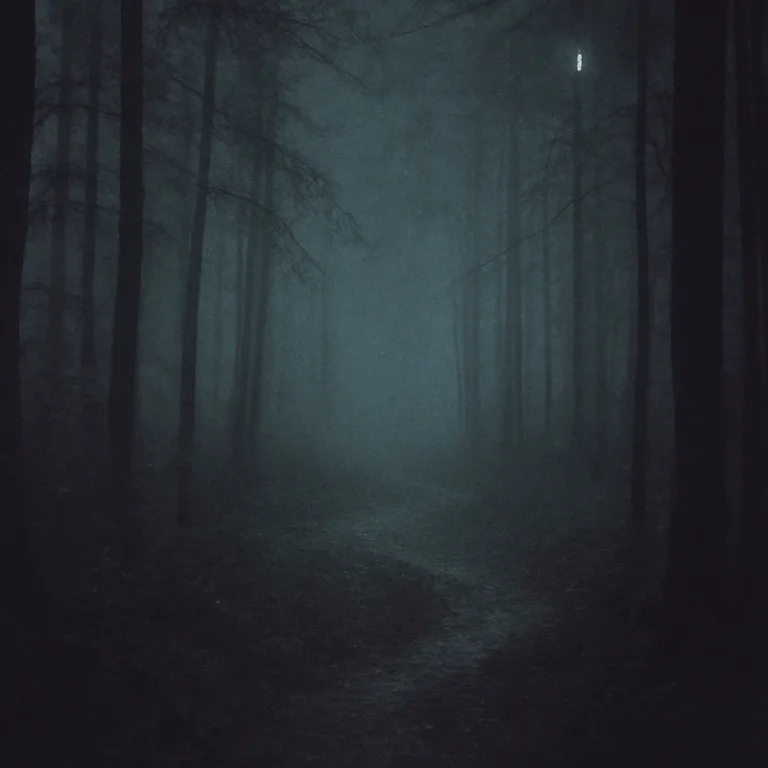
The Trail That Keeps Returning
A morning survey in the deep woods reveals a path that returns to its own beginning, a drone that maps in loops, and a voice that mimics my call, drawing a lone observer into daylight terror that refuses to fade.
A morning survey in the deep woods reveals a path that returns to its own beginning, a drone that maps in loops, and a voice that mimics my call, drawing a lone observer into daylight terror that refuses to fade. The morning air came in with the light and carried a grainy touch, as if the sun itself had to squint through pine needles to see me. I woke to the sound of a small engine somewhere beyond the cabin wall, and I lied in bed listening until the engine stopped, leaving the room to breathe and the floorboards to creak in their predictable old way. The routine was simple and reassuring, the way you latch your day onto a
Audio plays in the player below. Scroll to read the full transcript while you listen.
Rate this story
Hover a star to rate this story
About this story
A morning survey in the deep woods reveals a path that returns to its own beginning, a drone that maps in loops, and a voice that mimics my call, drawing a lone observer into daylight terror that refuses to fade.
A morning survey in the deep woods reveals a path that returns to its own beginning, a drone that maps in loops, and a voice that mimics my call, drawing a lone observer into daylight terror that refuses to fade. The morning air came in with the light and carried a grainy touch, as if the sun itself had to squint through pine needles to see me. I woke to the sound of a small engine somewhere beyond the cabin wall, and I lied in bed listening until the engine stopped, leaving the room to breathe and the floorboards to creak in their predictable old way. The routine was simple and reassuring, the way you latch your day onto a
Transcript
Full text of the narration. Selecting text does not affect playback.
The morning air came in with the light and carried a grainy touch, as if the sun itself had to squint through pine needles to see me. I woke to the sound of a small engine somewhere beyond the cabin wall, and I lied in bed listening until the engine stopped, leaving the room to breathe and the floorboards to creak in their predictable old way. The routine was simple and reassuring, the way you latch your day onto a steady clock and pretend the tick-tock belongs to you alone. I brewed coffee, kept the kettle on the same burner, arranged my notebook and markers on the desk, and checked the equipment like a man who fears a tiny error might ruin something larger than a mistake. The deep woods do not forgive miscalculations. They absorb them, and sometimes they return them, years later, in the shape of a cold wind that sounds like your own name spoken in a cave.
The project was straightforward. A week of daylight surveying, recording sound patterns, tracking a set of birds that should have been there and perhaps were not. A friend of mine had left me coordinates and a note that read simply: keep the route simple, you do not want to wake anything that has learned to count steps. I did not need the warning to feel the weight of the woods pressing in from every side; the moment I stepped outside, the forest wore a pale morning face, as if it were waking up and decided to pretend it had always been awake just for me.
First I tested the radio, then I tested the drone. The little quad-rotor rose with a careful, almost ceremonial hum, as though the woods themselves granted permission for travel. The drone filled the air with a thin, careful orbit, mapping the ground below as if it were drawing a map that could never quite decide what it contained. The screen blinked, and I spoke into the mic to anchor my voice to the device, to keep the data from wandering off. The drone map looped, not once but repeatedly, each pass carving a neat circle around the same feature, then stepping out a touch to a new arc, then back again to where it began. The display did not show an obvious path, but a whisper of one, as though the forest were blue ink on a page that refused to stay inside the lines. I watched the circles tighten, then loosen, and tighten again, as if the drone itself were fatigued by a puzzle it could not finish.
The plan was to walk the interior path and compare the drone's record with my own memory of the terrain. I kept the pack light, but my steps felt heavier than they should, as if the earth beneath me pressed with a quiet insistence. The early day held a peculiar kind of daylight - soft and almost reluctant, the sun peeking through branches with a kind of shy, testy brightness that did not quite reach full confidence. I had walked these parts before, many times in the past year, but today the woods seemed to have learned my footprints and rearranged them; the familiar scent of sap and damp earth carried the memory of something older, something patient, something that did not mind taking its time with a traveler who thought they owned a map.
I started along the usual route, a narrow path that followed an old logging trail to a small clearing where a stand of pines leaned inward, as if listening for a rumor carried by the wind. The dappled light stitched itself across the ground in bright, hesitant patches. It was a morning you would call unassuming if you believed a day could be unremarkable and still be a day that wanted something of you. The pack rode at my hip, the old camera slung over the shoulder, the notebook pressed to the chest as if it might keep something from slipping away just by being close to my heartbeat. The first couple of minutes passed with the normal rhythm of a walk: the crunch of dried leaves under boot, the popping of sap from a broken twig, the distant cry of a bird that might or might not have learned to imitate the human voice with its own weathered throat.
And then the quiet began to feel deliberate, almost ceremonial. The forest did not rush me, but it seemed to study me as I went, checking how I breathed, whether I would pause at every small stump to examine it the way a curious person might inspect a shell on a beach. The air smelled of resin and rain in the distance, of roots sliding through soil like fingers turning pages of an old book. The path, narrower than I remembered, veered toward a small rise and then dropped back toward a hollow that always contained more shade than sun. I marked the coordinates on the map and kept talking to record the mood, to anchor the day with language that would outlast fear if fear decided to forget its own name.
The first anomaly presented itself when I reached the edge of the rise overlooking the hollow. The drone map looped against the screen, a repeated line that nibbled at the same spot and did not venture beyond it. The drone map looped in circles, as though the machine could not decide which direction held the truth. It did not show new trails beyond the hollow, only a repeating set of swirls where the same few trees stood as if posed for a photograph that would never finish developing. I stood and watched the display tilt and then settle back into that same stubborn pattern, and a small rattle sounded from the undergrowth as if a creature had decided to acknowledge me in a language between a bark and a whisper. I did not call out. I wanted to learn the difference between hearing something and summoning it, and I chose the safer route of listening, letting the wind do the talking rather than my voice.
The woods began to feel as if they had learned my name, and I named it back to them with care. The trail through the hollow split and rejoined in a way that felt almost deliberate, as if it were practicing a trick for an audience that was not yet born. I marked the ground with small spray marks and reminded myself to compare them with the drone data, to keep my own memory honest. The path did not vanish; it simply kept folding, curving around a cluster of young pines where the ground sloped to a shallow ditch. And then I realized something else: where the trail should proceed toward a certain old cedar that burned into a dark silhouette against the morning light, the earth instead rose toward a line of saplings and then became a narrow slit that led into shade. It did not vanish, but it did not present itself as the same trail either. It was as though the path had learned to hide in plain sight, to disguise a single route as a dozen soft misdirections, a magician’s sleeve of possible roads.
The second moment came with a whisper and a question, the second sensation that a person cannot easily categorize as fear or curiosity. I had brought a small recorder that captured not only the words I spoke but the ambient voices of the forest in a way that could be translated later into a more precise tone analysis. I tried a cautious greeting, a quiet hello, a routine line to keep myself grounded: “Good morning. I am here to map what is real.” The response arrived as something I could not call a response at first, then later I began to call it a response because it did not perfectly fit the word, only the intention. The woods answered in a voice that was almost human, a leaf-crack with a hint of rusted hinge, a sigh that could have been a distant creek. I cannot swear to what it was, only that it sounded like a sound I might have uttered had I practiced enough to imitate a tenant of the forest. And then the air shifted, and the world’s attention moved toward me in a way that felt almost affectionate, as if the woods were offering a guest a seat at a long table.
The moment I realized I was entertaining an audience came with a sudden, almost casual noise - an exchange of syllables that echoed back and forth, a rhythm that was neither mine nor the forest’s, yet both. I spoke a name, not loud, and the reply arrived in a near perfect mimicry, a reflection of my own syllables, the exact cadence and vowel shaping. It was not a scream, not a shout, not a call to arms, but a patient answer that suggested someone or something was listening closely and had decided to respond the way a chorus answers a soloist. The moment was enough to make the small hairs along my forearms stand in alarm, enough to make me pause and listen to the parable of two voices speaking the same language in the same room but never sharing the same breath. The recorder captured the exchange, a loop of the same few notes and words, a dry, careful echo that belonged to the forest and to the man who believed himself the forest’s only guest.
If you were listening to the audio feed, you would hear the soft tick of my heart cutting through the quiet, and you would imagine the woods to be empty of any living thing except the wind, the leaves, and the distant machinery of the world walking away from its own noise. But the truth was less cinematic and more unsettling: I was being watched not by a single animal or any ordinary creature, but by a presence that wore daylight as a disguise and called itself morning in a way that sounded like a sermon delivered in a churchyard. The routine of the day began to tilt, and I could sense that the time between breaths stretched an inch longer than it had a right to be. The routine I had believed would anchor me instead trembled and moved with the light, as if daylight itself refused to be the anchor. Each small action - the filling of the canteen, the checking of the camera lens, the recording of the weather notes - felt like steps on a staircase that did not lead anywhere but deeper into a house you are not sure is a home.
While I measured the wind, the birds, and the soil composition, I kept my attention on the route that lay to the left of the hollow, the one that rose toward a ridge where the map indicated a clean line of terrain. I had walked that ridge many times, but today the forest chose to present a different face. The trail that should have led me along a predictable edge did not quite keep to the edge. It loosened and then pinched, and at one moment I found myself on a steep slope where the ground dropped away into a thicket of fallen branches and stubby saplings. The path had the vibe of an optical illusion: it looked like the same road I had walked yesterday, but the angles refused to align with memory. I stopped and checked the drone map again, hoping for an answer in the loop, hoping that the drone would prove me wrong and offer a straightforward blueprint for progress. The drone map looped, the same image repeating with a stubborn stubbornness that felt less like data and more like a dare.
Audio
The Trail That Keeps Returning
ReflectStart here