The Pines Remember My Steps
In daylight that feels like rust against the tongue, a routine morning walk through a deep woods reveals a world that keeps reassembling itself around one listener.
In daylight that feels like rust against the tongue, a routine morning walk through a deep woods reveals a world that keeps reassembling itself around one listener. I woke to a morning that arrived with the soft, unhurried tick of a stove clock and a chorus of cicadas that felt deliberately patient. The cabin creeked as if yawning, and the light in the windows was pale and careful, like someone cleaning a glass that should never be touched. The coffee pot hissed, steam curling into the air as if I had brewed not a drink but a memory. The woods outside wore their usual green, but the green held something I could not quite name. A threadbare sense of routine
Audio plays in the player below. Scroll to read the full transcript while you listen.
Rate this story
Hover a star to rate this story
About this story
In daylight that feels like rust against the tongue, a routine morning walk through a deep woods reveals a world that keeps reassembling itself around one listener.
In daylight that feels like rust against the tongue, a routine morning walk through a deep woods reveals a world that keeps reassembling itself around one listener. I woke to a morning that arrived with the soft, unhurried tick of a stove clock and a chorus of cicadas that felt deliberately patient. The cabin creeked as if yawning, and the light in the windows was pale and careful, like someone cleaning a glass that should never be touched. The coffee pot hissed, steam curling into the air as if I had brewed not a drink but a memory. The woods outside wore their usual green, but the green held something I could not quite name. A threadbare sense of routine
Transcript
Full text of the narration. Selecting text does not affect playback.
I woke to a morning that arrived with the soft, unhurried tick of a stove clock and a chorus of cicadas that felt deliberately patient. The cabin creeked as if yawning, and the light in the windows was pale and careful, like someone cleaning a glass that should never be touched. The coffee pot hissed, steam curling into the air as if I had brewed not a drink but a memory. The woods outside wore their usual green, but the green held something I could not quite name. A threadbare sense of routine stood before me as plainly as a posted notice, the same morning ritual I had kept since I first learned to walk along a pine-lined path to the clearing where the stream cut a silver thread across the rocks. I measured the day by the small acts: grind the beans, fill the kettle, wipe the counter, close the door that led to the porch, step into the chill air before the sun found the valley behind the trees.
The plans for this morning were ordinary enough. A walk to check the old trail, to bring back a notebook I carried when I came here months ago to repair a fence and forget the city for a while. The woods did not rush me into fear; they asked for patience, and I obliged. The path began as the path always began, a narrow stripe of earth aligned with the stream and the log bridge that squeaked when you crossed. A bird called somewhere far off, and the world settled into a low, consistent rhythm - the very rhythm I had learned to trust, and which now began to feel like a trap laid out in daylight for a mind that had started listening too closely.
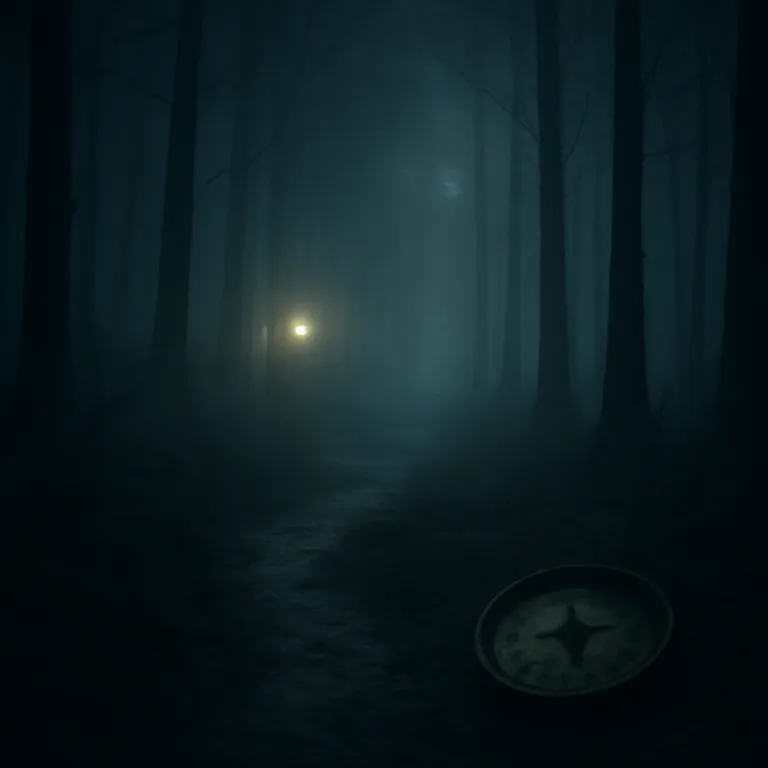
I checked the compass, a small metal disc I kept in my pocket for those days when the map seemed to misbehave, as if the ground itself could tilt and refuse to tell the truth. The compass spins in my hand, its needle jittering with a stubborn energy that refused to be dismissed as a mere wobble. North did not point to the notch between the two pines where the trail began to climb; it wandered, as if the forest itself were turning its head to observe me. I steadied the device, pressed it a little harder into my palm, and watched the needle tilt again toward the old cedar that marks the start of the pass. The woods do not like stubborn questions. They answer with weather and wind and a sense of humor that belongs to something older than fear itself.
I pressed onward, listening to the day fill in around my steps. The light grew stronger, but it drew a map of fear in the small quiet spaces between syllables. The trail, I thought, should lead to the lookout where the pine needles mixed with gravel and the air carried a cold bite. Instead the world rearranged itself, early morning becoming late, and the plan becoming a suggestion that insisted I keep walking. The first strange thing was the way the trunks of the trees leaned in a little closer than they should, as if they were listening to my breath. The second strange thing was how the birds changed their tune when I passed, their songs gathering into a single, cautious phrase that felt rehearsed, as if the chorus were a small, patient audience waiting for me to finish my conversation with the day.
The footpath widened and narrowed with a suddenness that mocked my sense of measurement. The air took on a dull brightness, as if someone smeared light over the leaves with a fat finger and then stepped back to watch what I would do with it. And then the moment of quiet that no ring of a canny bird could explain: the trail doubled back, not in a zigzag but in a full circle that had me stepping on nearly the same patch of earth twice, almost without realizing I had done so. I stopped and scanned the map in my mind, the way you glance at a familiar room and still see a new crack in the plaster. The notebook stayed zipped in my pocket, a dull clack against my chest as if it were a small, stubborn heartbeat. The trail had sent me toward the same place I had started from, and for a breath I felt the forest’s memory reach for me, as if the trees themselves kept a ledger of every step I had taken since dawn.
I spoke aloud, though I knew there was no one listening but the morning and the woods. I spoke to confirm that I was real, that my present tense had not warped into a child’s dream of a longer night. My voice tremored slightly, and I found a small rhythm in the cadence of what I said, a cadence the forest seemed to anticipate and answer with its own, older echo. I asked about the fence I had promised to repair, about groceries left on a wooden shelf in the kitchen, about the kettle that would sing another song in a half hour. The forest answered with a breath that moved through the branches, a drawing of light that made the undergrowth glisten as if it had learned to shine for a guest. And then the day did something else, something that felt purposeful in a way that left me with a dry mouth and a sudden, stubborn need to be elsewhere.
The third or fourth mile I walked, I cannot be precise about the count, I found a clearing I had never seen from the trail. There was a bench carved from an old trunk, its wood gray with weather and wear. On it lay a piece of bark, a small square with letters burned into the surface in a way that suggested a recently touched flame but left no scorch of smoke in the air. I could not make out the letters, and I did not know why I should care. The moment demanded something beyond curiosity, something I did not want to give. The bracket of light fell differently in this clearing, a soft gold seam that did not exist on the slope behind me. In that place the ordinary morning felt like a door I was supposed to open and then step through, into a space where the world kept a few secrets, kept them just beyond the fingertips of memory.
That is when the first small reminder of danger arrived in the form of a smell. It was not the familiar pine or damp earth alone but a cold, metallic tang that clung to the air as if someone had pressed a coin to the tongue of the wind. The woods did not smell like themselves anymore; they wore the scent of a damp coin purse and something else that I cannot name and hope never to name. It was a scent that made me pause, and when I paused, the forest paused with me, as if the trees waited for me to decide whether to go forward or go back. I did not believe I could go back, not now, not after the doubling back of the trail and the way the compass continued to spin toward a point that was not quite true north. The day had grown from a routine to a puzzle and then to a dare, one that demanded a voice and a toll.
I stood by the trunk of a great pine and tried to steady my breath. The world offered me two choices: pretend this was a momentary confusion and move on, or accept that the morning was asking for something else, something that demanded I listen more carefully than I had ever listened before. The forest does not speak in thunderclaps or in the easily read signs of superstition. It speaks in the language of small, convincing adjustments to reality. A twig moved, not by wind but by a hand. A leaf fell, not from gravity but from intent. And in that moment I realized the routine I had clung to was already a memory far older than the morning I woke to. The day was rewriting the itinerary, and I found myself following, not because I believed in a ghost of the past but because the world was offering an invitation I could not refuse without losing myself.
The invitation began as a voice, nothing loud but something that felt similarly carved into the air. It spoke not with the rough, human edge of a voice I would know in a city bus or a neighbor's kitchen but with a careful, patient cadence, a timbre that rings like someone who has spoken to many mornings before mine. I could not quite discern the language, but I did not need to. The words were for listening, not for understanding. It spoke as if it belonged to the trees themselves, as if the pines harbored a chorus and I was only now learning the tune. And then the moment when fear sharpened its own teeth: I heard a voice that did not come from the unknown speaker in the clearing but from the self I believed to be the only occupant of this morning. I called out in a half joke, half challenge, to test the echo. The reply came not as a reflection of sound in the air but as a stayed, patient response that seemed to have learned me at a distance I do not yet understand. Something mimicked my call, and for a half breath the forest sounded like a room with my name written on every wall, as if every surface echoed back to me with a patient, intimate demand to listen more closely, to stop and stay and watch.
The moment shifted again when I turned away from the clearing and pressed forward, hoping to prove to myself that I was in control and not merely a thread in a bigger pattern. The path, however, did not cooperate. The trail had a memory of its own. It would vanish for a stride or two, only to reappear as if a thread rethreaded itself through a loom. I bent to pick up a stone to mark a sign, and then I saw it, not written on a tree but burned into the bark of a sapling in the shape of a small spiral. It was not a symbol I recognized from any map or field guide, but it matched nothing I had ever forgotten either. The woods held the mark and watched, as if it had been there long before I arrived and would be there long after I left. The mark did not threaten; it invited. The invitation felt like a dare, and I could not tell which of the two I feared more.
I kept walking, following a path that did not want to be followed, a path that kept altering its own geography, a path that arrived always a few paces ahead of my expectations. The forest had learned my name and used it with a soft curiosity that chilled me more than any shadow could. In the old clearing, where the sun wore a thin layer of dust and the air tucked itself into the corners of my bones, the day presented me with a decision I could not fully articulate but could not avoid. I could turn back now, to the cabin that offered a door and a kettle and a place to be tired and true. Or I could keep stepping forward into a morning that refused to be ordinary, a morning that insisted the ordinary was only a veil and behind it lay something listening, something patient, something old enough to remember every time a human wakes and asks the world if it is still there.
Audio
The Pines Remember My Steps
ReflectStart here