The Hallway That Lingers at Dawn
In the soft glare of morning, a routine commute through a familiar building twists into a waking nightmare as a quiet labyrinth refuses to release its occupant.
In the soft glare of morning, a routine commute through a familiar building twists into a waking nightmare as a quiet labyrinth refuses to release its occupant. The morning began with the same sounds and the same sighing light as every morning had for years, yet something in them felt misfiled. I woke not in a bed but in a quiet room with a window that refused to show the city I knew. The blinds trembled at the edge of the frame as if a secret wind rattled them from the other side. The air smelled faintly of detergent and lemon, the kind that pretends to be fresh but leaves a stale sweetness on the tongue. I reached for a
Audio plays in the player below. Scroll to read the full transcript while you listen.
Rate this story
Hover a star to rate this story
About this story
In the soft glare of morning, a routine commute through a familiar building twists into a waking nightmare as a quiet labyrinth refuses to release its occupant.
In the soft glare of morning, a routine commute through a familiar building twists into a waking nightmare as a quiet labyrinth refuses to release its occupant. The morning began with the same sounds and the same sighing light as every morning had for years, yet something in them felt misfiled. I woke not in a bed but in a quiet room with a window that refused to show the city I knew. The blinds trembled at the edge of the frame as if a secret wind rattled them from the other side. The air smelled faintly of detergent and lemon, the kind that pretends to be fresh but leaves a stale sweetness on the tongue. I reached for a
Transcript
Full text of the narration. Selecting text does not affect playback.
The morning began with the same sounds and the same sighing light as every morning had for years, yet something in them felt misfiled. I woke not in a bed but in a quiet room with a window that refused to show the city I knew. The blinds trembled at the edge of the frame as if a secret wind rattled them from the other side. The air smelled faintly of detergent and lemon, the kind that pretends to be fresh but leaves a stale sweetness on the tongue. I reached for a jacket that was not mine, found a coffee cup that carried the faint imprint of a night I did not recall, and stepped into a corridor that should have opened onto a public lobby but instead offered a corridor that did not belong to any lobby I recognized.
The building spoke in color and form rather than in words, which is how the morning becomes strange enough to notice. The fluorescent hum sounded like a chorus of tiny engines running in slow, deliberate speeches. It filled the stairwell with a pale, electric warmth that pressed against the back of my neck, as if the ceiling itself had leaned forward to listen to every small plan I intended to make before breakfast. The ceiling tiles breathed; the lights winked as if blinking awake to watch me walk beneath them. I kept telling myself to trust that the day would unfold as it always did - coffee, commute, schedules, meetings - yet every step I took seemed to insist that the day did not want to unfold in that particular way today.
The lobby did not feel like a public space so much as a preserved memory of one. The marble floor was too clean, too reflective, as if polished for the sake of a ceremony I did not attend. The front desk stood in shadow, a silhouette of someone I half recognized from hundreds of mornings without ever meeting them. The automatic doors parted with a soft sigh, and beyond them the city breathed in a rhythm I could not quite place. But instead of the ordinary street roar there was a gentler sound, a distant murmur as if the city itself were listening to the morning instead of shouting at it.
I walked forward with the mind of someone who has learned to disappear in plain sight, and the building obliged by revealing only the surfaces I expected and not the ones I forgot. From the floor to the ceiling, there were details I should have noticed before, but they settled into my awareness like a sequence of steps that I had practiced without knowing I had practiced them. The floor mats bore the same geometric pattern, a pattern I had walked over a thousand times while the old clock in the lobby ticked a taunting, patient rhythm. It is not the pattern alone that unsettles you, it is the sense that it repeats with deliberate care, as if the space itself is counting on your arrival and your departure to perform its daily ritual with absolute precision.
In the corner there was a vending machine that would have delivered a perfectly ordinary snack, save for the way the buttons glowed with a pale, almost nervous light. The machine reflected a version of me I did not fully understand, as if the glass had borrowed my face to blur the line between memory and present. The hum of the machines was a quiet hymn, not loud enough to announce itself, but sufficient to seed the idea that every routine in this place has a memory of its own. I passed the security desk where a single monitor glowed with the same faint blue as the sky just before noon, though the room carried the scent of early morning dust, a little sharp, a little damp, as if the building remembered rain that never came.
There was a scent in the air that I did not expect on a workday, a metallic sweetness that clung to the back of the tongue and hung in the air long after I breathed. It reminded me of old elevators and new paint, the kind of scent that feels like a memory trying to resume its job after a long pause. The doors at the far end of the lobby faced one another as if in conversation, two doors that knew they were mirrors but pretended they were not. The space between them seemed to thicken, a space that did not invite you forward so much as demand that you choose between staying and moving, between certainty and something uncertain that wore the color of certainty like a miscast costume.
There was a moment when I realized I had no need to check a watch or a clock for the hour, for time itself seemed to inhabit the corridor in a way that made the minutes arrive with the inevitability of a tide. The morning light spilled through tall windows and lay in long, pale ribbons across the carpet, but the ribbons did not align with the carpet’s patterns. They shifted, as if the sun had decided to strike the floor at a slightly different angle every day, and I found myself stepping into those misaligned rectangles with the careful, almost ceremonial, hush of someone stepping onto a stage where no one else is present but the audience of their own fear.
I started to move toward the elevators, thinking that the simple act of ascending a dozen floors would prove that the day was legible, that the ordinary rules still applied. The doors opened with their customary sigh, and I stepped inside with a mind that was already half certain I would not emerge where I expected. The interior of the car was small and efficient, and the numbers above the buttons shone with a cold, perfect glow. But the panel did not show a floor number I recognized. It drifted, sliding from one familiar digit to another as if the elevator itself were blinking wrong. I pressed a button that should have sent me to the third floor, and for a heartbeat the car slid into a transparent stillness, a frozen breath between floors, and then the door opened onto a corridor that felt older than the building itself, a corridor that did not belong to any official floor but seemed to be the ceiling of some other place that had crawled into the walls to watch the day begin.
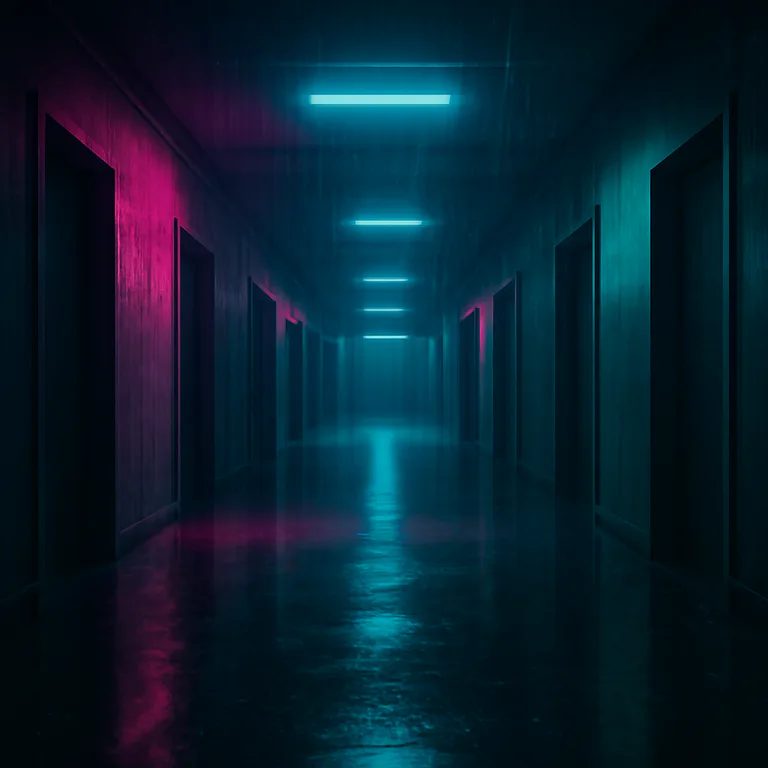
The endless hallway appeared as if conjured from a single memory I did not hold, a corridor that stretched farther than the architecture should permit and then refused to end. It had doors on either side, doors that were not the same door over and over, but doors that wore the exact same design and tone and yet held different inches of dark behind their hinges. The carpet showed a repeating motif, a pattern that should have offered a sense of progress but instead offered a sense of stasis. Each step muffled into the next, and the world beyond the doorways remained stubbornly still, as if the offices were all paused in the moment when the day begins and cannot decide whether to join it or stay within the shadows of sleep.
Somewhere up ahead a fluorescent light flickered, a temporary hesitation that persisted far longer than a flicker should. The light gave the walls a sickly brightness, a pale radiance that made the dust motes look almost purposeful in their choreography. In that place the air grew cooler and thinner, and I felt a familiar pressure behind my eyes, as if the building itself were pressing a question into my skull that I did not dare to answer aloud. The moan of the air vents rose and fell with a rhythm that could be mistaken for breathing. The corridor did not have a rhythm so much as it possessed a heartbeat I did not recognize, a slow, stubborn pulse that kept insisting I move forward even as I wanted to retreat.
I found myself pausing in front of a wall that bore no distinguishing features beyond a single, stubborn phrase etched in pale paint: no exit sign. It did not shout or glare, it merely stated a fact that felt more like a weather pattern than information. A tiny, almost cruel irony lived in the spaces between that phrase and the world around it. The hallway would not show me the exit, and yet every door bore the same handle and the same lock. It was not simply that the doors did not lead anywhere; it felt as though they led to the same place, a place I had visited in a dream and woken from with my heart still thudding in my chest. The endless hallway did not want me to find a way out. It wanted to remind me that I had always followed a routine, and that routines can own you in the morning as surely as they own you at night.
The more I walked, the more I understood that the building did not forget me or forgive me for waking. It rehearsed the day before and the day after in a sequence of small, almost imperceptible changes. The coffee in the break room tasted different each time I thought I would taste it again the sensible way. The elevator doors closed on a moment that was not my own, and when I pressed the button for the lobby, the doors opened onto a hallway that looked nothing like a lobby and everything like another corridor that refused to retire into ordinary daylight. The glass at the end of the corridor did not reflect the world but rather offered a peek at a version of the day that had not yet happened and might never happen if I could simply decide to walk away and leave the building to itself.
I tried to bargain with the morning. I offered a routine step or two from a life that felt stable and true, a life whose rules did not bend when the day began. The building listened in its own way, with the quiet rustle of air vents and the soft clink of a loose ceiling tile settling into a memory of a moment it had never experienced before. It was as if the morning were a guest in this structure, and the structure was politely yet firmly instructing the guest to take nothing for granted. The fluorescent hum persisted, a steady insulation around my thoughts that made every idea I had sound rehearsed, as if I were reciting a monologue for a role in a play that no longer has a director or audience.
A glance toward a reflective surface - a wall of glass, a mirror placed at a strange angle - revealed not my face but a faint echo of my outline, a silhouette that did not quite resemble me and did not quite vanish when I turned away. The echo seemed to reflect the actual me more honestly than the person I believed myself to be in the morning light. The echo did not smile. It simply watched, its presence both foreign and intimately mine. I touched the wall, and the wall answered by giving a little where there should be none, a subtle yield as if the plaster remembered my weight and acknowledged the fact that I belonged here at least for this moment.
I met a security guard who wore the same uniform as others I had seen on other mornings, but there was something about the way the guard moved that suggested they had never stood in front of me before.
Audio
The Hallway That Lingers at Dawn
ReflectStart here