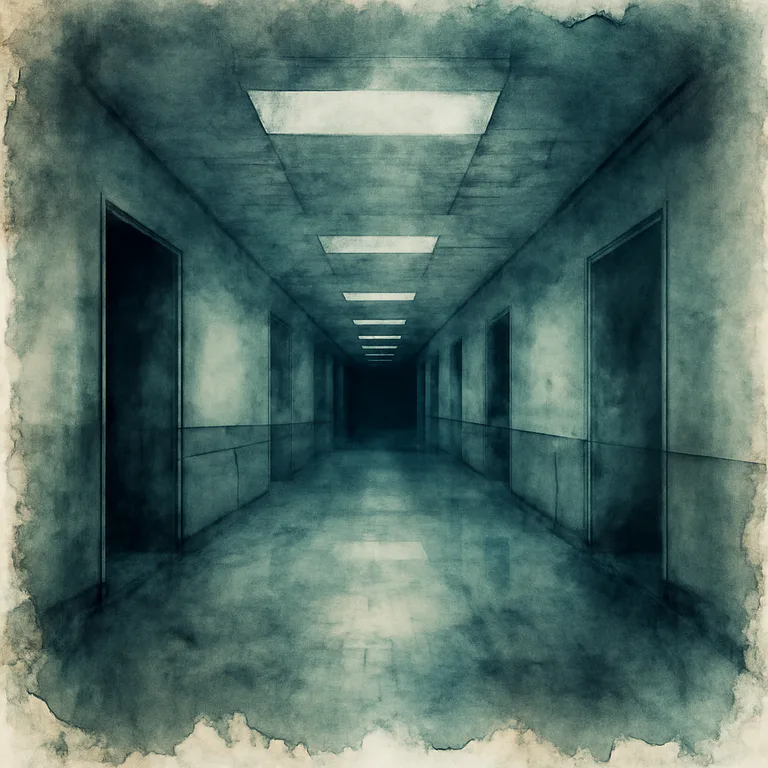
No Exit Sign
A morning in a building that should contain ordinary routines, yet unfolds as a waking nightmare of liminal spaces and daylight unease.
A morning in a building that should contain ordinary routines, yet unfolds as a waking nightmare of liminal spaces and daylight unease. The morning light crawled through the blinds in pale, measured strips, as if it were counting the hours with careful, clinical patience. I brewed coffee and watched the steam rise in thin, nervous wisps, then pinched the bridge of my nose and told myself to stop looking for danger in the edges of a routine day. The building where I work is old enough to pretend it is modern, new enough to make that pretense feel almost elegant. The walls remember too much. The floors are good at pretending they do not care who walks on them, which
Audio plays in the player below. Scroll to read the full transcript while you listen.
Rate this story
Hover a star to rate this story
About this story
A morning in a building that should contain ordinary routines, yet unfolds as a waking nightmare of liminal spaces and daylight unease.
A morning in a building that should contain ordinary routines, yet unfolds as a waking nightmare of liminal spaces and daylight unease. The morning light crawled through the blinds in pale, measured strips, as if it were counting the hours with careful, clinical patience. I brewed coffee and watched the steam rise in thin, nervous wisps, then pinched the bridge of my nose and told myself to stop looking for danger in the edges of a routine day. The building where I work is old enough to pretend it is modern, new enough to make that pretense feel almost elegant. The walls remember too much. The floors are good at pretending they do not care who walks on them, which
Transcript
Full text of the narration. Selecting text does not affect playback.
The morning light crawled through the blinds in pale, measured strips, as if it were counting the hours with careful, clinical patience. I brewed coffee and watched the steam rise in thin, nervous wisps, then pinched the bridge of my nose and told myself to stop looking for danger in the edges of a routine day. The building where I work is old enough to pretend it is modern, new enough to make that pretense feel almost elegant. The walls remember too much. The floors are good at pretending they do not care who walks on them, which is to say they care very much indeed.
The fluorescent hum started before the coffee finished dripping. It was not loud, not the kind of roar that makes you wince; it was a calm, constant ache, a sound you acclimate to until it feels like a heartbeat that is not your own. In the kitchen of the morning, the building seems to speak in this hum, a language of white light and patient electricity. I listened to it with the same attention I give to a neighbor who carries a secret. The hum is not a noise but a promise that something will be there when I turn the corner, something that explains why the day must unfold as it does.
I lock my apartment door behind me and ride the elevator to the seventh floor, where the offices begin to wake up to their own shadows. The carpet is clean and the air conditioning holds steady, but there is something in the air that refuses to be named, a hesitation in the light like a breath held too long. It is not fear yet, not exactly, but a suspicion that the day has agreed to wear someone else’s mask for a while. I tell myself to keep to routine: shut the blinds halfway, brew a second pot for the morning staff who arrive with slow smiles and coffee breath, check the mailboxes that never seem to collect anything other than the dust of yesterday’s promises.
I take the long way to the stairwell, past the reception desk where the guard’s computer screen glows and his head tilts with the rhythm of a man who never takes a vacation from listening. The building’s corridors are stitched together in the same way a quilt is, with panels that whisper of other rooms not quite closed. The moment I step into the hall, an echo answers me back, as if the walls need a witness for their private weather. And then I see it, a detail that is too careful to be accidental: a light fixture that is slightly off its place, a seam in the ceiling where two tiles do not align, a shadow that behaves as if it has learned to walk in front of me instead of behind.
The first alarm comes not as a shout but as a memory I did not know I carried. I have walked these halls a thousand times, and the walls should not be able to change their mind about where doors belong. But they do. The doors you push and pull to get into a workspace suddenly open into nothing you recognize, and the nothing is quiet, almost comforting, as if the building is offering a moment of mercy before it returns to its own fiddling with the geometry of morning. The endless hallway is not a single corridor but a map that refuses to stay flat. It folds and un folds, a whisper of a labyrinth that only pretends to be a corporate wing. Each turn reveals a familiar thing again, a desk, a plant, a coffee pot, and at the last, an empty corridor that should lead to another conference room but does not. It bends in on itself in a way that makes a person dizzy to notice, as if the building were testing whether I notice that it has decided to pretend I am a guest in my own workday.
There are moments when you think you are simply tired, that your eyes are playing a practical joke on you, that the state of being awake can mimic the state of being haunted. I remind myself that I am a responsible adult, that the clock is not the enemy but a patient thing, that the day will require my best quiet voice and a steady hand. Still, the fluorescent hum continues to insist on its presence, a soft insistence that says, You are here, and you will stay here until time chooses to loosen its grip. The floor beneath my shoes holds a memory of every footstep that has crossed it, a layered echo that makes the present feel as if it has learned to mimic a past I never had the chance to see.
I also notice what seems to be a familiar, intimate absence. The hallways do not end where they should. The map on the wall near the stairwell, the one that shows every floor in neat lines of ink, has a line that is missing where the seventh floor should meet the eighth. The line is gone as if someone erased it with a slow, careful hand. The maintenance crew would tell me this is a trivial misalignment, a grid that forgot its own logic; I tell myself the truth would be less forgiving. Hallway after hallway opens to rooms that feel like offices, but the names on the doors belong to people who never arrive in the morning, to projects that never began. The rooms breathe the same way a person does when they are quietly pretending to be someone else.
I step into a room that should be a simple supply closet, a place to stash extra toner and a spare coffee cup for the late shuttle of the morning. Instead, the shelves are arranged in a way that makes me think of a shipwrecked harbor, a place designed for something to come in and never leave. The shelves glow with a faint blue light that was not there when I last checked the room, a soft radiance like the edge of an ocean I cannot swim to. In the corner, a desk lamp flickers with a stubborn pulse, each blink in time with the fluorescent hum, each blink a small reproduction of the morning’s anxiety, the day’s first tremor in the quiet.
The first time I hear footsteps that do not belong to a coworker, I tell myself I am imagining it. Footsteps in a building without morning crowds sound different, more careful, as though someone is moving through a space that refuses to acknowledge the fact of their existence. The footsteps approach, retreat, approach again, and the sound is almost polite, as if the floor were a polite host pretending to be a battlefield. When I turn the corner, there is no one there, only the echo of a heel tapping once, twice, and then nothing. The endless hallway around me does not seem to mind this trick; it simply allows it, as though the hall knows my fear and chooses, with a patient cruelty, to let it linger until I am ready to declare it real.
By the time I reach the stairwell again, the morning has progressed into daylight that feels too white, too honest for the rituals I perform to keep the day orderly. The coffee tastes flat, as if the beans were ground to debunk a myth rather than to wake a body. My routine goes on, but there is a substructure to it now, a tremor that shakes the edges of the familiar. The elevator doors sigh when they close, a sound that reminds me of a tired animal curling into a corner for rest. The air is too clean, or perhaps I am too bruised by the idea that an ordinary day can hold a place for horrors disguised as minor irregularities.
In the third hallway I pass a bulletin board that should be full of notices, reminders of meetings, birthdays, and the occasional office rumor. Instead there is a single paper pinned in the center, a schematic of the building drawn with a pencil that has seen better days. The lines are not precise; they bend as if drawn by someone who never learned to control their hand. There is a note at the bottom in the same handwriting that appears on all the other boards when someone wants to be noticed but not remembered: a phrase that does not belong here, a warning dressed as a suggestion. The note simply says, Do not forget the doors do not belong to you. It is not signed, which only makes it heavier, as though the building itself is scolding me for believing its promises.
A coworker would have dismissed all this as a string of coincidences, a trick of light and a tired mind. But I am not the only one who has been here long enough to know the room can devour time the way a river devours small stones. The morning stretches, and the routine I rely on becomes a string of fragile beads, each one sliding toward a different fate if I am not careful to keep them in order. The endless hallway seems to extend into a space that has no end and no beginning, a corridor without an origin, a place where the concept of time loosens its grip. The day itself feels like a patient, waiting for someone to name what is wrong before it unravels completely.
I try to call out to a person who should be there, a manager who knows every inch of the building and how to guide a nervous employee through the ritual of the day. His office is supposed to be a few doors down, the kind of place that makes you feel safe because it is tucked between two doors, a sentinel in a sea of walls that would rather pretend you do not exist. But when I reach his door, it does not present as a door at all. It opens to a pale corridor that smells faintly of lemon disinfectant and something else, something old and patient, like a library that forgot to close its books for the night. The room inside has a desk that looks as if it saw the same thing I am seeing now and decided to pretend it never happened. A chair rests under the window; the blinds are half drawn in a way that casts striped light across the floor with suspicious neatness. There is a name plate on the desk, the letters worn nearly smooth by use, and the name itself brings a memory back with a sting - the name of someone who has not worked here for years, someone whose absence should not be a relief but feels like a final mercy.
The paper on the desk is the kind that tells you a meeting has been canceled, a formality that should ease the nerves of an anxious morning. But the handwriting on the paper is the same as the note on the bulletin board: a careful, patient script that asks questions rather than offers answers. Do you hear the hall breathing? Do you hear the lights sigh when the day disperses? Do you remember a time when rooms kept their promises? I pocket the note, because to leave it would be to admit that the morning has been tampering with me as surely as I am trying to tamper with it.
Audio
No Exit Sign
ReflectStart here