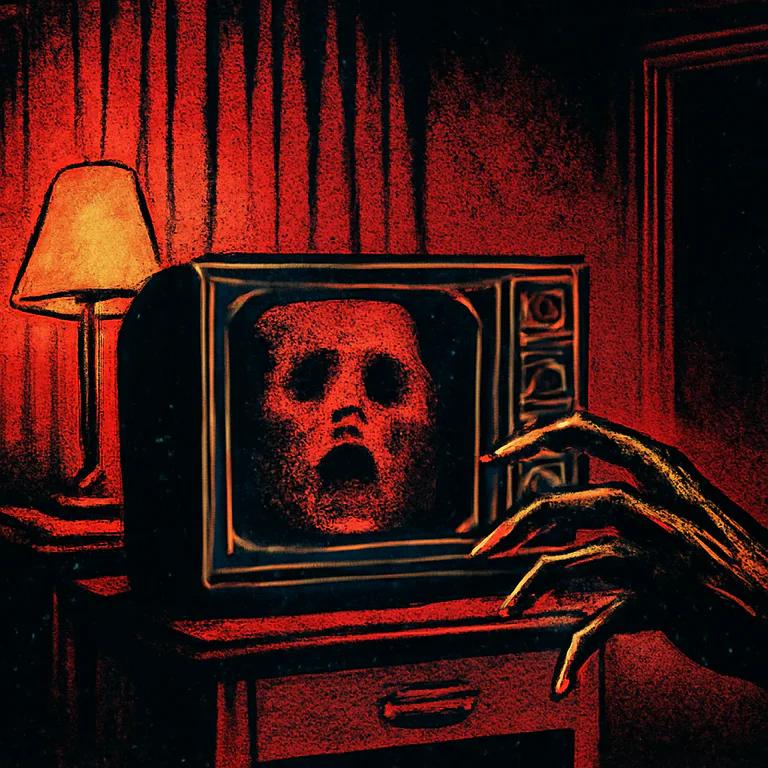
Channel Thirteen, Living Room 7B
An evening spool of old tape, a municipal channel, and an emergency voice draw a private room into public ritual.
Playback controls appear in the player when you start.
Behind the story
An evening spool of old tape, a municipal channel, and an emergency voice draw a private room into public ritual.
An evening spool of old tape, a municipal channel, and an emergency voice draw a private room into public ritual. The VCR hummed like something thinking. Its green clock glowed 8:43 and the room smelled like dust and cold plastic. I found the tape under the couch, wedged in the foam pocket where I keep receipts. The white sticker said DO NOT PLAY in a hand that had been printed and printed again until the ink ran thin. I should have left it there. I did not. When I pulled it out, the VHS labeled 'do not play' was already rewound. The spools were tight and patient. The leader sat taut and ready like a held breath. I set it
Explore more Analog horrorFull transcriptExpand to read the complete story
Every paragraph of the narration, formatted for reading.
The VCR hummed like something thinking. Its green clock glowed 8:43 and the room smelled like dust and cold plastic.
I found the tape under the couch, wedged in the foam pocket where I keep receipts. The white sticker said DO NOT PLAY in a hand that had been printed and printed again until the ink ran thin. I should have left it there. I did not.
When I pulled it out, the VHS labeled 'do not play' was already rewound. The spools were tight and patient. The leader sat taut and ready like a held breath.
I set it in and pressed play because there are some things you will look at whether you want the answer or not. The tube TV blossomed with static. The static settled into a frame. My living room filled the screen.
Not a recording of my living room. My living room itself. The camera sat low, tucked behind the end table where the houseplant used to be. It was an angle I did not own. The couch looked wrong, longer. The lamp leaned at a different fault. I recognized the threadbare throw I had folded across the back, the coffee mug, the dent where my knee usually sits. I recognized the absence of me.
Then the figure in the corner of the frame moved. It was me in the shirt I had taken off and left on the chair that afternoon. It was me with my hair down. I sat on the couch and watched the television watch me.
After a minute the image flicked, like someone changing channels slightly off. The timestamp in the lower corner was not a timestamp at all. It counted down by minutes. The numbers marched backward.
I paused the VCR. The machine clicked and kept humming. The screen held a frozen image of my living room and my paused self. I felt like someone had taken a photograph of the inside of my chest and left it to cool on the table.
I should have turned it off then. The room was safe enough in its small geometric way: couch, rug, lamp. But curiosity is a long, patient animal. I hit play again.
The tape resumed and the wrongness turned two. The camera that watched my couch pulled closer. It found the spaces under cushions and the seam where the carpet sucked at the edge of the baseboard. It panned to the doorway. At the threshold, long and slow, a shadow leaned in and waited.
Not a person exactly. It had shoulders and silhouette in the way that a cutout has shape. The shadow did not have the edges of a thing you could name. It made no sound. The shadow placed one finger against the glass of the television in the tape. The finger pressed, leaving no print, but the glass in my living room hummed like a chorus of bees.
Across town the public access station aired my living room. The voice of the host, tinny and pleasant, introduced a community spotlight they had no right to program. He talked about vintage tapes and local history. His smile froze into gravel when he realized he was broadcasting a room that was not on their cue list.
I turned the TV down and turned my head toward the real doorway. The hair along my arms feathered up. I had no plan. I had only the tape and the live channel and the cold geometry of my furniture.
The broadcast and the tape matched sometimes like two mirrors set at an impossible angle. The host's voice overlapped with the tape's own background hiss. When the shadow pressed to the screen in the tape, a slow smear appeared on my window as if someone on the outside were tracing the shape with a palm.
A third wrongness rose when the red alert tone took over the city feeds. The emergency chime was old, like a siren from a movie. My phone vibrated and the television caption blinked. The emergency broadcast used my name.
"Eleanor Maris," the announcer said, voice official and oddly small. "Eleanor Maris, for your safety stand in your doorway and do not close the door. Remain visible until assistance arrives. This is not a drill. Repeat, Eleanor Maris." The name sounded like a pebble dropped into my ribcage.
I live alone. I have two neighbors who are asleep or at work. I heard sirens distantly but nothing moved on my stairwell. On the screen my paused self leaned forward, eyes fixed on the TV. On the live channel the host looked at me with a complicated sympathy. He shrugged on camera and said there had been a feed issue.
I walked to the doorway because the emergency voice had become a command that felt like a law. The evening pressed against the glass. My hallway was a corridor of small lights. I stood with both hands gripping the jamb, and I left the lights off.
Through the peephole I could see the landing. It was empty. The building's air smelled like boiled carpet and someone else's laundry. My name echoed in the silence. I thought if I smiled at the wide openness of my hallway, nothing would happen.
I stayed put for seven minutes and counted them like beads. The TV in the living room showed me through three different cameras now. One camera was older. It recorded in grain and white points. One camera recorded in a thin, cold black. They all agreed about the shadow at the doorway.
It did not come from the hallway. The shadow in the tape did not cross the threshold. It pressed a hand to the inside of the glass and watched me watch the glass. The shadow was closer to the lens than to any door. It was nearer to being inside the room than outside.
My phone buzzed again. Emergency text. A short bullet of information: DO NOT LET IT IN. The sender ID was Municipal Emergency Services. The number was my own.
You do not know how small you feel until your devices begin to talk down to you in your own handwriting. My throat tightened. I thought about the sticker on the tape that said DO NOT PLAY and its polite imperative like a prophecy.
I went back to the couch and the television. The tape had reached the end. The timestamp had ticked to zero. The image stuttered and then, with the soft rattle of a machine feeding film, it rewound itself. The film hissed backward. The shadow's finger lifted slowly from the glass and rewound with the rest of the tape. The figure faded into the static for a heartbeat and then it became a smear of light again.
On the public access channel they played the same loop. Neighbors called the station and were put on hold. Someone in a production van outside whispered into a radio and then panicked, because even their microphone voice sounded like a ragged tape.
I paused the VCR to look at the label again. Under the white sticker, in a lighter hand, someone had written a new line in ballpoint. It said: WATCH UNTIL IT STOPS LOOKING LIKE YOU.
That was the fourth wrongness. The tape did not ask me to watch as a pastime. It asked me to keep looking until recognition broke down. It told me the time and the manner of my own erasure.
I kept watching.
On the screen my living room breathed on its own. The throw on the back of the couch shifted as if someone settled there. The recorded me shifted my weight and scratched my ear, exactly the way I did when I thought I was alone. Then the recorded me did something I had never done in my life. The recorded me reached beneath the cushion, pulled out a small, folded piece of paper and unfolded it with a deliberate ceremony.
On the paper was a single photograph. It was a photograph of my living room. The photograph was older than the tape and smaller than my palm. In the corner of the photograph was another living room. The rooms telescoped into one another, each one smaller, each one recorded by a camera that had found a place to hide.
I felt something in the real room where my shoulder blades met the couch. The hair along my spine rose. A weight settled on the back of the couch like a hand. Not a cold, wet press, but the patient pressure of a finger laid there to remember a place.
I did not turn around.
On the television the recorded me looked up from the photograph and stared directly at the lens. I am good at pretending. I can arrange my face into nonchalance and boredom with the skill of a practiced liar. On the tape I could not fake it. My eyes were empty of choice. They were made of the same dull glass as an old recorder's lens.
The emergency voice returned on the municipal feed and this time it did not call my name. It called the building. It called the block. The announcement told everyone in a three-block radius to stand in their doorways and remain visible until personnel could verify their safety. The voice was careful. It left room for no improvisation.
The public access channel circled the feed. A neighbor appeared on camera from a different building. They were breathing hard and their hair was soaked like they had been out in rain. They said, over and over, that she was right here and she is fine. They pointed at their own empty couch. A soft, panicked laughter bubbled through.