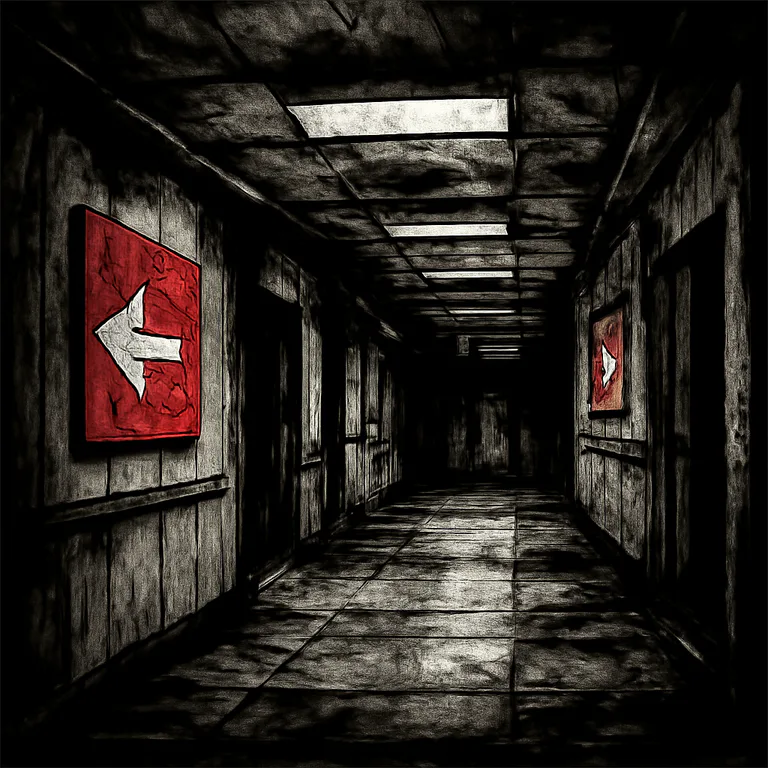
Vestibule of Repeating Light
A morning custodian discovers the building's in-between places refuse to let him leave, and the rules of transit start to repeat around him.
Playback controls appear in the player when you start.
Behind the story
A morning custodian discovers the building's in-between places refuse to let him leave, and the rules of transit start to repeat around him.
A morning custodian discovers the building's in-between places refuse to let him leave, and the rules of transit start to repeat around him. There was a strip of sunlight on the marble that behaved like a doorway. A pale arrow of light pointed at it and kept pointing as if it expected me to step through. I was on the first round. I push a cart with a dented bucket, a stack of paper towels, and a radio that always stuck on one station. The building belongs to commute hours and dead air. It was built to funnel people from door to desk, platform to platform, room to room. That is its design. It also knows the most efficient way
Explore more Liminal spacesFull transcriptExpand to read the complete story
Every paragraph of the narration, formatted for reading.
There was a strip of sunlight on the marble that behaved like a doorway. A pale arrow of light pointed at it and kept pointing as if it expected me to step through.
I was on the first round. I push a cart with a dented bucket, a stack of paper towels, and a radio that always stuck on one station. The building belongs to commute hours and dead air. It was built to funnel people from door to desk, platform to platform, room to room. That is its design. It also knows the most efficient way to keep the day moving.
This morning it wanted me to follow the light.
The projection system is old and decorative. It throws wayfinding arrows onto floors and walls before the lights come on. They help people who are still bleary eyed. They are supposed to turn off. They never did for me.
I stepped across the strip and the air felt colder on the other side. The carpet swallowed the sound of my shoes. There were signs above the doors telling me which way to the loading dock, to the staff entrance, to the stairwell. They all pointed away from the door I had just come through.
I follow staff rituals. I make the rounds in the same order. I pass empty waiting rooms where chairs face the wrong wall. I pass vending machines set to show their nightly test screens. I pass a stairwell and check the clipboard nailed to the frame. The opener's initials are written in the same loop every morning.
Today the initials were new.
I took the stairwell because it was part of the sequence. The stairs smell of wet rubber and sour paint. Halfway down I noticed the handrail was warmer than the banister above. The stairwell led back up.
I said the words aloud because they sounded the same as they looked. The stairwell led back up. I had started down to the basement fridge and found myself stepping into the second floor corridor.
People talk about buildings that have good bones. This one had bones that liked to shift. You get used to weird doors and broken locks. You do not get used to corridors that fold over you so a room repeats its own pattern.
I found the conference room I clean every morning. The carpet squares had a tea stain from last Tuesday and a scuff near the third chair. I recognized the scuff before I could process it. The room looked right in its wrongness. But then I turned and the carpet pattern was rendered twice.
At first I thought I was seeing double from fatigue. Then I saw the seam. The same dang stain at the same angle. The scuff on the same tile. The fluorescent light hummed the same note twice as if two bulbs had learned to breathe together. I checked the clock on the wall. Two second hands overlapped for a beat and then slid apart.
I left with the cart slower. My shoes made that soft, embarrassed sound carpet makes when it notices a footprint it does not recognize. I passed the vending machine twice. The second time it had a paper cup on top with steam curling out like someone had left mid-sip.
I checked the hallway map because I was a creature of maps. It told me where the restrooms were and where the back stairs led. Its legend showed a neat rectangle for the lobby and an L shaped arrow for the corridor by the mailroom. The legend did not include the place I had just left. The physical wall opposite the map had a maintenance hatch that was bolted shut. The key tag for it was looped through a ring on my cart.
I do not carry spare keys. The ring should not be there. I clipped the ring to my belt because things like that have a way of being useful. When I stepped into the next slice of hallway the air tasted like someone had lit a match and then decided not to strike it.
The arrows on the floor were supposed to help people. They were soft projections from the ceiling. They were polite. They never shouted. Then the arrows bent.
They curved around me. They formed a circle when I walked past the atrium. I stood in the center of them and watched the light point at my shoes. There was a small text overlay I could barely read, flickering like a bad subtitle. The letters were not meant to be read by human eyes. They were schematic ticks for a system humming in the ceiling.
Later I would find the log. For now I could only say what I saw. The augmented arrows looped.
I laughed once. It came out as more of a cough. If you are a morning worker you learn not to make jokes about the building. Buildings will answer in the currency they know. They will rearrange things.
I walked. The corridor lengthened like a held breath. Doors I had never seen before opened into service rooms that smelled like print toner and lemon oil. A playlist I did not recognize played over speakers that belonged to the fire alarm. The janitor's closet held an extra mop with new twine. The restroom tiles mapped out a pattern I could not place until I saw it mirrored across the hall.
I passed a woman sitting on a bench. She wore a uniform jacket like mine and her hands kept busy folding a paper schedule. Her hair was tidy in the way people keep it when they think no one is watching. She looked up at me with an expression that was all shape and no person. She mouthed three words.
Follow the light.
I tried the front doors. They swiped open to the street and then closed on nothing. The street in the glass was the same strip of sidewalk I had seen from the lobby, but the sky there was less bright. A lunchbox sat abandoned by the curb. I could see my own reflection walking toward the doors in the glass. When I reached forward to push them open properly the reflection pushed through me and did not look back.
I went back inside. I tried the back exit. It opened on a staircase that came down and wrapped around and brought me right where I had started, beside the atrium with the strip of sunlight that behaved like a doorway. The stairwell led back up. I said it again, and this time the words did something in the rafters. A projector blinked.
I have keys, and I have a supervisor's phone number. I also have a tolerance for nonsense that comes with early shifts. I dialed. Someone on the other end asked if I was okay. I said I was a little lost. They asked where I was. I described the atrium and the marble and the strip of light. They said there was no atrium in the building. They said the place I described was an annex that had been decommissioned for years.
Their voice sounded like a recording. The call held, waiting for me to give it a place to land.
I found the service panel in a utility closet behind the loading bay. It was the size of a small television and covered in stickers warning you not to look into the lens. Panels always have stickers like that. Someone thought warnings would help.
Inside the panel the projector feed looked like a blueprint. It had layers on layers. There were camera markers and timestamped overlays. In one corner was a line of text that repeated like a heartbeat. The text said, augmented arrows looped. Below it, a small dot pulsed slowly.
Someone had put the system in maintenance mode and left it looping. The arrows had been told to keep pointing, to keep pointing forever, to hold the traffic in a continuous orbit until error messages were cleared.
I unplugged the power. The lights in the hallway took a breath and then dimmed. The arrows winked out. A cool quiet filled the space where the light had been shouting. For a second I felt like a person who had unplugged a loud neighbor.
Then the pattern on the carpet restarted under my shoes. I watched two squares converge and lay down on top of each other, the tea stain exactly aligned, the scuff placed like an exclamation. The carpet pattern rendered twice and then again. The tiles replicated like frames of a GIF looping too fast to be a human trick.
The hallway became grainy as if someone had scaled up a tiny image to fill a billboard. Each step made the loop pulse. The seams in the ceiling began to hum.
It was not just the projection. The building wanted what it had before anyone came. It wanted the day to begin the same way it had yesterday. It wanted the same arrivals and the same exits. It wanted the ritual of being between places preserved so precisely someone had coded it to repeat.
I left the panel and the lights flared back with a staged cheerfulness. The projector screen showed a menu. It offered to restore default flow. It offered an option called Preserve Sequence. Someone had built a setting that prioritized the morning's movement. Maybe an architect had thought it would be comforting to have a day begin the same way, every day. Maybe a vendor had sold them an update called continuity.
I do not know which is worse - deliberate will or a kindness that works like glue.
I tried to open the back door again. It returned me to a corridor with a man in a reflective vest holding a tray. He looked at me like a familiar painting and told me the schedule had been moved to seven fifteen. He handed me a badge that had my name printed on it in a font I had never seen. I had worn that name for years. The letters looked new and surprised.
I refused the badge. I left it on a bench. I walked until the sun scraped me with its thin morning light. The strip of sunlight no longer felt like a doorway. It felt like a mouth.
Then I heard a radio clip on loop. A woman reading the morning announcement said the building thanked staff for their punctuality. The voice was warm and corporate and it repeated the same exact phrase three times. The bulletin board had a new post-it that said DO NOT ALTER SEQUENCE in stamped ink. It smelled faintly of gum and old printer toner.
I found another person who worked mornings in a corridor stacked with discarded folding chairs. He looked like every other early worker who had learned to hide panic behind careful routines. He told me he had tried to leave once and had walked into the same lobby four times. He said he had found a line of his own footprints on a hallway two hours after he walked them. He had followed them and found a pair of shoes waiting on a mat by the glass doors. They were his shoes.
I checked my shoes as if they might betray me. They were scuffed the same way they always are. I checked the mirrors in the corridor. My face looked like mine until it did not, and then I saw only a light that measured breath with a metronome.
We tried to break the pattern. We jammed a door open with a chair. We knocked a projector off its mount. We stuffed a sticky note over a sensor. The building patched itself quicker than we could break it. A seam would close and the arrows would route around the repair like water.
By midmorning the lobby was full of people who did not belong together. Tourists with luggage.