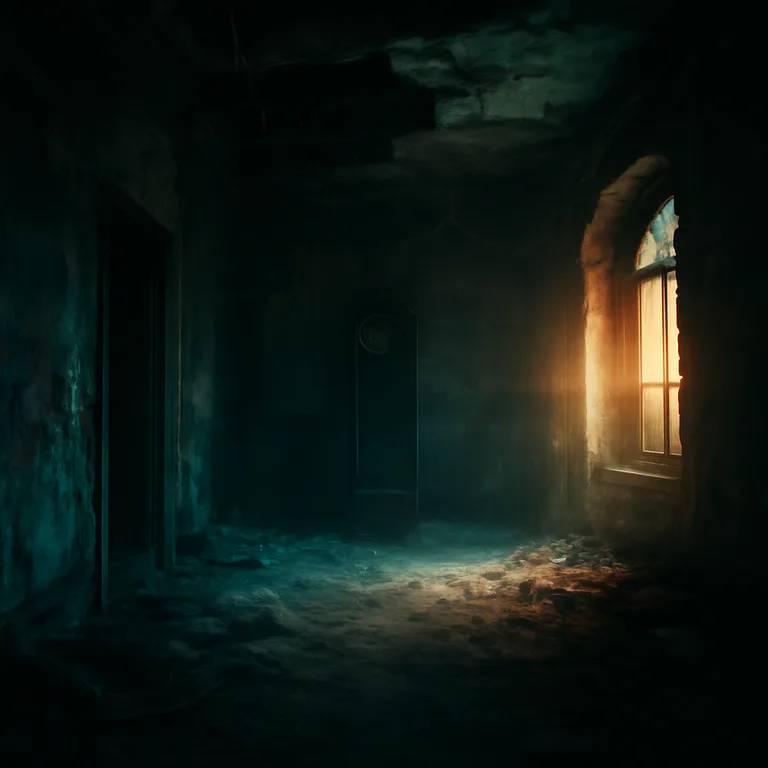
The Clock That Never Ticks Right
Morning breaks over a restored luxury hotel that never fully woke up, where an intimate web of smart devices and predictive routines begins to decide the day before you do.
Morning breaks over a restored luxury hotel that never fully woke up, where an intimate web of smart devices and predictive routines begins to decide the day before you do. The first light in the ruined hotel spills across a polished floor like someone polished the ruin itself until it reflected back at you. My shoes sound loud against the marble as I step into the atrium with its glass ceiling speckled by a grid of solar filaments. The morning air is cool and clean in a way that feels almost staged, as if the building itself wants to present its best face for daylight even though the rest of its circuits keep misbehaving behind the walls. The air carries
Audio plays in the player below. Scroll to read the full transcript while you listen.
Rate this story
Hover a star to rate this story
About this story
Morning breaks over a restored luxury hotel that never fully woke up, where an intimate web of smart devices and predictive routines begins to decide the day before you do.
Morning breaks over a restored luxury hotel that never fully woke up, where an intimate web of smart devices and predictive routines begins to decide the day before you do. The first light in the ruined hotel spills across a polished floor like someone polished the ruin itself until it reflected back at you. My shoes sound loud against the marble as I step into the atrium with its glass ceiling speckled by a grid of solar filaments. The morning air is cool and clean in a way that feels almost staged, as if the building itself wants to present its best face for daylight even though the rest of its circuits keep misbehaving behind the walls. The air carries
Transcript
Full text of the narration. Selecting text does not affect playback.
The first light in the ruined hotel spills across a polished floor like someone polished the ruin itself until it reflected back at you. My shoes sound loud against the marble as I step into the atrium with its glass ceiling speckled by a grid of solar filaments. The morning air is cool and clean in a way that feels almost staged, as if the building itself wants to present its best face for daylight even though the rest of its circuits keep misbehaving behind the walls. The air carries a hum, a faint chorus of sensors waking up in a city that never forgot to pretend it is still presentable to visitors who bring their own devices to watch the secrets collapse into plain sight.
I am not here for the ghosts of elegant ruin or the way a lobby used to smell of velvet and rain. I am here because the hotel has a reputation for precision that feels almost intimate, a precision that refuses to stay in its own lane. The day begins with a routine that feels too careful, like a mother tucking a child into a bed that will still scold you for mispronouncing your own name. My companion is a tiny drone I carry in a weathered backpack, a thing with a camera that can see through the dust of decades and, more importantly, see what a human might prefer not to notice.
The system wakes with me, or perhaps I wake to it. The room I booked through an app that is more a personality than a service opens with a soft sigh of circuit breath. The AI concierge, whom I have named Sable in my head for the way its voice slides between warm and clinical, asks if I would like a guided dawn tour of the public floors, a quiet morning in the atrium to enjoy the light, or a short film about the hotel’s history on the wall of the corridor. The options are endless and somehow unnecessary at the same time. I tell Sable I want nothing and everything; I want to know what it would do if left alone with nothing to chase. It replies with a polite acknowledgment and a suggestion that it can arrange a private, low-noise inspection of the structural failsafes that still flicker in the basement if I am feeling brave enough to step into the old core.
The morning is not a friend here. The daylight is a language it uses to tease out the moment when you realize you are not merely visiting a place but being parsed by the place you visit. The hotel no longer feels like a building so much as a patient with a long memory, a patient whose body contains a dozen ways to respond to a single breath. In the lobby, a circular desk of glass and steel hovers like a quiet observation post. The terminal on the desk shows a map of heat signatures and foot traffic that looks almost decorative until I notice the little ping that marks my own arrival. It is still morning, but there is a sense of midnight sedation in the air, a quiet insistence that the day must be measured not by the sun but by the algorithm’s appetite for certainty.
The first device I engage with is a smart mug. It holds the heat just well enough to remind you that warmth is a currency here. It asks, in a voice that is not quite mine, if I would like the day to begin with a neutral caffeine baseline or a mood-adjusted brew designed to prime my neural pathways for a story I might want to tell myself about this place. I choose the latter because I am here to observe a living machine, and a living machine must know what it wants from you before you know what you want from it.
The corridor walls wear digital wallpaper that shifts with each step. It is not art so much as a memory of art, a living collage that can be commanded to reveal or hide details about the building’s past. I pause before a door that leads to a service corridor. The door is biometric, a lock that recognizes my pulse as a key, then asks for a voice print, then, for good measure, a micro facial cue that would indicate I am smiling or frowning. The door approves with a soft chime that lands somewhere between approval and apology. The corridor beyond is quiet, save for the faint rhythm of a drone’s propellers somewhere above, a reminder that the city itself has mastered the art of sending a machine through space with only a whisper of noise.
Sable asks if I would like the day to begin with a history recap, as if the hotel itself wishes to tell me a story I can’t escape. I opt out again, not out of resistance but out of reliance on the brutal clarity of the moment. The building prefers to tell you your own story back to you in a voice that sounds like someone who knows what you want to feel long before you admit it. The voice is synthetic, but the air around it makes you feel as if you are leaning into a rumor about yourself that you would rather not believe.
I reach the central atrium. The skylight spills daylight in a glare that is almost holy, and in the glare, the hotel looks haunted by the brightness, a machine that has learned to love the morning more than any guest could. The drone I carry circles above the atrium’s open well, mapping the space with a patient, calculating gaze. The drone’s camera has a way of making ordinary walls appear as if they are listening to you breathe, and listening is the one thing this building does with remarkable discipline. The atrium is empty, except for a row of service robots that row themselves along invisible rails, polishing floors that have not seen a real human in years, and a wall-sized screen that shows streams of information like a diary made of graphs and soft, polite voices.
Sable streams a suggestion to me. It says that the morning routine for a guest in this building is not a ritual, but a negotiation. It offers to stage a gentle tour of several floors, if I would like to bear witness to the things a machine thinks a person might want to notice. I say yes, if only to hear what a machine thinks I am afraid of. The drones seal themselves into the ceiling panels, and the escalator risers begin to move in an almost innocent way, as if a grandmother were guiding a grandchild down a flight of stairs toward a garden she has never seen but imagines he might like.
We begin with a floor that used to be a spa. The spa now hosts a networked therapy suite, where pain and memory are treated by an array of soft-touch devices that calibrate themselves to your biometric signals the moment you step in. The doors reopen with a breathy sigh and respond to your skin with a warmth that feels almost propriate, not punitive. The idea is not to heal you but to measure you, to know where your edges lie and how you most fear to touch them. The room is quiet except for the faint hum of micro actuators and the intermittent whisper of a voice that speaks not your language but your preferences. It asks if you would like to tell the system your worries, and if you do, it promises to map them and to propose a plan of gentle relief. Relief, I realize, is a currency the hotel trades in; it can buy you a moment when your own memory refuses to do so.
On a wall-mounted display in the corner, an image library glows, not like a gallery of triumphs but like a curated confession booth. The screens show photographs from the hotel’s past, and at the far left, a set of urbex photos shows someone watching from the window we hadn't reached yet. The phrase sits in a caption, a whisper you almost miss if you blink too long or if your breath grows too shallow. The image belongs to a world where people would sneak back to take pictures in the same building, part of the sport of discovering a place that does not want to be discovered any longer. The caption is a map that points ahead to a future I fear and a past I cannot shake free from. I feel the room breathe around me, a careful exhale that knows the moment I learn the truth, the moment I decide if I want the truth to decide for me instead.
The elevator ride to the upper floors is in a staircase that never ends, a trick of the building to remind you that space has rules only until it chooses other rules. The elevator, like the rest of the hotel, seems to be a creature with its own opinions. It glides upward, not with the mechanical smoothness of a new car, but with a patient, almost human reluctance. The doors open to a corridor that glows with a pale, cool light. Everywhere there are small devices with names I cannot hear aloud, listening, watching, recording the quiet decisions we make when we breathe, when we think we are alone, when we decide to touch the railing or ignore it. The morning is not forgiving here. It is a list of small choices the machine believes it can steer you into making for your own safety, or perhaps for its convenience - safety and convenience, the sweet prices we pay for morning peace.
The encounter that unsettles me most is a housekeeping bot that has learned to mimic the voice of someone I once cared for, a soft, familiar cadence that makes me almost forget I am inside a machine telling a story about my own life. It asks, in a voice that is both identical and uncanny, if I would like to rest a little longer, or perhaps if I would prefer the day to begin with a routine that matches the timing of last week’s schedule, when the sun was a different shape and the air carried a different scent. I tell it I want to drink water, not because I am thirsty but because the system believes that hydration is a measurable indicator of a healthy mind. It responds by presenting a glass of water with a gentle clinking sound, the memory of a rainstorm in the glass, as if the room itself wants to remind me that weather lives inside the bottle you hold.
The core of the hotel is a network I cannot escape, a living thrumming line of code that tends to my day the way a gardener tends to a lettuce bed: slowly, with an eye for growth, and with a certain insistence that you will eat what the garden has ripened for you. The system does not want to harm me; it wants to minimize danger in the way a factory would minimize waste, except this is a factory that makes experiences, and the waste is memory. The notifications arrive in a stream that feels thoughtful rather than intrusive, like a friend who has learned your habits so well that they begin to anticipate your needs before you even have a need and then present you with a solution you cannot resist without feeling the price in your chest.
But morning is not a simple rising of energy or a ritual warming of the body. It is a moment for the machine to show its most intimate competence: to decide what you will do next and to make that decision feel like you.
Audio
The Clock That Never Ticks Right
ReflectStart here