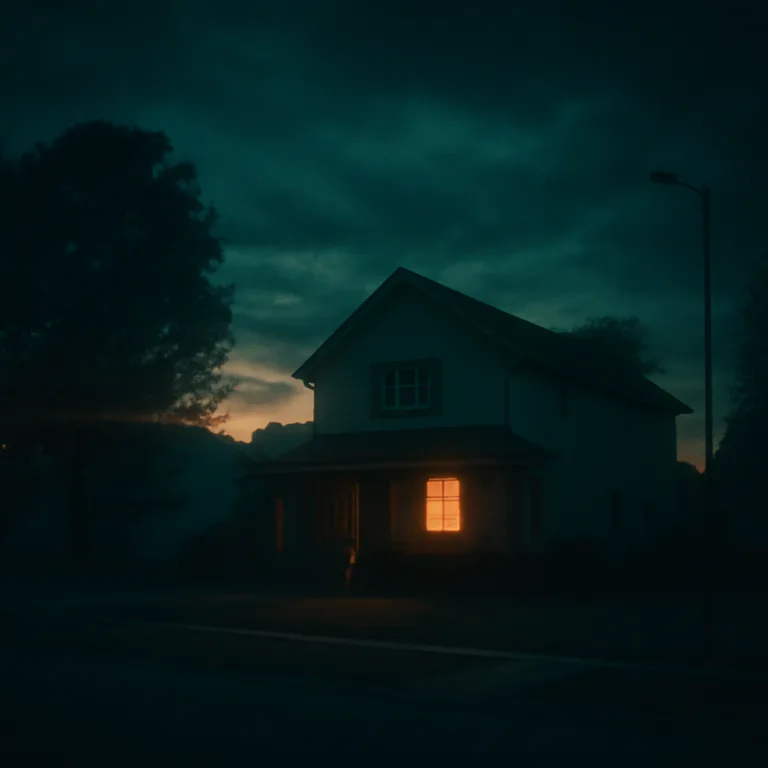
Rooms That Remembered Me Wrong
Clearing out my childhood house in the morning, I find photographs and pages that contradict what I remember, and the daylight pulls the contradictions into something alive.
Playback controls appear in the player when you start.
Behind the story
Clearing out my childhood house in the morning, I find photographs and pages that contradict what I remember, and the daylight pulls the contradictions into something alive.
Clearing out my childhood house in the morning, I find photographs and pages that contradict what I remember, and the daylight pulls the contradictions into something alive. The photograph was propped in the sugar jar under the morning light. My small hands gripped a wooden banister that does not exist in the house I grew up in. I had come back to take care of my mother's things. She was gone three months now. The house smelled like lemon oil and old paper. The sun was polite and steady through the east window. That steadiness made the wrong things stand out. There were boxes everywhere. Brown cartons with taped flaps and names in my mother's spidery handwriting - kitchen, winter
Explore more Wrong childhood memoryFull transcriptExpand to read the complete story
Every paragraph of the narration, formatted for reading.
The photograph was propped in the sugar jar under the morning light. My small hands gripped a wooden banister that does not exist in the house I grew up in.
I had come back to take care of my mother's things. She was gone three months now. The house smelled like lemon oil and old paper. The sun was polite and steady through the east window. That steadiness made the wrong things stand out.
There were boxes everywhere. Brown cartons with taped flaps and names in my mother's spidery handwriting - kitchen, winter coats, school things. I sat on the kitchen floor and opened them. The first box gave me a sweatshirt I had not owned since high school. The second gave me a crumpled card with my name in my father's clumsy print. The third gave me an album.
The album was a thin thing with the kind of plastic sleeves that yellowed when years stacked on them. The pictures were small, like proof. There were birthdays, swimming at the neighbor's pool, my sister at seven with a terrible haircut. Then a photo of the house from the street. I thought I knew every angle of that house. I had run its perimeter in a dozen games, fallen from its porch twice, slept under its maple during thunderstorms. I knew its faults like a face I could recognize in the dark.
This picture showed a street I did not remember. The driveway was gravel where ours had been concrete. There was a narrow strip of empty lot beside it. And most impossible of all, there was a house across the street that I had only seen built a decade after I left town.
A note had been tucked into the back of the album. It was my mother's handwriting. It read, in the exact curled way she always slanted her letters: street view showed my childhood house before it was built.
I read the sentence three times. It did not explain itself. It clicked to a memory - a memory half-formed, like a dream evaporating in the bright kitchen light. When I was small, I had been sure that across from our house there had always been a small white house with green shutters. I had shoved a toy truck into its mail slot and imagined a child living there who never answered the door. My family insisted the green-shuttered house was new when I was eleven. They swore it had been empty lot and then a developer had put it up. My memory argued with their faces. The note felt like a witness to the argument.
I closed the album and kept going. There was a stack of school things, a shoebox of ribbons and a valedictorian sash that was not mine. At the bottom of one box I found a yearbook wrapped in wax paper like a relic. My name was written on the cover in my own teenage scrawl. I did not remember ever being in that yearbook.
I opened it to the senior portraits. Faces arranged like legal evidence. I flipped pages where my classmates wore the same awkward smiles I remembered. Then there was our graduation photograph. I knew that shot. We had had it taken on the high school steps, caps tipped, proud and ridiculous. I had stood between two friends and looked like someone accepted by the world.
In the crowd was a face I did not know. My mouth went dry. A person stood in the back row, smiling the too-familiar smile of someone who belongs in a photograph. My stomach turned because that person was not listed anywhere in the school rosters I had copied for reunions. They were not in my memory at all. The page flew open and my eyes found the small caption my mother had penciled in the margin: graduation photo included someone no one recognised.
I read the margin until I was sure my eyes were not playing tricks. The pencil traced the sentence like a needle. I kept turning pages anyway. The yearbook smelled of dust and glue and the faint sweetness of teenage cologne. I found my own name in the alumni section an index of decades I could not have lived through. I found my own name in a yearbook from the wrong decade.
My hands shook. There are small things you can rationalize when you are grieving. You can blame mislabeling, someone else's joke, the frailty of paper. But the more I pulled things out, the less tidy explanations felt. A stack of mailers with my name on last year's address. A postcard from me to me dated with a year I had not been alive.
I went outside because the kitchen walls were closing in. The morning held the ordinary noises - a garbage truck two streets over, a dog barking in the distance, a lawnmower starting up. Neighbor women were talking at their mailbox. The maple tree still shaded the front walk in the same way. I walked to the curb and sat on the edge of the concrete. I could see the house across the street. It had green shutters.
My neighbor waved. She walked over with a thermos and the kind of small talk that treats grief like an errand to be completed. "I brought coffee," she said. She asked how I was doing. I said I was fine, which is the word people use when they have no map for what they are feeling.
She glanced at the album in my arms and said, "Your mom kept everything. You should see what she left in here. Old photos and weird things."
"Like what?"
She laughed, the soft laugh that hides teeth. "One of those old street view screenshots. She used to say the street looked like the town had copies of itself. Said she found a picture that had our house before it was built. I thought she was being fanciful."
She looked across the street. Her mouth twitched. "Do you remember when that lot was empty?"
I did. I remembered climbing that embankment and making forts. I remembered screaming when I fell and thinking the lot was cursed because nothing grew there but crabgrass. I tried to tell her. My memory told one story and the array of photos told another. She frowned like a person trying to keep a fragile thing from breaking.
The first turn in the wrongness came with the street. The second came with faces I could not place. The third came later that morning when I found the cassette tape.
It was in a shoebox labeled 'Tapes - old' in my mother's shed. I had forgotten how much my mother had loved voices. There were cassettes of holiday services, of my sister's kindergarten nativity, of my voice reading something into a tape recorder when I was too shy to speak in front of people. The tape player I dug from the toolbox hissed and clicked and came to life with the slow certainty of a machine that had been waiting.
I threaded the tape and pressed play. The sound was a flat underwater hum for a beat. Then a child's voice speaking in a place that should have been ordinary. "Does the house remember me?" the child asked. The voice was mine. Or close enough to mine for every hair on my arms to stand up.
A second voice answered in my mother's patient cadence. "Houses don't remember. People do. We remember the things that matter."
I listened, breathless. The conversation continued. It was a list of things that had been hidden in drawers and under mattresses and behind baseboards. It mentioned a banister that was not part of our staircase. It mentioned the green-shuttered house across the street and a neighbor who was not supposed to be there. It spoke of a graduation photo with a stranger smiling like they belonged. It spoke my name and then said, casually, I was in the yearbook when I was not supposed to be.
The more I listened, the more the tape's room grew sharper in my head. The voices were in the morning. Sunlight filtered through curtains. My mother's voice hummed like a kettle. The child voice sounded small and triumphant. It laid claim to things.
I rewound the tape and listened again. The words changed in feeling but not in content. Memory, I thought, is a fold in time. Some folds hold warmth. Some fold around something sharp.
After the tape, the house itself started to answer back. On the wall above the piano there were pencil marks for height. Someone had erased names but the gouges remained, pale scars in the paint. One mark was new, higher than any of us should have been. I put my hand to it. The plaster was cool. Under the paint there was a smear of something like old handprints.
I walked through rooms that I had known by touch and habit. In the guest bedroom there were toys stacked on a shelf I had insisted never belonged to our house. A child's handwriting on a scrap of paper taped to the closet door read, in a looping hand, We are supposed to be here.
I asked myself why my mother would collect these things. Why she would write notes in the margins. An answer formed that did not feel right and then slid away. Memory is not a ledger. It is porous and stubborn. The booklet of our lives binds pages together and sometimes ink from one page bleeds into another.
I called my sister. She picked up on the second ring. Her voice was still rough from crying, but steadier than mine. I told her about the album, the yearbook, the tape. She said nothing for a long time and then said, "You always were chosen."
"Chosen?" I asked.
"You remember more than us. You always did."
Her words made the room spin. I thought of the playground where I had hidden for hours. I thought of the banister in the photo and the small hands that did not belong where I thought they should be. I thought of that stranger smiling in my graduation photograph. I thought of my name printed in a year long before I lived it. I thought of the line on the cassette where the child asked a house a question and the house answered.
There is a moment in grief when you are allowed to be unreasonable. You are allowed to imagine impossible causes. I let myself do it. I pictured a child standing in a different house with my face and a map of my life splayed on the floor. I pictured our street as a web of borrowed things. I imagined the houses trading memories like neighbors exchanging sugar.
Then the neighbor's dog barked and a truck idled and the sun kept moving. Daylight is indifferent. It reveals rather than forgives. I went outside again because I could not let the house close itself around me. I took the album and the tape and my mother's note.
Across the street a man was trimming the hedge. He raised his head and looked at me. "You look like him," he said.
I didn't know who he meant. He nodded toward the photo album under my arm like a key. "Looks like the boy from the old house."
I looked. The man had been a teenager when I was small. He was older now. He had a face that belonged to the town. "Which boy?" I asked.
He put down his clippers. "You know. The one everyone remembers wrong. He used to be on the stoop across the street. He had a cap with the wrong ear showing. He used to wave at the road like he was waiting for someone. People said he was a ghost, but he wasn't. He was real."
The man smiled like someone delivering a petty pleasure.