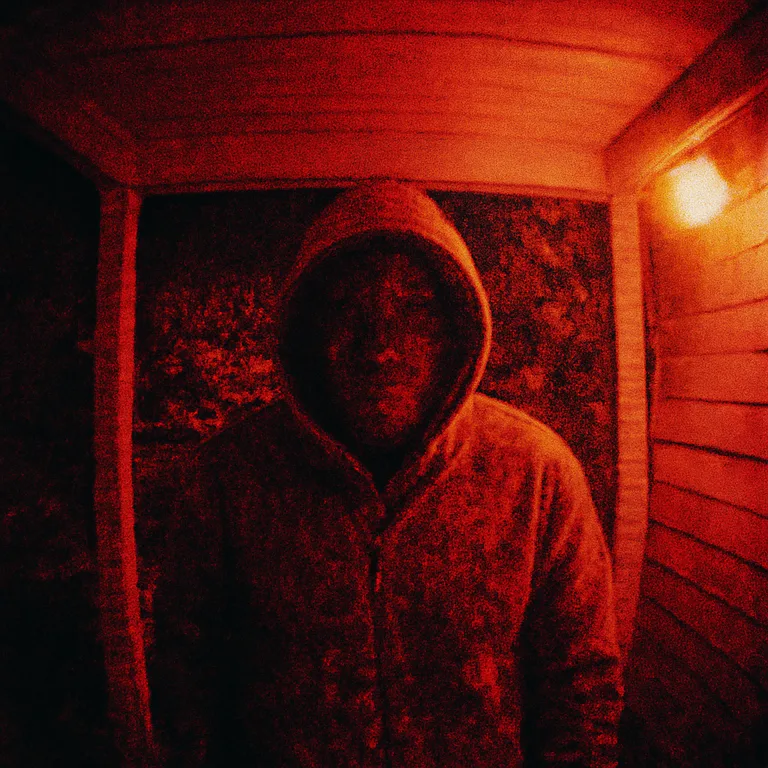
Porchlight Evidence
A morning's collection of household footage is archived as evidence and reveals a patient, daylight watcher not seen until you look behind the camera.
Playback controls appear in the player when you start.
Behind the story
A morning's collection of household footage is archived as evidence and reveals a patient, daylight watcher not seen until you look behind the camera.
A morning's collection of household footage is archived as evidence and reveals a patient, daylight watcher not seen until you look behind the camera. The first frame is a green sneaker on its side. Sun stripes lay across it like tired bars. The camera sits low on a hall table and everything reads as ordinary morning light. That sneaker is where the tape latches me. I watch it, because the owner is gone. I watch it because these clips arrived as part of an exhibit labeled EVIDENCE - Case 74-B. I watch it because someone else thought a shoe mattered. The files come in three folders. Interior living. Neighbor doorbell. Handheld. Whoever packed this left notes. Whoever packed this used
Explore more Found footageFull transcriptExpand to read the complete story
Every paragraph of the narration, formatted for reading.
The first frame is a green sneaker on its side. Sun stripes lay across it like tired bars. The camera sits low on a hall table and everything reads as ordinary morning light.
That sneaker is where the tape latches me. I watch it, because the owner is gone. I watch it because these clips arrived as part of an exhibit labeled EVIDENCE - Case 74-B. I watch it because someone else thought a shoe mattered.
The files come in three folders. Interior living. Neighbor doorbell. Handheld. Whoever packed this left notes. Whoever packed this used the words corrupted doorbell clip right on the label. Whoever packed this expected me to notice corruption.
The interior camera is static. It frames a small kitchen and a table with a cup ring. The sun moves across the linoleum in thin bright bands. A woman comes into frame, hair in a towel. She wipes the table without looking at the camera. She hums a tune into her phone. Her motions are precise like a recorded routine.
She prepares a bowl of cereal and does not eat it. She carries it to the sink, pours it into the basin, and then turns on the faucet. Water runs over cereal until the milk fades to gray. She rinses the bowl and leaves it upside down. None of this makes sense to the woman watching that footage later. None of this makes sense until the second tape.
The neighbor doorbell clip is labeled with a date but it goes wrong a minute in. The time code skips. A frame sags and turns to snow. Then nothing. The footage resumes with a missing timestamp for a chunk the size of a breath. The audio keeps going though. Grainy, distant, the sound of a truck. A child's laugh. A radio playing a station that does not belong to this block.
This corrupted doorbell clip is a clean example of loss. It proves that we are dealing with gaps. It proves that photographic truth is fragile. It is also where I find the first real oddity.
When the doorbell feed picks back up the porch looks the same. A mat, a potted geranium. Morning light again. A shadow crosses the frame at the speed of a slow wind. A hand appears at the edge and leaves. Nothing else. The camera's sensor catches a fingertip pressing the edge of the bell housing and for one frame the glass over the lens fogs with breath.
The handheld footage is from a phone. The owner is a man named Marcus in the file notes. Marcus walks the block to collect a package. He talks to the camera as he goes. He narrates peeling labels and counting steps. His voice is casual. It mixes with distant birds. The sun is loud in the shot. Marcus passes the house with the green sneaker and does not notice anything. He looks straight through the window and remarks that Mrs. Halley left the cereal bowl in the sink again. He shrugs and keeps walking.
Here is the first turn. The wrongness begins small and familial. A routine unsettled. The woman's clothes are draped wrong on their hooks. The clock on the wall reads 7:52 when the radio says 8:03. A newspaper is folded to Page Three instead of sports. These are errors that a living eye could miss. They are errors that the camera keeps, patient and impartial. They are errors you feel in your teeth.
The second turn arrives in motion. In the interior camera the woman moves and her shadow doesn't. She steps toward the sink and the shadow lingers at the doorway like a witness. The shadow looks at the window. It does not follow her hand to the faucet. It is several seconds behind and then, in a sliver of footage that looks like a mistake, the shadow turns toward the lens and looks like it is waiting.
On the handheld Marcus pauses mid-step. He stumbles as if the world has tilted. The phone still records but the angle slides by a centimeter and holds. For the length of a breath someone in the street lifts a hand and points at the house. The camera cannot see their face. Their finger is long and pale in the sunlight. Marcus says, hey, and keeps walking.
The neighbor doorbell clip shows something that the others do not. For one second, the lens reflects another scene. You have to pause and magnify to see it. The reflection is an interior across the street that does not match any view we have. There is wallpaper with pale flowers and a small framed photo of a child. A clock reads the wrong hour. A kettle whistles though the audio is quiet. The reflection carries a person standing in the doorway. They press their forehead to the glass and do not move.
It takes me three rewinds to understand that the person is not in the frame. They stand behind the glass of the door on the other side of the street and yet the reflection shows them inside. The camera records light and cannot argue with it.
The files contain a written note from the scene investigator. It reads simple things - witnessed absence between 0726 and 0745. Entry marked: missing timestamp. Return to files when possible. There is no speculation. The note is clinical and useless and perfect.
You start to feel the third turn in your throat. Objects begin to answer one another across footage. The cereal bowl in the interior camera shows a line of dents in the rim that match a dent in the mug shown in the reflection. The green sneaker is seen in two frames at once, once completely and once backwards like a mirror. When Marcus passes the neighbor's living room window his shoulder shoulders past a chair that the interior camera never shows. The house is both full and empty at once.
I say aloud the thing I am careful not to say in print. I say: someone moved between the feeds. The recordings do not occupy the same space. They share the outline of a morning and disagree about what lived in that outline.
Listen to the audio. The woman hums for a long time. It is the same three notes repeated. At 7:34 the radio in the handheld clip plays those notes but slowed and reversed. In the corrupted doorbell clip the notes play through a filter that makes them sound underwater. The same three notes knit the three files together like a bad thread.
Now the cameras stop being passive. In the interior feed the faucet turns on by itself for a full second. The water arcs like a small comet and then shuts. The woman does not touch it. She walks to the hallway and stands, still, looking at the door. On the hallway table the sneaker sits. She lifts her hand and hovers it over the sneaker, and for a beat she breathes on the air above it like someone smelling a coin.
Marcus's handheld shows him stop and fumble for his keys. He sets the phone down on the fence rail. It records the street and the house. In the frame a figure emerges from the doorway without a sound. It walks to the table and touches the sneaker. You can see the tip of a sleeve, pale, and then the figure bends and presses something flat onto the sneaker's surface. There is a smear that catches the light. The phone keeps recording but its gyroscope glitches. When Marcus picks his phone back up the figure is gone. The smear is still visible and then it is not.
At this point the files are not simply records. They are interactions. The cameras describe a house rewriting itself in daylight. They show hands that collect small things and exchange them across screens. They show a person pressing a forehead to a glass in a reflection that claims an interior that does not exist. You begin to suspect that the film is making arrangements.
I find a frame that makes my stomach drop. It is a crop from the corrupted doorbell clip. The glass in the lens holds the face of a child. The child's nose is flattened. His eyes are open and patient. He is pressed close. The background in the reflection shows the kitchen and the green sneaker and the rings on the cup. The child is not in any interior footage. He is not in Marcus's walk-by either. But the reflection claims him with the certainty of morning sun.
The file name for that frame is 07_34_HEAD.jpg and nothing in the directory explains how a still image sits among raw video files. The investigator's note at the top of the folder is now a question. He writes: Was he visible to anyone? He writes: Was there movement at the lens? He writes: something behind the lens.
Those words are in the file. Not paraphrase. They are printed as part of a typed list and then highlighted. The phrase hits me like a cold hand. Something behind the lens. Not in front. Not recorded by the camera. Not in frame. Behind the lens.
If you have worked with cameras you know that the space behind a lens is not a place for people. The lens is glass and mechanics. Behind it are screws and the shutter and air. Behind it are tiny reflections of the room in the aperture. Cameras are devices that watch forward. They do not keep occupancy lists. They do not invite.
But here is the evidence. The corrupted doorbell clip returns to life for a final minute. The doorbell's motion sensor triggers though no one moves on the porch. The camera swivels a degree to the left with a small mechanical sigh. It captures the edge of the neighbor's curtain and then, impossibly, the face of the woman from the interior camera. She is standing not inside her house but in the middle of the street as if she has walked across a strip of daylight we do not own. She looks at the camera. She looks like someone who knows they have been seen. Her mouth opens.
The sound in the video is gone. A faint scrape lives in the track like fingernails on glass. In the interior feed the same sound is recorded live and the woman clutches at her throat. She mouths the same movement as the exterior woman, and without audio you can read the intent of a syllable. She mouths the name of the child in the photo from the reflection. She mouths your name in the observer seat.
I rewind and freeze. The hand in the foyer, the fingertip on the bell, the child's face in the reflection. They align like a constellation. You start to imagine corridors behind glass, rooms mirrored out of phase, people who have learned to stand in the tiny negative spaces of cameras because cameras are honest in ways people are not. You imagine something patient enough to study aperture curves and sunrise schedules. You imagine something that moves by the margin of recording.
The case notes end with a procedural detail. The investigator writes that at 0758 the family home was found empty except for an overturned chair and a single cup still warm. On the table the green sneaker remained where it had been. The neighbor reported seeing no one leave. The doorbell housing was cold. The interior camera was found still recording with a dead battery.
There is a final file. It is a one-second grab from the interior camera taken at 0801. It is badly compressed and the time stamp is smeared. The woman is back in frame. She sits at the table and folds her hands. The camera is positioned lower than before. The shot is tighter. On the table beside the morning cup is the green sneaker.