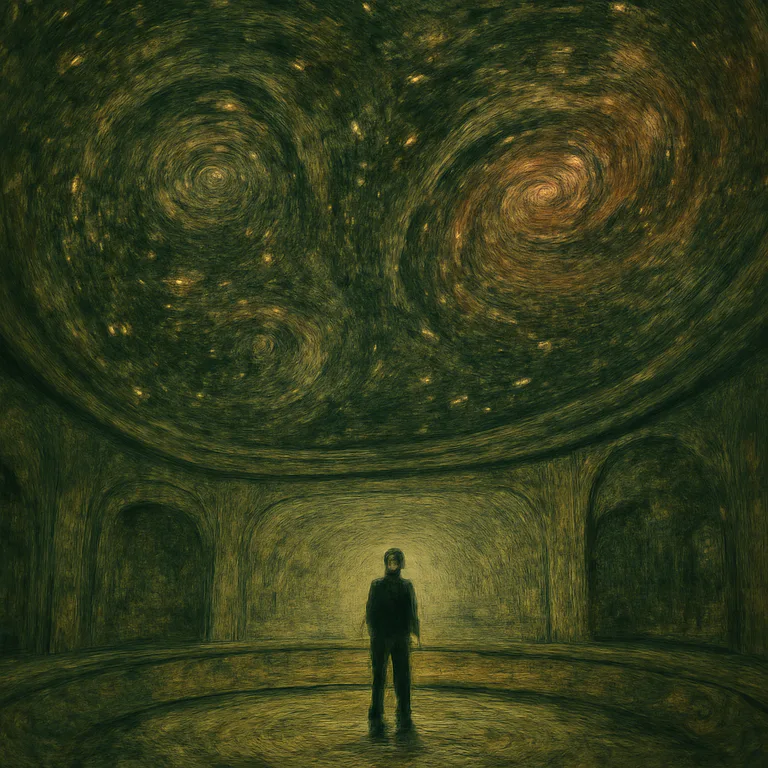
Map of the Wrong Morning
A coastal village wakes to small wrongnesses that become a pattern, and an old book shows how the sea and the sky take measure of us.
Playback controls appear in the player when you start.
Behind the story
A coastal village wakes to small wrongnesses that become a pattern, and an old book shows how the sea and the sky take measure of us.
A coastal village wakes to small wrongnesses that become a pattern, and an old book shows how the sea and the sky take measure of us. They told me sunrise came from the north before the baker handed me bread. His hands trembled like someone who had learned how to hold a thing that does not belong to him. Light poured over the roofs from a place none of our maps named. It washed the chimneys and threw shadows the wrong way down the lane. I fumbled with the porch key and my shadow went inland. The town clock kept its face. The hands moved. People dressed. Children walked to school with their faces lit as if by a stranger.
Explore more Cosmic horrorFull transcriptExpand to read the complete story
Every paragraph of the narration, formatted for reading.
They told me sunrise came from the north before the baker handed me bread. His hands trembled like someone who had learned how to hold a thing that does not belong to him.
Light poured over the roofs from a place none of our maps named. It washed the chimneys and threw shadows the wrong way down the lane. I fumbled with the porch key and my shadow went inland.
The town clock kept its face. The hands moved. People dressed. Children walked to school with their faces lit as if by a stranger. We behaved like the world had only traded one small habit. We thought habits could be traded back.
It began with remarks at the market. The fisherman swore the sea tasted of iron. The postman complained his route smelled of old paper and far hills. An old woman in the square showed me a scrap of ledger she had found in her attic. She pushed it toward me on both palms, as if it might still sting.
The ledger was water-marked and thin as a mussel. In a margin someone had written, in a careful hand I could not place, the words prediction model named the stars.
Not a sentence. A label. A thing that fit like a key with no lock. The letters had the dust of other nights in them. The old woman said it was a sailors' joke. The fisherman crossed himself. The postman did not laugh.
That afternoon the tide moved uphill.
I think of that line whenever I try to remember the first real wrongness beyond light. The sea came like a slow, polite guest. It padded the flagstones and left a film on the cobbles. It licked the base of the cliff and climbed without surge or roar. It moved up past the quay, past the shed where boys kept tackle, and into the lane as if following a path. It filled the well and refused to leave.
We watched like people watching a bad ceremony. The water did not drag, or rush, or savage. It lay itself against doors, like a fat animal leaning its head on a lap. The ferryman's boat floated past the baker's window and the baker kept kneading. People began to whisper about old rites. The ledger returned to mouths. The fisherman's wife said, You do not borrow the sea without giving something back.
That night the stars were wrong, too. They were not fewer, and not merely in the wrong place. They were active, like a flock rearranging itself to point somewhere nobody had named. I thought of the margin in the ledger. Prediction model named the stars. A phrase that felt like a riddle solved by the ocean.
We tried to make sense by daylight. We stood with buckets and thought we could scoop the sea back down the cliff. The buckets filled with the black of deep water and spilled out names in froth. I knelt and saw one clump of foam that spelled my brother's childhood nickname. It melted before I could say it.
The wrongness deepened in gestures. Shadows did not touch shoes. Dogs would not follow commands. The church bell tolled, and the sound came thin and doubled, as if two distant clocks were striking at once. Someone set a lantern on the quay and the flame burned green for a breath. A child stepped into a puddle and came up with sand in her hair though she had not crossed a dune.
I read the ledger that night by lanternlight. It was not a book of prophecy in the cheerful sense. It was a ledger of positions and weight. It listed names of harbors. Next to each harbor a set of coordinates. There were annotations in a hand like someone who had taught himself patience. The annotation read: alignment, then a list of births and burials. Beneath that line, in the same cramped script: consult prediction model named the stars.
The way the book was written implied something obscene about scales. People do not occupy places on maps the way stones do. People are variables. They are measured. Someone had used the sky to wager where bodies should sit. The margin numbers did not tally with our births. They moved as if the town were an instrument being tuned.
A man from the next parish came with a brass wire and a chant his grandmother had taught him. He stood on the quay and stroked the rope across the water like a compass. He said the ledger taught them to sing to the grid above. They sang in a language of time and high tide.
The singing did not make the sea lower. It made the waves answer. The first reply was small: gulls stood in the lane as if on poles. The second reply was the tide coming higher than any of us had memory for. The third reply was a shape in the foam that took, for one wicked second, the clearest thing I have ever seen.
It was not a face. Faces are small. This was a map of ribs or of ribs as seen from without. The foam fell away and left behind a blackness that held the outline like a stencil. I thought: the town is being read. I thought: the ledger said consult. I thought: prediction model named the stars.
Sleep did not return to us easily. My dreams tasted of compass points. I dreamed of a child with a sundial face. I dreamed of the sea clasping a church spire between two slow palms. Morning came. We stood on porches and watched the light cross the roofs from the north again. We tried to act like that answered anything.
A woman in my street opened her curtains and screamed because when the sun struck the mirror on her dresser, the mirror reflected not her face but the lane as it might be painted on the belly of a whale. The streamers of foam along the curb were spelled in tiny letters. They were not English. They were a stitched, archaic hand. When read aloud they did not name things so much as locate them.
They read my name.
People began packing small bags with bread and salt and their children's blankets. The ledger was copied in desperate hands. We tried to weigh ourselves, to change the numbers, to lie about births. The book would not be fooled. It was patient in a way that does not feel like mercy.
On the morning the ferryman's wife rowed up the lane, not down it, I stood at my door. The water had pinned the street light with a glass globe half-submerged. Inside the globe, a figure swam upright.