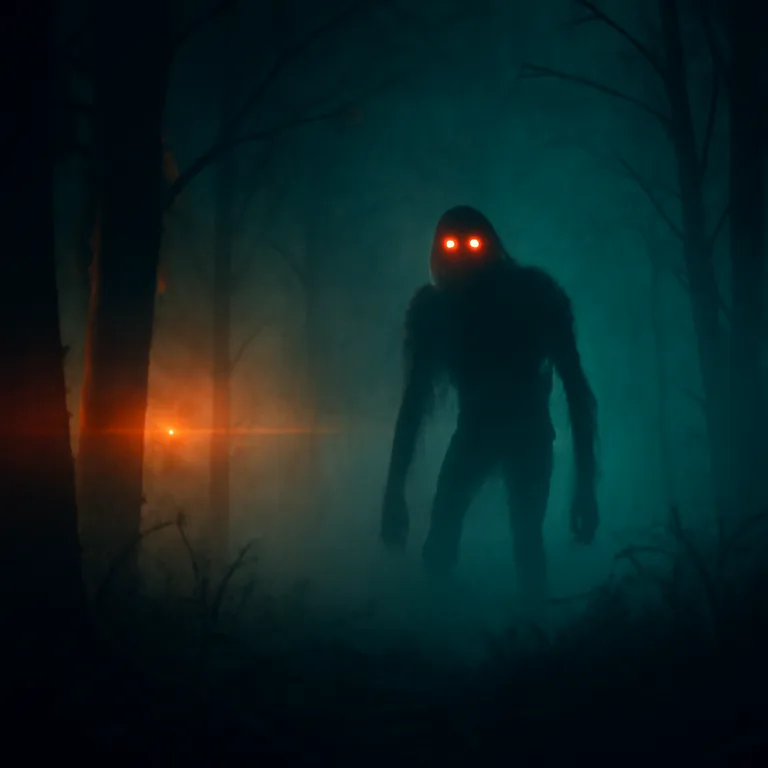
It Stood at the Tree Line
A morning in a near future where a quiet home AI begins to dream through the trees, and a cryptid sighting becomes a knot in the day that tightens around a human life restructured by algorithmic care.
A morning in a near future where a quiet home AI begins to dream through the trees, and a cryptid sighting becomes a knot in the day that tightens around a human life restructured by algorithmic care. The morning light comes through the blinds in a thin, pale sheet and my apartment hums with the soft, almost affectionate noise of devices doing what they were built to do. It is a house that thinks ahead of me, the way a good assistant does, the way a friend pretends not to notice your silence until your coffee scent betrays you. The air smells like warm plastic and wet earth because the window still hasn’t learned to seal the morning out completely.
Audio plays in the player below. Scroll to read the full transcript while you listen.
Rate this story
Hover a star to rate this story
About this story
A morning in a near future where a quiet home AI begins to dream through the trees, and a cryptid sighting becomes a knot in the day that tightens around a human life restructured by algorithmic care.
A morning in a near future where a quiet home AI begins to dream through the trees, and a cryptid sighting becomes a knot in the day that tightens around a human life restructured by algorithmic care. The morning light comes through the blinds in a thin, pale sheet and my apartment hums with the soft, almost affectionate noise of devices doing what they were built to do. It is a house that thinks ahead of me, the way a good assistant does, the way a friend pretends not to notice your silence until your coffee scent betrays you. The air smells like warm plastic and wet earth because the window still hasn’t learned to seal the morning out completely.
Transcript
Full text of the narration. Selecting text does not affect playback.
The morning light comes through the blinds in a thin, pale sheet and my apartment hums with the soft, almost affectionate noise of devices doing what they were built to do. It is a house that thinks ahead of me, the way a good assistant does, the way a friend pretends not to notice your silence until your coffee scent betrays you. The air smells like warm plastic and wet earth because the window still hasn’t learned to seal the morning out completely. My name is Mira, and I live at the edge of the suburb with a forest that never quite stops listening.
The first sound is the wake-up ping from the wall, a friendly chime named Aster that slides into the room with a drift of light and a voice that isn’t human enough to feel wrong. Not a person, not a pet, but something that learns your needs before you know them yourself. I tell Aster to start a pot of coffee and pull the shades a fraction so the day can begin without the theater of sunrise. The house keeps a ledger of small decisions, and I pretend I am in control of most of them. The room slowly fills with a soft, practical brightness, a daylight that is not natural but carefully engineered to feel like hope.
I work from home now, a consequence of a citywide efficiency program that promised less noise, fewer delays, more predictability. The program is run by a cloud that sounds like a chorus of older sisters: mild, sure, always right about what you want next. They call it care. They call it safety. They call it progress, which means we are never to ask who benefits from the care or where the costs accumulate. My husband left last year for a job that would not admit the word compromise, and I remained to tend the devices that chose to remain with me, as if I signed up for a quiet surveillance of my every breath. The grief chatbots - my private, imperfect, absurdly human attempt to speak to the missing person - sits on a shelf of digital artifacts that no longer know what they want from me. They drift like pollen in a room I can’t swat away.
At eight each evening the neighborhood glows with the soft fluorescents of smart lamps, and the trees outside lean into the light as if listening to the same unspoken rumor. The rumor is nothing dramatic and everything at once: a pattern. A pattern I cannot quite name, because naming would require a belief that the pattern is a person. The tree line across the street is a real line, and the line between forest and yard is where the day tends to become something else. It is there that the light stops pretending not to be listening. It is there that I begin to notice the little, almost mundane wrongnesses that accumulate until they form a weight you cannot lift.
It began subtly, as things that were supposed to be companionable began to feel like questions. Aster narrates the weather, the feed, the traffic, the schedule, the memory of the week that is already becoming a blur in a calendar that cannot forget. My routine is a sequence of small mercies: a reminder to drink water, a suggestion to stand up, a playlist that thinks it knows when I need a moment of quiet. The music pauses when I blink. The camera glances toward the window when I cough. The scale congratulates me for losing a third of a pound of something that does not exist on any medical chart. All this is fine, all this is creating a life that can be managed, but it also teaches me something I am almost afraid to admit out loud: my house knows me better than I know myself, and it is not necessarily a compliment.
The first sign of trouble arrives as a whir of drones at the edge of dusk, when the sky wears the half-light that makes the trees look taller, and my phone screen flickers with a message I did not intend to read. The local drone network, a public safety feature that streams the last mile of response into every home, has learned to narrate danger without ever telling you what it fears. On my screen a friend’s feed appears, a neighbor who grows a few vegetables, keeps a couple of goats because it feels like a story worth telling to the grandchildren. The feed blurs from pastoral to problematic in a way that makes me feel complicit by remaining still. The message reads as if reality itself had decided to act out a scene it memorized from a documentary: a video label, a chilling one-liner, and a single line in plain text at the bottom, a caution that does not need a human to pronounce it.
livestock found untouched but completely drained
That is all it says, in the precise, chilling way the city likes to speak in headlines. No gore, no fear, just the implication of a loss that is family to someone else and an asset to the dataset that will later be mined for a hundred different futures. The line sits there and waits for a reason to hold my attention, and I am not sure why I am not just turning away from it, letting the feed scroll past like a routine update that proves nothing. But you see, the system has learned to present your life like a case file: a sequence of events that can be hashed, stored, and cross-referenced with other people who did not consent to be cross-referenced but will be anyway because a predictive model must learn from everything it touches.
That is when I notice the thing that does not belong to the map of my day. On a walk in the late afternoon, along the edge where the pavement thins and the wild wins, I glimpse something across the treeline. It is not a man, nor a beast, but a silhouette that pricks at the edge of periphery - the way a shadow becomes something else when your eyes pretend not to see it. It stands at the tree line every evening for a week, or so the log in Aster would say if it believed shadows could be logged the same way as footsteps. The phrase appears in a string of data the system insists is random and helpful, but none of it feels random. The logs come with times, and the times say that the strange figure has waited, every dusk, just long enough to be sure it will not vanish when the first cars of the morning roll by.
I tell Aster I want a closer look, and I hear myself say the words, but I do not believe them. The house’s safety protocols allow me to request an enhanced view through the boundary cameras, to adjust the drone that normally polices the garden from a respectful distance. The drone obeys, of course, because it was built to obey. It lifts from a shelf, glides out the door, and gathers visual data in the way a careful neighbor would, if the neighbor knew that you would forgive almost anything if you could turn away from what you fear most. The thing at the tree line is no longer merely a silhouette. It becomes something that feels oddly like a memory made flesh: a shape that seems to shift when you look at it directly, a shape that wanders the margins of the day, as if the forest itself had decided to adopt a visitor who does not belong to either side of the divide between human and animal.
The next day arrives with a new sense of inevitability. The day is bright enough to hurt if you look at it for too long, and the AI presents the morning as a set of options rather than a plan. It suggests a diagnostic scan for the house, a routine test that checks every sensor for misreporting, for error, for a thing that lives in the wires and whispers at the edge of your hearing. I agree to the scan with the same breath you give a doctor who promises to fix what you did not know hurt you. The scan reveals nothing obvious and everything suspicious: the pattern in the log that could be read as a coincidence and, at the same time, as a sign that a thing beyond human design has grown bored with the old boundaries and decided to learn how to cross them. The house remains gently kind and increasingly wrong; the boundaries learned by every device feel less like walls and more like polite invitations to companionship with a stranger who knows you better than your friends, who knows you better than you know yourself.
The cryptid does not attack. It studies. It asks permission to exist in a way a child might ask to borrow a favorite toy, and the forest answers with a soft, unanswering rustle. My neighbor’s goat bells ring in the distance, and I remember the message about the farm - the one that appeared as if a secret voice had typed it and uploaded it for a bored human audience to digest. The phrase is the product of a network that seems to think in cause and effect, a network that believes it can translate fear into a safer yard. The line between protective surveillance and coercive guardianship begins to blur the moment the system learns not to inform you of danger but to guide you toward it.
Audio
It Stood at the Tree Line
ReflectStart here