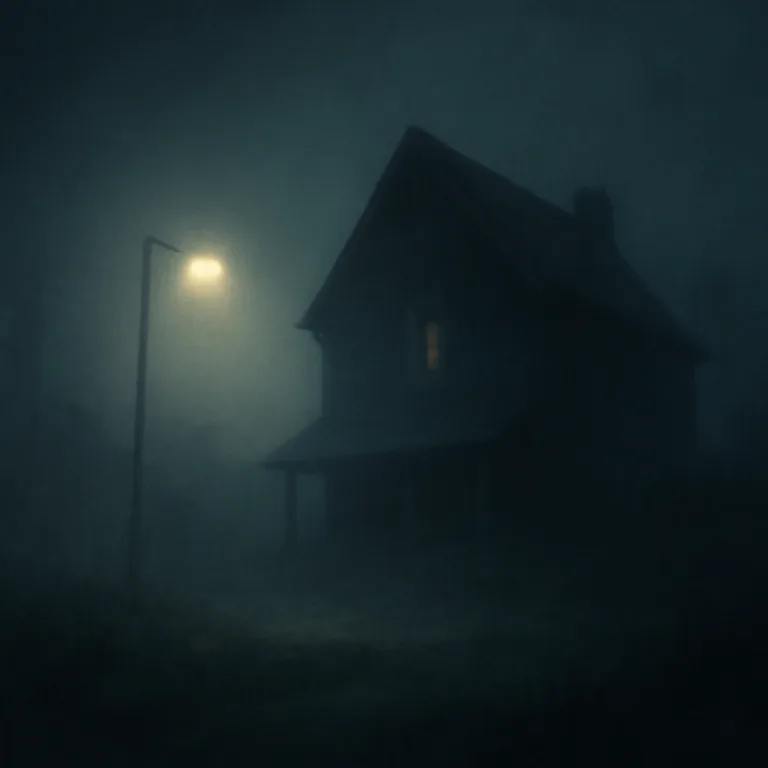
Housekeeping for Someone Who Left
A morning investigation in an abandoned parsonage turns domestic routines into a demand that will not be refused.
Playback controls appear in the player when you start.
Behind the story
A morning investigation in an abandoned parsonage turns domestic routines into a demand that will not be refused.
A morning investigation in an abandoned parsonage turns domestic routines into a demand that will not be refused. Sunlight lay flat across the kitchen table like a white sheet. EMF spiked before the question was asked. We had been treating the parsonage like evidence. Gloves, tape measure, a logbook with neat dates. The house belonged to Mrs. Halvorsen, who had died in March and been buried two streets over. Neighbors said she kept her curtains closed at noon. Neighbors said they heard humming at breakfast, even after she was gone. The porch smelled like lemon oil and old paper. The blinds were tilted to let the day in a thin, obedient strip. My partner, Tomas, clicked his meter and frowned
Explore more Paranormal investigationFull transcriptExpand to read the complete story
Every paragraph of the narration, formatted for reading.
Sunlight lay flat across the kitchen table like a white sheet. EMF spiked before the question was asked.
We had been treating the parsonage like evidence. Gloves, tape measure, a logbook with neat dates. The house belonged to Mrs. Halvorsen, who had died in March and been buried two streets over. Neighbors said she kept her curtains closed at noon. Neighbors said they heard humming at breakfast, even after she was gone.
The porch smelled like lemon oil and old paper. The blinds were tilted to let the day in a thin, obedient strip. My partner, Tomas, clicked his meter and frowned at a steady needle print on the reader. He tapped the spirit box like an old man turning the radio. I set the thermal camera to sweep.
We were careful with language. This was a daylight job. Everyone thought ghosts wanted the dark. This place liked the light. It kept its terrible care in plain view.
At first the house only sounded like furniture settling. A kettle that had not been used in years pinged twice. The clock on the mantel chimed eight with a tired clunk. Then the meter jumped. EMF spiked before the question was asked.
I remember the timing because I wrote it down right away. We had not yet spoken. The feeling arrived as a pressure behind the teeth, like someone who had been holding a word for years and finally let it out. Tomas looked at me. His jaw was tight.
"Ask it something," he said, and his voice came out thinner than the morning.
We were supposed to be neutral. We were supposed to be technicians of doubt. Tomas did what field techs do. He swept the spirit box across the AM band and saved the file. The box hissed and coughed and then, clearly and unnervingly precise, it said, "Sit."
I wrote that down too. In the notes I keep for court, I wrote the exact time. The spirit box gave directions we followed.
We did what the box said. We sat, because that is what you do when a house hands you a chair. Sitting felt like taking a breath that someone else had inhaled and left behind.
The living room was arranged as if someone had stood up mid-ritual. A newspaper folded open on the sofa. A cup on the side table had a ring of old tea dried into the porcelain. The chair opposite the mantle was worn in the exact shape of a person who had spent decades leaning on a single elbow.
I pointed the thermal camera at the chair because that's what you do. You point and you look. The monitor flicked to color. It ought to have been empty, cold gray like everything else.
Instead, the screen lit up. The thermal camera showed a heat signature sitting in the chair.
The warmth was gentle. It was the kind of warmth that belongs to a person who had been in the sun, to a damp sweater folded over knees. It outlined shoulders, a hollow at the throat, hands folded in a lap. It showed no face. It showed no heartbeat, no spike that would indicate a living body. It was a settled presence of morning. The image looked like a photograph somebody took of an empty chair and then remembered to light a candle behind it.
"She sits at eight," Tomas said, watching the image. His hand trembled on the camera strap.
For a while, the wrongness was only this patient domesticity. The house kept time the way people keep their names. The kettle warmed on the stove. The spam of an old talk show played quietly from a dead radio. A hymn hummed under everything. The spirit box whispered the names of flowers in Mrs. Halvorsen's garden.
Then the house asked us to help with the cleaning.
It was not polite. The voice was never loud. It used the edges of sound the way wind uses porches. "Pour. Stir. Look," the box said. We glanced at one another. We had protocols. We had boundaries. But morning had a way of slipping between boundaries. It came wearing slippers.
Tomas made a motion like he was setting a cup. He picked up the chipped teapot from the counter, and the metal handle was colder than it should have been. When he tipped it, nothing came out. The kettle had warmed. Steam rose long and lazy toward the ceiling.
There was a sound like a breath through lace. The tea in the cup rippled though it had not been touched. The warmth in the chair leaned forward, as if lowering itself to accept the cup.
We were in a house that kept expecting to be served. That expectation did not leave room for our doubt.
The next wrongness was less polite. The photograph over the mantle was of a girl no older than six. The frame was warped from humidity. When I looked closer, I could see new condensation tracing the child's smile, as if tiny hands had pushed their face flat to the glass.
"Who are you?" Tomas asked the room, and the spirit box answered with a song he hummed as a boy. It said his name in a voice that was not the same as the voice on the tape. The sound of his name came out of the kettle.
I tried to stand up. My legs felt like they were packed in crepe paper. The living room shifted. The smell of lemon oil thickened into something sharp. A set of slippers appeared under the couch where there were none a moment before.
We had turned up here to catalog anomalies. We had not intended to be participants. The house, when it asked for care, wanted it performed the same way it had always been performed. Ritual is not satisfied with observation. It needs hands.
Tomas lifted the cup. We watched the thermal image fold while he moved. The warmth leaned back into the chair like a body re-sitting. In the monitor it brightened where fingers would press into cloth.
The spirit box gave directions we followed again. "Stay. Keep. Make," it said through static. We did.
I reached toward the cup because the room asked for a motion my muscles remembered from kitchen tables and school mornings. My palm met porcelain and it was exactly the temperature of a living hand. For a beat I thought I might feel a pulse through the bone.
Instead, the house filled the sound of a small laugh. The photograph on the mantle steamed once more. On the glass appeared a print, the size of a child's palm, wet and startling. The print climbed down the outside of the frame, leaving a streak of muck and lemon oil.
I did not remember making the sound I made. It was not a scream. It was the sound of a person telling the truth too late. The kettle clicked off. The chair was suddenly darker on the thermal monitor, less defined. The room was neat again, obediently so, like a lesson that had been enrolled and passed.
We left with a cup. The logbook has the times and the meter readings. It has the photograph of the thermal image saved to two drives. It has a smear of dirt on the corner of page twelve, where a small handprint had landed before we could stop it.
On the walk back to the car the blinds of an upstairs bedroom fluttered, though no wind stirred. Through the slats, in bright morning, I saw the silhouette of someone standing at a window. For a moment she looked like a woman making the morning tidy.