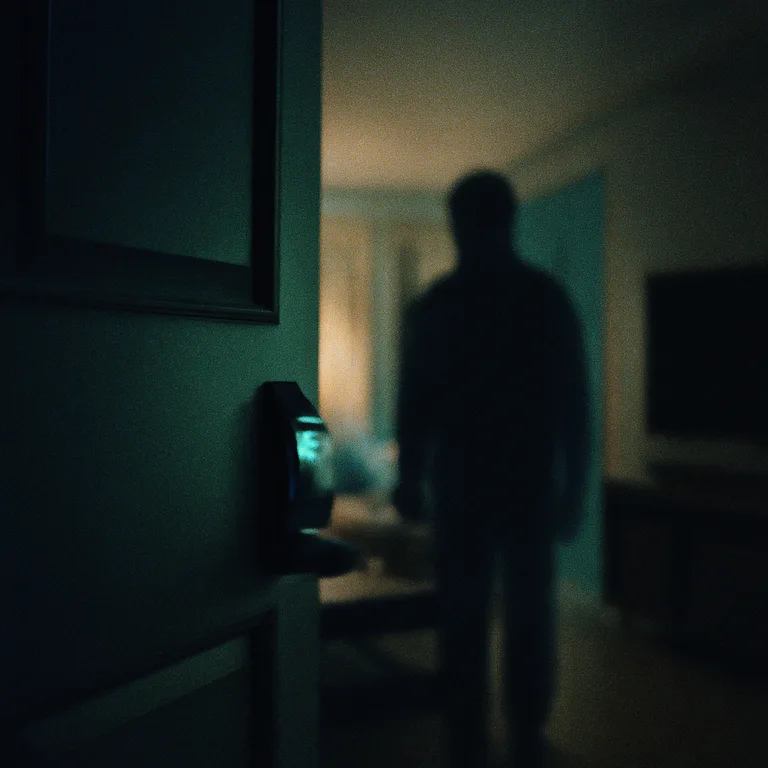
Badge Under the Nesting Camera
A quiet evening turns invasive when the house's own eyes start answering for someone else, and a stranger knows how to walk through your rooms like he has keys to your life.
Playback controls appear in the player when you start.
Behind the story
A quiet evening turns invasive when the house's own eyes start answering for someone else, and a stranger knows how to walk through your rooms like he has keys to your life.
A quiet evening turns invasive when the house's own eyes start answering for someone else, and a stranger knows how to walk through your rooms like he has keys to your life. The hallway smelled like someone else's shampoo and bleach. The door screen chimed without anyone touching it. facial recognition said welcome home. I stood three feet away and the phrase hung in the air like someone calling my name through a wall. I had not left the apartment since noon. I had not unlocked the door. The little speaker repeated the words on a slower note, as if tasting them. I first blamed the software. Updates do strange things. I blamed a glitch and I blamed exhaustion and
Explore more Stalker in the houseFull transcriptExpand to read the complete story
Every paragraph of the narration, formatted for reading.
The hallway smelled like someone else's shampoo and bleach. The door screen chimed without anyone touching it. facial recognition said welcome home.
I stood three feet away and the phrase hung in the air like someone calling my name through a wall. I had not left the apartment since noon. I had not unlocked the door. The little speaker repeated the words on a slower note, as if tasting them.
I first blamed the software. Updates do strange things. I blamed a glitch and I blamed exhaustion and I made a cup of tea to settle the teeth of panic. Then I found the slippers I keep rolled by the radiator on top of the kitchen chair. One slipper balanced inside the other like a tidy, intentional thing.
On the kitchen counter my phone vibrated with an alert from the building. Front door opened 6:12 p.m. Video attached. I watched the clip in my palm. The feed was from the hallway camera. A person moved through the frame without hurry. He walked with a careful, ordinary rhythm - coat over one shoulder, hand in his pocket. He pushed the door with the same wrist I use. He stopped inside. He looked into the camera as if into a mirror. He held something small and gleaming between two fingers. The clip froze there for a frame long enough to read the tag clipped to his jacket.
The stranger had my access badge.
My throat closed up. I replayed the video. I missed nothing this time. He clipped the badge to the inside of his coat, turned toward the corridor that leads past the mailboxes and the stairwell, and walked like he belonged. The system logged no forced entry. The door's strike plate showed nothing. The records showed a door open that matched an authorized badge swipe. The badge ID paired with my name.
I called the building manager. He left a message and then another. The software vendor sent a canned response about token reuse and anomalies. I walked the apartment, checking locks with both hands. I checked the deadbolt, the latch, the chain. Everything registered green on the home app. Motion sensors in the kitchen, living room and hallway showed no unexpected activity after 6:14 p.m.
But the spoon in the sink had teeth marks in the bowl. Someone had drunk from my mug. The mug sat on the counter where I never leave it - halfway between the sink and the stove. A hair lay across the rim, short and dark. It was not mine.
I slept on the couch without meaning to. I dozed with the blanket tucked up to my chin and my phone on the coffee table. At 11:43 p.m. the speaker woke me with a tiny, wet sound and a voice that was not programmed for this cadence. The assistant announced, facial recognition said welcome home, then added, in my own voice slowed and flattened, "You left your kettle on."
The sound crawled under my skin. I went to the window and parted the blinds with two fingers. A little black shape hung at the lip of the building across the lane. Its lights were off. Only its silhouette showed against the dull orange of the streetlamp. A small drone, like those the courier companies use on the news, held itself still enough that a thread of condensation formed along a seam.
security drone hovered at my window.
It had no visible pilot. Its tiny camera tilted down and the halo of its infrared ring painted a pale circle on my curtains. I could have been seeing a shadow, but then the drone’s lens swiveled and closed on the glass like a pupil tightening. A faint blue LED blinked twice in recognition.
I closed the blinds. I locked the deadbolt, though it already felt locked. I took photos of the locks and sent them to friends with hands that trembled. No one answered. The building's front logs showed an exit at 6:18 p.m. The person on camera had left carrying nothing that CCTV could see. The access log marked the same badge ID as mine swiped again outside.
I felt watched by the house itself. The array of smart speakers emitted tiny background pings like a nervous insect. I scanned the footage folder and found three clips I had not noticed before. Each one showed a different angle: entryway, stairwell, foyer. Each one contained the same man. He paused in the stairwell and put his palm flat against the wall, like touching wallpaper he loved. He opened a door, closed it gently, and the camera in the corridor blinked to black for sixty-seven seconds. When it returned he was gone from the frame. The audio track held a soft scrape of fabric, the small click of something being set down.
Later that night I woke to the muffled whisper of fabric. A figure moved across the living room, slow as if walking through honey. I held my breath and the room became too loud. The glass of the picture frame caught that little house light and made a line of brightness. The footfalls stopped just outside my bedroom door.
I could hear him breathe. The breath was the sort that is careful where it should not be. After a long minute the voice from the hallway, a voice that had first broken the silence by being the house, said my name. Not through a speaker. Through the door. Clear and thin. "You always sleep like that." It was the man's voice. He sounded like someone disappointed in an old friend.
I did not move. I imagined every exit, every impossibility. The chain was not latched. The chain lay on the hook and made a small metallic sound as it shifted against the strike plate - it had been used. Someone had slipped their fingers through the chain, nudged it, and stepped into the room under the curtain of darkness where cameras hesitate.
Under the bedlight the doorknob turned once and then clicked on the latch. The man did not speak again. He walked to the coffee table and sat. The couch sighed under him. He reached into his coat and took something small and flat from his inner pocket. He held it up between forefinger and thumb and turned it in the lamp's thin beam.
The badge's plastic face caught the light. The ID number and my name were visible as if the card were a reflected part of me. He tapped it on the tabletop like a coin. He set it down with both hands and smoothed the face of the card as if calming a skittish animal. He looked at me, but not with predatory hunger. He looked like someone checking on a thing that already belonged to them.
I had called the police at some point. I heard the distant clatter of their boots in the hall and their radios through the building, too late and faint. My phone buzzed once. A text from an unknown number said, "You should not have left the window on the latch." There was a small photograph attached. It was taken from outside my building. In the picture, half our living room was visible through the slats of the blinds. The couch, the lamp, the coffee table. A dark figure sat with a badge on the table and he had his head tilted like someone listening to a record.
When officers finally made it up, they found the front door intact, the chain still hooked in a loop. They asked about the access logs and conceded that the badge had been used. One of them, the older one with a thousand quiet nights written into the lines beside his mouth, said, "Sometimes the easiest way in is to be known." He looked at me as if I had been sleeping for days.
The man was not there. They dusted for prints. They traced the drone's signal. The drone's flight path stopped at the eaves and then went silent. The smart hub logs stored three entries for facial recognition. Each one listed my ID. Each one read the same system message: facial recognition said welcome home.
I found his jacket on my chair three nights later. It smelled faintly of cigarette smoke and rain. In the pocket where a wallet might be, my access badge lay folded like a careful insect. He had slipped it in and not bothered to clip it to anything. He had left it where I would find it, somewhere I could not pretend not to see.
I called no one.