The Quiet Town of Hollow Creek
A calm audio diary from a town overrun by the dead, where every house holds a memory and the names of the living prove more dangerous than the dead.
A calm audio diary from a town overrun by the dead, where every house holds a memory and the names of the living prove more dangerous than the dead. Night after night I drive toward Hollow Creek, a town that kept its own secrets even as the world burned in the distance. The road is quiet, though the trees lean close as if listening, and the headlights throw long shadows that look back at me as if they know my name. I carry a small recorder in my pocket, a gift from a friend who believed that memory evaporates without someone to listen. Tonight the device is warm against my skin as if it wants to tell me something in
Audio plays in the player below. Scroll to read the full transcript while you listen.
Rate this story
Hover a star to rate this story
About this story
A calm audio diary from a town overrun by the dead, where every house holds a memory and the names of the living prove more dangerous than the dead.
A calm audio diary from a town overrun by the dead, where every house holds a memory and the names of the living prove more dangerous than the dead. Night after night I drive toward Hollow Creek, a town that kept its own secrets even as the world burned in the distance. The road is quiet, though the trees lean close as if listening, and the headlights throw long shadows that look back at me as if they know my name. I carry a small recorder in my pocket, a gift from a friend who believed that memory evaporates without someone to listen. Tonight the device is warm against my skin as if it wants to tell me something in
Transcript
Full text of the narration. Selecting text does not affect playback.
Night after night I drive toward Hollow Creek, a town that kept its own secrets even as the world burned in the distance. The road is quiet, though the trees lean close as if listening, and the headlights throw long shadows that look back at me as if they know my name. I carry a small recorder in my pocket, a gift from a friend who believed that memory evaporates without someone to listen. Tonight the device is warm against my skin as if it wants to tell me something in return for attention. The car tires hiss on the old asphalt and I remind myself to breathe.
I reach the edge of town and the place feels older than the last time I passed through. The storefronts wear their dust like old coats and the street signs tremble in the wind. There is a sense of expectation in Hollow Creek, not the welcome kind but the kind that waits for your cautious steps to falter. The first house I pass shows no movement in the window, only the weight of history pressing through the glass. I switch the recorder to a higher gain and speak into it in a calm voice that I hope hides the tremor in my hands.
The town holds its breath, and so do I. Then I hear something else, a soft irregular rhythm that does not belong to any human I know. It is a sound that slides along the skin of the night, a kind of proof that I am not alone. It has a rhythm full of doubt and hunger, a rhythm that makes time slip sideways. I listen and I listen, and the sound grows louder, gradually turning into a pattern that could be footsteps, but not the careful, measured step of a living person. It is shuffled footsteps, and it comes from the edge of the alley between two row houses. I tell myself it is a neighborhood cat with a bad memory for quiet, but the memory sits in the back of my skull and refuses to die.
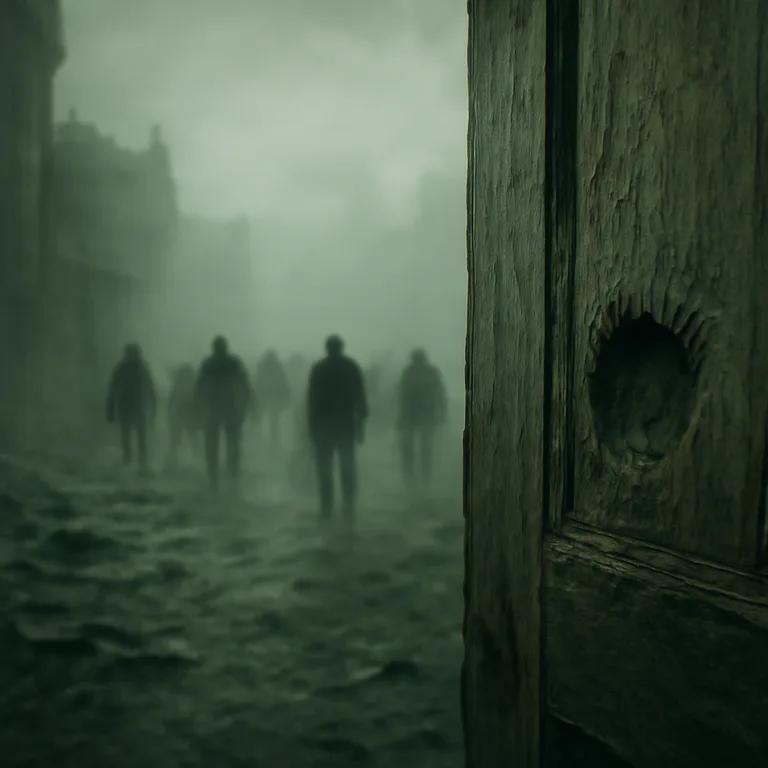
I push deeper into the town, looking for a place with signs of life or at least a place where the power still hums. In a small grocery store the freezer doors stand open, the cold air mingling with warm breath from the outside. A door stands slightly ajar, and on the door there is a bite mark on the door. The mark is crescent shaped, teeth marks that you would expect on a torn animal or a fevered patient in a hospital bed. The distance between the bite and the frame is small, a mark that tells of a struggle and a hunger that has no mercy. I press my palm against the wood and feel the grain give way to something rough and wet that does not belong to paint. The bite mark on the door is a warning carved by an act that should not be possible, a sign that the dead have learned what it means to chase.
I squeeze the recorder and continue, tracing the corridor of the empty building until I find a back room that still holds the ache of a life once lived. The air tastes of rust and old rain. In the corner, a chalk mark on the wall, a scribble that looks almost deliberate, as if someone tried to leave a message for the living. The letters are smeared but legible enough to read, a single line that repeats in my memory when I least expect it. they remembered my name. A chill climbs the spine and refuses to go away, the phrase looping around the edges of my thoughts like a cicada in a hollow tree. I know it is not mine to own, that the sentence belongs to someone else, to a memory that refuses to die. Yet here it sits, a presence in the room with me, as if the person who wrote it never left.
Outside the building the world continues to fall apart in slow, almost reverent increments. A siren somewhere far away wails once and then ceases as if it has forgotten why it was needed. My eyes adjust to the broken light of the convenience store. Shelves stand with their tips tipped in the way that suggests someone tried to reach something in a hurry and failed. The city outside is not the city I recognize, and the dead are not the story of an old movie scene. They move with a relentless patience, as if learning a language through repetition. The world is a classroom in which the dead are the only students who will not leave when the bell rings.
I decide to move along to the back exit, the one that leads toward the river and away from the central square where the lights blink and go out in a way that feels purposeful. The river is a memory of a place where people used to gather on hot nights to tell stories and pretend that nothing terrible was happening beyond the bend. Tonight the river is a line of reflection, a dark mirror that asks questions without answers. I search the banks for a boat, anything that will carry me away from a town that refuses to stop whispering. The world stops being a map and starts being a rumor that follows me wherever I go. The rumor says that the dead will not sleep until they have counted every living heartbeat.
In the quiet of the back room I find a single telephone handset that still holds a battery that believes in the possibility of contact. When I lift it, there is a pause, and then the other end answers with a breath that sounds almost human, almost hopeful. The voice on the line does not ask for a name, and yet it seems to know mine. A second later the call ends as abruptly as a leaf hits the water in a windless afternoon. I tell myself not to listen to voices on the line, or to read too much into a moment that might be nothing more than static and old transmissions decaying. But something in Hollow Creek has learned to speak through interference, something that knows how to plant a memory inside a tired survivor and let it grow into fear.
Then the sensory assault intensifies.
I return to the street and the world has changed again. The shuffling of feet grows louder, not as a single march but as a chorus of soft movements that surround the buildings I pass. It is as if the town has learned to listen to itself and to the echo of every toe that touches the pavement. The air grows heavy with a scent I cannot name, something metallic and sweet at the same time, a scent I have smelled in dreams that did not belong to this life. I move faster now, slower than fear would demand, as if speed will not save me but only make the moment louder for those who follow.
Another house yields a scene that makes the fear solid. A chair lies on its side as though someone rose from it and forgot to finish the action. A family portrait on the wall has a single edge of glass missing from a bite mark on the door or perhaps a bite mark somewhere else that indicates a person fought to stay in a room where the end was not far away. I cannot tell if the people inside are still present in some way, or if their presence is a memory that clings to the corners of the room like cobwebs. The days bleed into a single sensation: hunger, memory, and a sound that never leaves the ear.
In the middle of all this I realize I have been speaking to the recorder in a voice that pretends to be calm while the world trembles around me. The city has turned itself into a creature that does not need to sleep, a patient and relentless thing that moves with a patient hunger. I am perhaps the only one still listening to the story of Hollow Creek, and I suspect that is a crime I have committed against the living and the dead both. I tell myself that I will walk away, and yet the town pulls me inward, like a tide that never quite recedes.
So I step out into the night once more, feeling the weight of all the moments I have witnessed settle on my shoulders. I move from house to house, keeping my voice low and my steps careful so as not to attract the motive force of the dead that now follows me with the patience of a parent who will never tire of a child’s questions. The streets are a gallery of memories, each door a painting of a life once lived and the moment when it stopped. The silence that sits between movements is thick and heavy and almost tangible, as if you could reach out and touch it and it would answer you with a small, intimate secret.
The last stretch of the night brings me to a school that has long since been forgotten by the town and the world outside. The gymnasium floor is slick with rain and something else, something not quite water. I stand in the doorway and listen for the first time to a chorus of voices behind the wooden boards of the stage area. They order me to stay, to keep moving, to keep listening, to keep telling this story until the last breath leaves the town and nothing remains but the memory of a voice that would not go away.
Audio
The Quiet Town of Hollow Creek
ReflectStart here