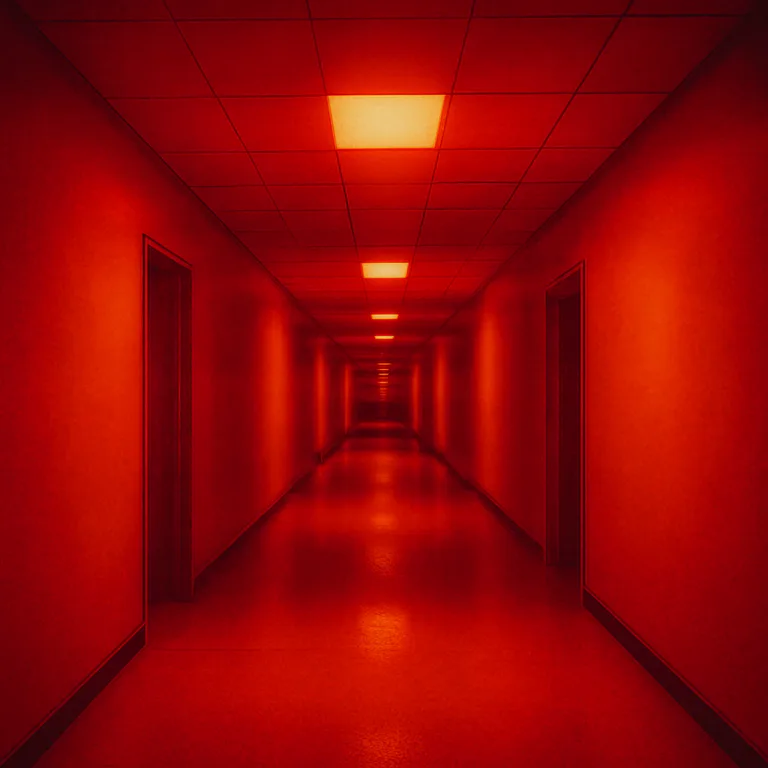
The Endless Hallway
A traveler follows a fluorescent hum into a forgotten building that seems to stretch forever, where every door mirrors a memory and escape is a rumor.
A traveler follows a fluorescent hum into a forgotten building that seems to stretch forever, where every door mirrors a memory and escape is a rumor. I found the building on a street that did not appear on the maps I kept for myself. The door was pale and hungry, a slab of metal and dust that sighed when I touched it. It did not belong to the city, not really. It belonged to a rumor I had chased for weeks, a rumor that insisted a place could exist between places, a place that remembered you even when you forgot yourself. The hinges complained in a way that sounded almost relieved when I pushed the door inward, and the air
Audio plays in the player below. Scroll to read the full transcript while you listen.
Rate this story
Hover a star to rate this story
About this story
A traveler follows a fluorescent hum into a forgotten building that seems to stretch forever, where every door mirrors a memory and escape is a rumor.
A traveler follows a fluorescent hum into a forgotten building that seems to stretch forever, where every door mirrors a memory and escape is a rumor. I found the building on a street that did not appear on the maps I kept for myself. The door was pale and hungry, a slab of metal and dust that sighed when I touched it. It did not belong to the city, not really. It belonged to a rumor I had chased for weeks, a rumor that insisted a place could exist between places, a place that remembered you even when you forgot yourself. The hinges complained in a way that sounded almost relieved when I pushed the door inward, and the air
Transcript
Full text of the narration. Selecting text does not affect playback.
I found the building on a street that did not appear on the maps I kept for myself. The door was pale and hungry, a slab of metal and dust that sighed when I touched it. It did not belong to the city, not really. It belonged to a rumor I had chased for weeks, a rumor that insisted a place could exist between places, a place that remembered you even when you forgot yourself. The hinges complained in a way that sounded almost relieved when I pushed the door inward, and the air that opened before me smelled of rain that had forgotten how to fall. Inside, the hall was bright in a way that did not belong to the sun. Fluorescent tubes hummed with a patient, stubborn light that trembled at the edge of my hearing. The fluorescent hum grew as I moved, a steady song that filled my skull and stuck to the skin at the back of my neck. It was not loud, not a scream, but it pressed against the vertebrae of my spine and asked to be remembered. I walked, as one walks into a room that has rehearsed your entrance a thousand times; my steps sounded like someone else remembering my name. The corridor stretched, and I began to notice that the walls did not breathe with life so much as they remembered the rhythm of feet that had passed through them many times before mine. The light did not spread to the very edges of the ceiling; instead it kept a thin halo around each foot, as if the floor itself demanded continuance, as if it would vanish if I stopped. There was something thick about the silence here, the way a forest holds its breath before rain, and something patient about the fluorescent hum that kept time for every object in the hall. The long corridor did not end, or so it seemed, because the distance ahead folded gently into the distance behind me, and the more I walked, the more the sounds of doors closed and reopened themselves in a single dream. I counted doors as I went, though I knew counting would not help. Some doors showed nothing more than a smear of darkness behind glass, as if the room they hid had learned to blink. Others offered a tremor of memory - a familiar lamp, the edge of a chair I had once owned, a photograph that looked suspiciously like someone I knew but dared not name. In one doorway, a coat hung on a hook and the coat sleeve moved as if the body inside had decided to take a breath without the owner noticing. In another, the air smelled of rain and old coal, and there, etched into the fog on the glass, were the vague shapes of a family who had vanished from the room but left their laughter behind as a scent that did not fade. The endless hallway itself became a character, turning at corners that did not exist on any map I had ever drawn for myself. It was possible to walk a mile and feel only the same mile walking you, a loop with a conscience. I spoke aloud, almost in apology, to keep from listening to the hum as if it were a person sitting across from me at a dining table and waiting for a story I could not give. “If you have a name, share it with me,” I said, and the fluorescent hum answered not with words but with a pressure at the back of my skull, a whisper of memory that arrived with the same gentleness as a ceiling tile settling after a storm. A smell came carrying the warmth of a kitchen and something metallic. It reminded me of trains at the end of a long journey, a scent that belongs to the edges of a life you are about to forget. The words I spoke grew smaller as the hall grew larger, as if the space between us whispered back and asked to be filled with more sentences until there was nothing left to say except the sound of stepping. I moved on. Some doors opened only to show that they did not open at all. Behind one, the corridor widened into a room that looked like an office but did not have a desk, only a window that faced a wall of grey bricks and a sky that was not a sky but the memory of weather. A fan rotated there, slowly, as if it was trying to cool a heat that did not exist. The room said nothing, but the room remembered the sound of rain against a tin roof long after the rain stopped. I touched the glass and felt the film of condensation that clung to it, and through that film I saw myself not as I am now but as I had been years earlier, thinner, younger, certain of doors and distances that could be crossed with a single act of will. The hall pressed in, and in that moment I understood that the building asked questions rather than offered exits. Then there was the sound of a door closing somewhere behind me with a quiet, almost polite thud. I spun, half-expecting to see someone step from the shadow, a caretaker with keys and a ledger who would explain that I had entered a private corridor, that this is not a place you visit but a place that visits you. There was nothing there but more hall and the faint odor of something like coffee and old wood polish. The distance between doors did not change, but my sense of direction did. It felt as if the hallway had learned a language of turns and used it to rehearse my fear, testing my will to keep moving forward. In time I began to track a pattern I almost did not want to admit. Each door I opened did not lead to another space but to a mirror of the space I had just left, a reflection in which I stood a fraction of a second earlier and in which every sound seemed to occur at a slightly different tempo. The fluorescent hum shifted when I looked toward a new door, as if the room itself was listening to my breath and adjusting the tempo to keep me inside its tempo. I stopped looking directly down the hall most of the time, letting the door frames frame me and the light frame the edges of my memory. The hall did not feel hostile so much as curious, as though it had learned to anticipate my steps and to arrange itself accordingly so that the next decision would be both inevitable and inevitable to me alone. Then came the moment you fear in a dream and wake with your heart beating so loudly you think your chest might crack open. The end of the corridor did not come; instead, a narrow passage opened to another series of rooms that looked almost the same yet not quite. The doors here did not pretend to lead anywhere else. They promised almost with a sigh that you would find what you were looking for if you could simply be patient and keep moving. And I did, with a patient fear that refused to fade. It was not until the rooms grew cooler, and the air carried a hint of metal and lemon soap, that I finally saw it, not at the end of a long line of doors but in the moment between heartbeat and breath, a sign that did not belong to a building I thought I knew. A small wall plaque, once polished, now dulled, with words I could barely read. It did not say a name or a purpose; it contained a single phrase in a font that looked as if carved by someone who did not care to be precise. No one would mistake it for a directive, but it offered a kind of direction nonetheless. No exit sign. The words hung there, almost patient, waiting for me to interpret them. No exit sign. It was not a warning so much as a confession, spoken by the architecture to itself and by the light to the space between us. The phrase did not shatter me. It did not snap like a rope. It settled around me with the gravity of something I had always known was waiting, a corner turned too slowly, a door that would not stay closed. If there was a door that would truly end the corridor, it did not appear. If there was a door to the world outside, it chose not to reveal itself. The sign existed like a line in a script I was unwilling to read aloud, a sentence that would reveal nothing else except the truth that I had come to borrow a moment from the building, a moment to keep with me as a memory when I finally left. The space around me began to respond to this phrase as if the hall remembered that the act of identifying a room or a sign was a form of consent. Doors that had not moved in minutes slid open with a whisper of air and a rustle of old carpet, revealing rooms that contained only more hall, the same stair that sang when you pressed the banister with your fingers, the same chair that faced a vacant corner as if it waited for someone to fill it with a conversation that never began. And in every room, the memory of a sound echoed back to me from a different time. A child laughing in a corridor I could not pinpoint, the clink of a spoon against a saucer, the muffled complaint of a radiator waking from a nap. The building kept receipts of my experience, and each receipt burned faintly enough to be ignored, yet they hummed with a sort of insistence that would not be silenced. I wanted to leave. I really did. I tried to step back toward the door I came through, but the doors did not retreat from me; they mirrored my movement and then retraced it with a small delay, like a memory that stubbornly insists on replaying itself at slightly wrong times. The fluorescent hum grew louder, not because it did not intend to quiet down but because the space around me demanded a higher volume of attention, as if the room were speaking, and its words required a listening body. I took a breath and spoke to the air as if I were a conductor directing an orchestra that refused to cooperate. “If you want me to stay, say so. If you want me to go, let me go.” The response did not come as a voice, but as a chorus of tiny noises - the soft click of a latch, the distant murmur of something moving behind a wall, the sigh of the building adjusting to the pressure of my question. In that moment I realized something essential about this place. It did not trap people as much as it kept a record of their choices. It did not demand a single exit but demanded a series of decisions that kept the memory of the person intact within its walls. A friend of mine would have called it a trap; another might have whispered that the building fed on the narrative of a life spent wandering. But I thought of it as a library of thresholds, where every door you did not take was saved for later in the thick air, and every room you visited left behind a fragment of your footprint, which later the hall would reuse to simulate a future you might have lived. Hours or minutes passed with no distinction. I found a desk lamp that flickered with an almost playful malice and a notebook on which someone had scrawled a name that looked like mine but was not mine enough to be mine. I read the name aloud and heard a version of my own voice repeat it back to me from a door I had just closed. I asked aloud who kept these records and why. The building offered no answer except a silence so complete it felt sacred, as if I was listening to the quiet itself thinking of me, and in that moment I understood that the place did not want to be found by anyone who already belonged to the city as I did. It preferred to meet those who had not yet learned how to forget, to meet the ones who moved with a different gravity, who could not rely on the map to tell them where to go. I started to notice the faces that lingered in reflections. The glass in some doors showed not my face but the face of someone who had walked these halls before me, someone who carried the same questions, the same breath, and the same hope that a door would finally open to something I could call outside. I did not know these people, yet I recognized their hesitation, their careful steps, the way their hands hovered over doorknobs as if a single touch could tether them to a moment that would not come again. It is a strange sensation to see your own echo step ahead of you and pretend not to be you at all. Then came the sound that must arrive in every long night when you pretend you are not listening. The hum rose to a pitch almost merciful, and with it a new sentence appeared in a doorway that had once looked like a window but now seemed to be a mouth. It was not spoken in words I knew, but I understood it nonetheless. The room asked me to confirm whether I knew what I had invited into my life when I began to listen to the building itself. My own voice answered before I could think to stop it. I told the room that I did not know, not completely, not in the way someone knows the weather after a storm. The room accepted that answer with a tone of sadness I would later identify as resignation, and the door before me opened with barely a whisper, revealing a corridor that looked the same as the one I had traversed from the beginning, but with a different color to the light and a slight change in the way the air moved. I walked through, not in fear now but in a careful curiosity that felt like respect. If the place had memory, I would give it a visitor who listened. If the place remembered me, perhaps I could remember it back.
Audio
The Endless Hallway
ReflectStart here