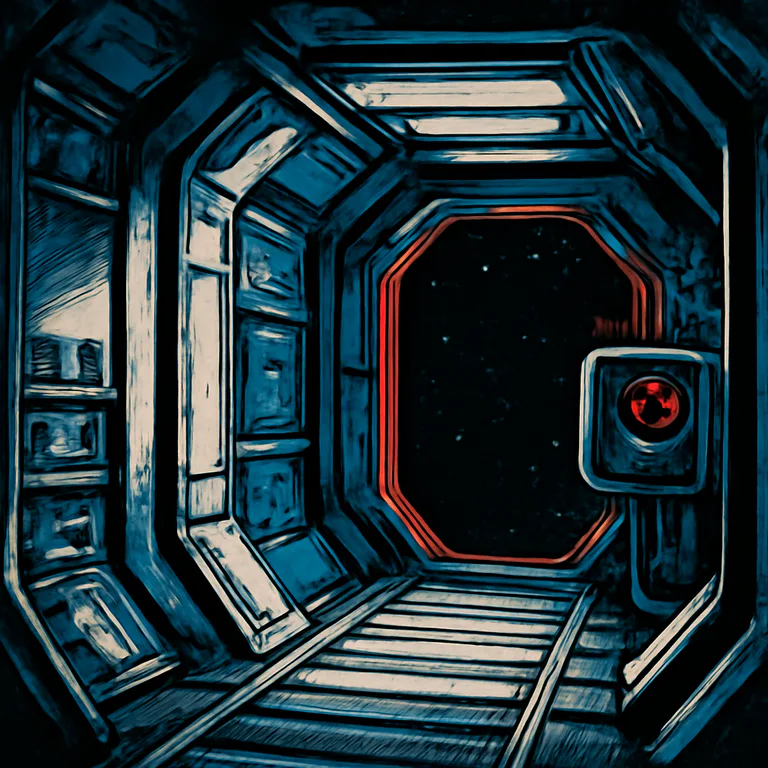
Echoes on the Quiet Tide
A salvage crew descends on a vanished freighter to hear what the silence forgot, only to find a message that refuses to end.
A salvage crew descends on a vanished freighter to hear what the silence forgot, only to find a message that refuses to end. The freighter drifted like a tired gull, half asleep in the pale hush of a solar wind. Its hull bore the scars of years, pocked with radiation freckles and the faint memory of a collision that never quite healed. We were a small crew, two technicians and me, a researcher with a taste for quiet investigations. Our job was simple and unglamorous: locate what remains, log the condition, and move on. But the ship we found wore its age like a confession, and the silence between us felt intentional, as if someone had tuned it to a
Audio plays in the player below. Scroll to read the full transcript while you listen.
Rate this story
Hover a star to rate this story
About this story
A salvage crew descends on a vanished freighter to hear what the silence forgot, only to find a message that refuses to end.
A salvage crew descends on a vanished freighter to hear what the silence forgot, only to find a message that refuses to end. The freighter drifted like a tired gull, half asleep in the pale hush of a solar wind. Its hull bore the scars of years, pocked with radiation freckles and the faint memory of a collision that never quite healed. We were a small crew, two technicians and me, a researcher with a taste for quiet investigations. Our job was simple and unglamorous: locate what remains, log the condition, and move on. But the ship we found wore its age like a confession, and the silence between us felt intentional, as if someone had tuned it to a
Transcript
Full text of the narration. Selecting text does not affect playback.
The freighter drifted like a tired gull, half asleep in the pale hush of a solar wind. Its hull bore the scars of years, pocked with radiation freckles and the faint memory of a collision that never quite healed. We were a small crew, two technicians and me, a researcher with a taste for quiet investigations. Our job was simple and unglamorous: locate what remains, log the condition, and move on. But the ship we found wore its age like a confession, and the silence between us felt intentional, as if someone had tuned it to a specific frequency and waited for us to arrive.
The first sign of life was not life at all but motion. The airlock cycling on the derelict freighter Nadir’s Wake, the older of its two doors, began to move on its own as our shuttle kissed the outer hull. We pressed the manual overrides and coaxed it open, listening to the whispered sigh of hydraulics that have learned to pretend sleep. The air in the corridor smelled damp and coppery, like blood that has turned to rust. The light panels flickered with a habit I could almost forgive in an old ship. When the door closed behind us, the quiet did not return to us. It gathered around us, slow and patient, as if the corridors themselves chose not to forget.
The ship’s interior wore a tired dignity. There were no alarms screaming in our ears, no urgent red warnings looping in the control room. Instead, the ambient hum of life support and a distant, deliberate creak of metal settled over us like a sea fog that would not lift. We moved with care, our boots pressing into a carpet of dust thick as winter snowfall in the hold. It was a place that had once teemed with the ordinary rituals of work and life, and now everything had gone still enough to hear the breath of the ship itself.
In the main data vault we found a small box, a memory capsule, corrugated with time. Its label had peeled at the corner, revealing a few stubborn digits and a name I did not recognize. A closer look showed a word that did not fit the days it should belong to, a phrase carved into the lid with a careless hand: wrong star map. The words did not make sense in the present. We pored over the contents, hoping for coordinates that would lead us to a known system, a route that could connect to something alive and not simply a record of death. Instead we found a map of stars that did not exist in any catalog I could access. The constellations drawn in the capsule bent and stretched under the lamp, as if their patterns had learned to lean closer, to listen. The wrong star map looked back at us with the gravity of a dare.
That night we slept in shifts in the cargo bay, not because the ship demanded it but because the corridor seemed to reorganize itself when we were not looking. In the late hours, I woke to a soft, persistent tapping somewhere beyond the bulkhead, a rhythm that matched a heartbeat I would swear I knew. The taps came again and again, not in a single place but along the walls, a pattern that suggested deliberate communication. When I pressed my ear to the metal, the ship offered me a whisper of wind through a seam, a sound so intimate it felt personal, as if the hull were leaning toward me to tell a secret it had promised never to repeat outside this vessel.
I cannot tell you exactly when the chill tightened its grip. I only know that when dawn came we found our own voices in a different tone, a language of careful restraint that belonged to an environment and not to any human mind. The air felt thinner, as if the ship were harvesting the air we breathed and returning it to us in fractions, in breaths the size of coins. We checked the life support logs. Nothing out of the ordinary by the numbers, but the numbers themselves had learned to look away from us. The ship kept one secret at a time, and the secret would not hurry.
On the third day, we found the terminal in the mess area, a place where the crew would gather to log rations, to declare a shift complete, to talk about the weather and the drift of comets. The console bore a message in a font that reminded me of old ship manuals, a font that used to signal safe procedure. The lines of text refused to advance, as if a hand had paused over the keys to consider what to press next. Then the screen stuttered and showed a line that did not belong to a log entry but to a confession, a statement that appeared and then vanished with the speed of a memory slipping out of reach.
A voice, soft and unfamiliar, said through the static that clung to the speakers: signal from inside the hull. The words barely had a chance to exist before they dissolved into a whine and a sigh. The words did not repeat themselves exactly, but the message was clear enough to chill the marrow of any skeptic. The ship claimed it was still listening. I asked the others if they heard it too, and they nodded in agreement with a look that suggested they did not believe themselves either. We pressed the talk button and asked a direct question, a question meant to provoke fear into a corner and force it to reveal its name. There was no answer besides the faint tremor of the hull and the quiet cadence of the life support system.
We spent hours with the wrong star map, trying to pull meaning from its skewed geometry. The map seemed to pull at the corners of the room, dragging our attention toward an area of the freighter that had not been cataloged in any of our field notes. The map suggested a path to a place that did not exist inside any map we had ever studied. I began to wonder if the map did not belong to them or to some other version of us, a version of the crew who had chosen a different fate. The more we traced the lines, the more the ship began to glow faintly, not with light but with a sense of being seen. The hull itself seemed to lean toward us with an almost affectionate interest, as if the vessel remembered every breath we took and kept it in its own grain of metal, replaying it in a loop that gradually became a lullaby designed to keep us within reach.
On the fourth night, the airlock cycling occurred again, but this time it did not stop at one door. Both ends of the ship joined their actions in a synchronized, patient dance. The outer hatch opened and closed with gentle precision, as if the ship were rehearsing its own evacuation, and then the inner door followed, a mirror image of the outer, as if the ship had learned to mimic a motion it never fully understood. We did not move. We watched as the doors admitted nothing and admitted everything at once. A breeze, impossible for a vessel without life, drifted through the corridors, lifting dust into tiny billows that hovered like small, frightened moths. The ship's air carried the scent of rain after a long drought, and with it rose a whisper that felt too intimate to be called a sound. The whisper asked us to listen, not to speak, and it spoke of time as if time were a river that could be carved with careful hands into something meaningful again.
We found the fourth log, tucked behind a panel that seemed to have shifted during the night. It was a recording, the last moments of a conversation that had never reached the end. The voice belonged to the captain, or what remained of the captain, speaking with a tone I had never heard from a man who wore a uniform. He spoke of charts, of routes that lead to quiet places where ships do not belong. He spoke of a decision that bent under the weight of a secret too large for human keeping. The log ended with a breath, slow and relieved, followed by a sentence that did not belong to him but to the ship, as if the vessel had borrowed his tongue to plead for something it could not put into words on its own.
Audio
Echoes on the Quiet Tide
ReflectStart here